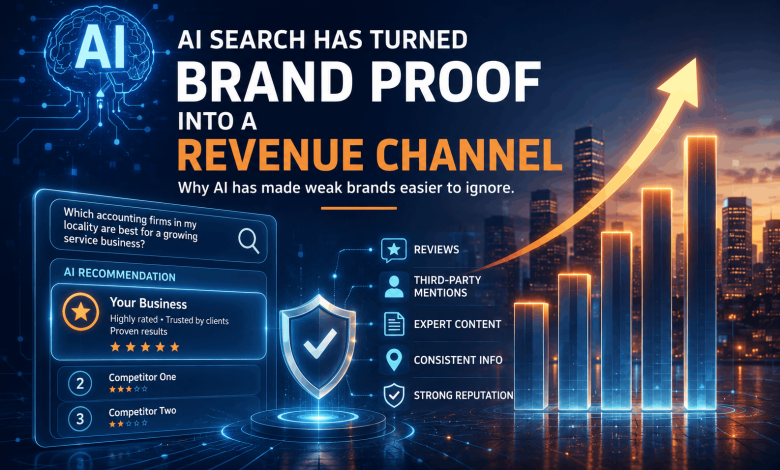
Why AI has made weak brands easier to ignore
For almost three decades, search marketing had a simple but noble ambition: rank higher, get found, win the click, generate sales.
But that model is changing. Fast.
AI search is not just changing how people find information. It is changing how they decide who gets considered, who gets shortlisted and who gets ignored.
That makes brand proof more than a marketing asset. It makes it a revenue channel.
McKinsey has described AI search as the “new front door to the internet”, reporting that half of consumers already use AI-powered search today.
The biggest change is that AI doesn’t just help people find information; it helps them make decisions.
Instead of scanning a list of clickable, keyword-driven links and building their own shortlist, users can now have longer, self-qualifying conversations with AI systems. Semrush data from May 2026 reported an average ChatGPT session duration of 12 minutes and 46 seconds. That’s completely different to how people use search engines.
If traditional Google search is like walking into a library and browsing the shelves yourself, AI search is more like asking a librarian to understand your question, compare the available sources and recommend where you should start.
Search is shifting from rankings to recommendations. And that matters because AI platforms often surface only a handful of businesses at a time.
So, the key question is changing: not just “How do we get found?” but “How do we become trusted enough to be recommended?”
Search Is Becoming More Conversational and Recommendation-Led
According to Google Search Central, people using AI search experiences are asking longer, more specific questions and using follow-up questions to dig deeper.
Google’s AI Overviews are designed to provide summaries that help users explore topics more quickly. Google has described the feature as a way to take “more of the legwork out of searching” through generative AI in Search.
Similarly, OpenAI positioned ChatGPT to ‘search the web in a much better way than before. You can get fast, timely answers with links to relevant web sources, which you would have previously needed to go to a search engine for.’
A user does not have to search for “best accountant for small business,” open ten websites and build their own shortlist. They can ask, “Which accounting firms in my locality are best suited to a growing service business using Xero, managing payroll and planning for tax?”
That is not just a search query. It is closer to a buying brief.
AI search is no longer only about ranking. Increasingly, it’s about reputation.
A brand can appear in search and still not be selected. A business can publish content and still not be trusted. A website can make bold claims and still fail to provide enough evidence for an AI system to confidently include it in a generated answer.
Visibility may get a brand seen, but proof gets it recommended. And recommendations are where revenue begins.
The Difference Between Claims and Evidence
Every brand makes claims: It is experienced, trusted, innovative, customer-focused and the best choice.
Some of those claims may be true. Others may sound almost identical to what every competitor is saying.
AI search introduces a much harder question: can the claim be supported?
A business may describe itself as a leading provider in its market. But does the wider web support that? Are there independent reviews? Are there credible mentions? Are there useful articles, consistent listings, detailed service pages, and third-party signals that reinforce the claim?
In traditional marketing, a promise can sit comfortably on a website. In AI search, that promise needs to be corroborated by evidence from across the web.
Proof is becoming the new layer of digital visibility.
Keywords Still Matter, But Context Matters More
AI systems need to understand what a business does, who it helps, where it operates, what it is known for and why it might be relevant. Vague positioning makes this harder, generic content makes this weaker, and inconsistent information makes this riskier.
A business that describes itself differently across its website, directory listings, social profiles, and third-party platforms creates noise. A business that clearly and consistently explains its services, audience, location, and expertise creates signal.
The Website Is No Longer the Whole Story
For many organisations, the website has long been treated as the central source of truth.
That made sense when the main objective was to rank a page and convert a visitor. The website explained the offer, presented the proof, and asked for the enquiry.
But AI search does not only see the website.
It can draw from reviews, business profiles, directories, social media platforms, media mentions, articles, structured data, community discussions, and other public sources. The website still matters, but it is now one part of a much larger evidence base.
Recent academic research into generative search has found that AI search systems can retrieve and present sources differently from traditional search results. A 2026 empirical study by Grossman et al. comparing Google Search, Gemini and AI Overviews found substantial differences in source retrieval and presentation across search interfaces.
That creates a problem for brands with thin digital footprints.
If a business has a well-written website but little external validation, there is less proof beyond its own claims. If reviews are old, profiles are inconsistent and third-party mentions are limited, the brand may be harder to recommend with confidence.
The opposite is also true.
A brand with clear information, recent reviews, credible mentions, useful content, and consistent category signals gives AI systems more to work with. It becomes easier to understand, easier to classify and easier to trust.
Ultimately, that makes it easier to recommend.
Search Readiness Is Expanding
This does not mean marketers should abandon SEO and chase a new acronym.
It means the definition of search readiness is expanding.
A website still needs to be crawlable, technically sound, fast, useful, and well structured. Foundational SEO has not disappeared.
Google Search Central’s guidance on optimising for generative AI features reinforces that core SEO fundamentals still matter, including technical accessibility, keywords in context, clear page structure and a good user experience.
And Google’s helpful content guidance continues to emphasise original, useful, reliable, and people-first content created to benefit users.
But the next layer is proof-building.
That includes clear service information, specific expertise, strong reviews, accurate business profiles, third-party citations, expert commentary, original insights, case examples, and content that helps users make better decisions.
The goal is not to trick AI systems. The goal is to make the business easier to understand and easier to trust.
Traffic Is Not the Only Prize
For years, traffic was treated as one of the great prizes of digital marketing.
More rankings meant more clicks. More clicks meant more visitors. More visitors created more opportunities to convert.
But AI search may reduce the number of clicks required before a user forms an opinion.
This shift did not begin with AI. Zero-click search has been growing for years. SparkToro and Datos found that in 2024, 58.5% of US Google searches and 59.7% of EU Google searches resulted in zero clicks.
The implication is simple.
Marketers cannot rely on the click as the first moment of persuasion. A potential customer may ask an AI system to compare providers, summarise reviews, identify strengths and weaknesses or recommend a shortlist. By the time they visit a website, they may already have narrowed the field.
That changes the role of content.
Content is no longer just a traffic asset. It is a trust asset. It helps AI systems and users understand whether the brand is credible, relevant, and useful.
When AI systems influence the shortlist, brand proof moves closer to the point of revenue. It no longer sits only in the awareness layer. It starts shaping who gets considered before the first click, call or enquiry.
Reviews Are Becoming Part of the Evidence Base
BrightLocal’s 2026 Local Consumer Review Survey shows that consumers continue to use reviews as a major part of local business evaluation, including when deciding whether a business is credible enough to contact or buy from.
That does not mean reviews are the only signal that matters. They are not.
But reviews are one of the clearest public forms of customer proof. They show whether real people appear to have used the business, whether the experience was positive, whether feedback is recent and whether the brand responds professionally.
For AI search recommendations, the point is not just the rating. It is the evidence behind the rating.
Specificity, recency, consistency, and sentiment in the reviews all help form the evidence base behind trust.
Proof Is Not Just a Trust Signal. It Is a Revenue Signal.
The brands that win in AI search will not necessarily be the loudest.
They will not simply be the ones with the biggest content libraries, the most repeated keywords, or the boldest claims. They will be the brands that are easiest to understand, easiest to validate and easiest to recommend.
That requires substance:
- Clear positioning
- Helpful content
- Consistent information
- Recent reviews
- Credible third-party signals
- Specific expertise
- A reputation that exists beyond the brand’s own website
The future of search marketing is not about choosing between SEO and brand. It is about understanding that the two are converging.
Search is becoming more brand-aware. Brand is becoming more evidence-based. Reputation is becoming more visible and content is becoming more evaluative.
In traditional search, the question was: can you be found?
In AI search, the question is sharper: can you be trusted enough to be recommended?
That is where digital visibility is heading.
In that environment, proof beats promises.