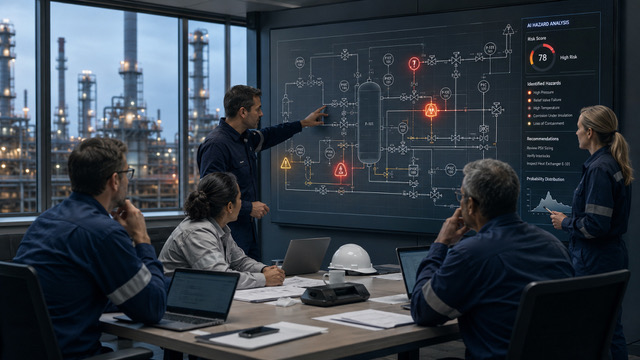
Introduction
Industrial facilities rely on complex networks of equipment, piping, valves, instruments and control systems. Within these networks, hazards may arise from overpressure, reverse flow, loss of containment, abnormal temperature, incorrect isolation, control malfunction or inadequate safeguards.
Piping and Instrumentation Diagrams, commonly known as P&IDs, are one of the most important sources for identifying these risks. They show process connectivity, equipment relationships, control loops, relief devices, isolation points and the intended movement of material through a system.
Traditional hazard identification methods, particularly Hazard and Operability Study (HAZOP), remain essential in process industries. The Center for Chemical Process Safety describes HAZOP as a systematic qualitative technique that uses guidewords to examine deviations from design intent and identify hazards or operating problems [1].
However, HAZOP and similar reviews require significant time, documentation effort and experienced multidisciplinary teams. Artificial intelligence can support this process by interpreting P&IDs, structuring engineering information and generating preliminary hazard scenarios for expert review.
Why P&IDs Are Suitable for AI Analysis
P&IDs are visually complex, but they are not random documents. They follow engineering conventions through repeated symbols, tags, line numbers, valve types, instrument bubbles, control loops and process connections.
This structure makes them suitable for AI-supported interpretation. Computer vision can detect symbols, optical character recognition can extract tags and annotations, and graph modelling can represent how process elements are connected.
The key value comes from relationships rather than individual objects. A valve symbol alone does not define a hazard, but a valve positioned between a pressure source and a closed downstream section may raise a relevant safety question.
For example, a pump discharge line without visible recycle or relief protection may indicate a blocked-discharge concern. A liquid-filled section between two isolation valves may require review for thermal expansion, while a missing check valve may suggest possible reverse flow from a higher-pressure system.
How AI Can Interpret a P&ID
An AI-assisted workflow begins by converting the P&ID into machine-readable information. The system identifies equipment, piping, valves, instruments, relief devices, control signals, line numbers and off-page connectors.
After this extraction stage, the system reconstructs connectivity. Equipment, valves and instruments can be represented as nodes, while piping and signal lines become edges that describe how elements are linked.
This graph-based representation allows the AI system to analyse the process more like an engineer. It can identify upstream and downstream relationships, isolation boundaries, pressure sources, flow paths and possible protective layers.
The next stage is semantic interpretation. At this level, the system does not only identify a control valve or pump; it interprets the engineering function of that object within the wider process context.
AI Reasoning for Preliminary Hazard Identification
AI-enabled hazard identification can combine rule-based logic, knowledge graphs, machine learning and natural language generation. Each method contributes to a different part of the workflow.
Rule-based logic is especially useful in safety-critical settings because it is transparent. For instance, if a positive-displacement pump is identified without an apparent relief path, the system can flag a potential overpressure scenario and show the rule behind the finding.
Knowledge graphs can connect equipment types with typical deviations, causes, consequences and safeguards. A pump can be linked to no flow, low flow, reverse flow, high discharge pressure, cavitation, seal failure and overheating.
Machine learning can support pattern recognition when historical P&IDs, HAZOP worksheets, incident reports or maintenance records are available. If similar configurations have previously led to recommendations, the system can highlight comparable cases in new projects.
Large language models can then convert structured findings into readable hazard statements. Instead of giving only a label such as “high pressure,” the system can produce a review question explaining the assumed deviation, possible causes, likely consequences and safeguards to verify.
Example: Pump Discharge Review
Consider a P&ID section showing a storage vessel connected to a transfer pump. The pump discharge line includes a control valve and a downstream isolation valve, but the drawing does not clearly show minimum-flow protection or pressure relief.
An AI system may identify this configuration and generate a preliminary hazard scenario for review. The deviation may be no flow or low flow from pump discharge, caused by a closed control valve, closed manual valve, blocked discharge line or downstream unavailability.
Potential consequences could include pump overheating, mechanical damage, seal failure, process interruption or loss of containment depending on the fluid and operating conditions. Safeguards to verify may include low-flow alarms, pump trips, minimum-flow recycle, pressure indication, relief protection and operating procedures.
This output should not be treated as a final safety conclusion. It is a structured prompt that helps the HAZOP team confirm whether the design, procedures and protective functions are adequate.
Integration into Industrial Workflows
The strongest use case for AI is not isolated document review, but integration into existing engineering workflows. AI can support early design review, HAZOP preparation, management of change, maintenance planningand digital twin development.
During early design, AI can scan preliminary P&IDs and highlight incomplete control loops, unclear relief paths, inconsistent instrumentation or missing isolation details. These issues can be corrected earlier, when design changes are usually less disruptive.
During HAZOP preparation, AI can help divide drawings into nodes, prepare draft deviations and identify safeguards to be verified. This allows the review team to focus more time on judgement, site context and complex scenarios.
During management of change, AI can compare old and revised P&IDs. It can identify new bypass lines, removed instruments, changed valve locations, modified equipment connections or altered relief arrangements that may require safety review.
During maintenance planning, AI can link P&ID data with isolation plans, permits and procedures. Before work on a pump, vessel or line, the system may identify relevant isolation points, trapped pressure risks, drain locations and potential exposure routes.
Benefits for Process Safety Teams
AI-assisted P&ID analysis can improve efficiency by reducing repetitive manual tracing. Large projects may include hundreds of drawings, and automated pre-screening can help engineers focus on the most important safety questions.
It can also improve consistency. The same rule set can be applied across different drawings, helping teams identify similar nodes that have different safeguards or documentation quality.
Traceability is another important benefit. A well-designed AI system can link each hazard suggestion to specific equipment tags, drawing locations, assumptions and rules used in the analysis.
AI can also support knowledge retention. Experienced engineers often recognize recurring patterns from past projects, and AI systems can help capture these patterns so they can be reused across future reviews.
Limitations and Governance
AI-assisted hazard identification has clear limitations. P&IDs may be outdated, incomplete, poorly scanned or inconsistent with the actual plant configuration.
Some important information may also be outside the P&ID. Control narratives, cause-and-effect charts, relief calculations, operating procedures, alarm settings, equipment data sheets and vendor documents may be required for a complete safety assessment.
Incorrect outputs remain a major concern. The system may misclassify symbols, miss off-page connectors, misunderstand design intent or generate irrelevant hazard scenarios.
For this reason, AI outputs should be labelled as preliminary and should always be reviewed by qualified professionals. Final decisions must remain with multidisciplinary safety teams, not with autonomous software.
Governance should include explainability, version control, human approval, audit trails, cybersecurity and data confidentiality. The NIST AI Risk Management Framework also emphasizes the need to manage AI-related risks through structured governance, mapping, measurement and management activities [2].
The Future of AI-Supported Hazard Identification
The future of AI in this field is likely to involve deeper integration between P&IDs, digital twins, process simulation, asset databases, alarm histories and maintenance systems. This would allow teams to compare design intent with operational reality.
In such a workflow, AI could identify whether a safeguard listed in a HAZOP is visible on the P&ID, whether a revised drawing changes a previous assumption or whether similar equipment has experienced repeated failures. These functions would support earlier and more traceable process safety decisions.
However, the value of AI should be measured by the quality of engineering questions it helps generate. The objective is not to automate responsibility, but to strengthen human review through better information, consistency and preparation.
Conclusion
Artificial intelligence can significantly support hazard identification from P&IDs by extracting engineering information, reconstructing process connectivity and generating preliminary hazard scenarios. These capabilities can improve early design review, HAZOP preparation, management of change and maintenance planning.
The most effective approach is to position AI as an expert-support tool rather than an autonomous decision-maker. P&ID-based analysis cannot capture every operating mode, procedure, human factor or site-specific condition.
When implemented responsibly, AI can help process safety teams move from reactive document review toward earlier, more systematic and more traceable hazard identification. Its greatest contribution is not replacing professional judgement, but helping engineers ask better questions before risk becomes reality.
References and Further Reading
[1] Center for Chemical Process Safety (CCPS), AIChE. Hazard and Operability Study (HAZOP) glossary definition. https://www.aiche.org/ccps/resources/glossary/process-safety-glossary/hazard-and-operability-study-hazop
[2] National Institute of Standards and Technology (NIST). Artificial Intelligence Risk Management Framework (AI RMF 1.0). https://www.nist.gov/itl/ai-risk-management-framework
[3] Elhosary, M. et al. Evaluation of AI-assisted HAZOP Software Tools, IChemE Hazards 34. https://www.icheme.org/media/27631/hazards-34-paper-175-elhosary-revised.pdf
[4] Kim, J. B. et al. Automated inspection of P&ID object recognition using deep learning, Scientific Reports, 2025. https://www.nature.com/articles/s41598-025-25506-2
[5] Schulze Balhorn, L. et al. Rule-based autocorrection of Piping and Instrumentation Diagrams (P&IDs) on graphs, 2025. https://arxiv.org/abs/2502.18493