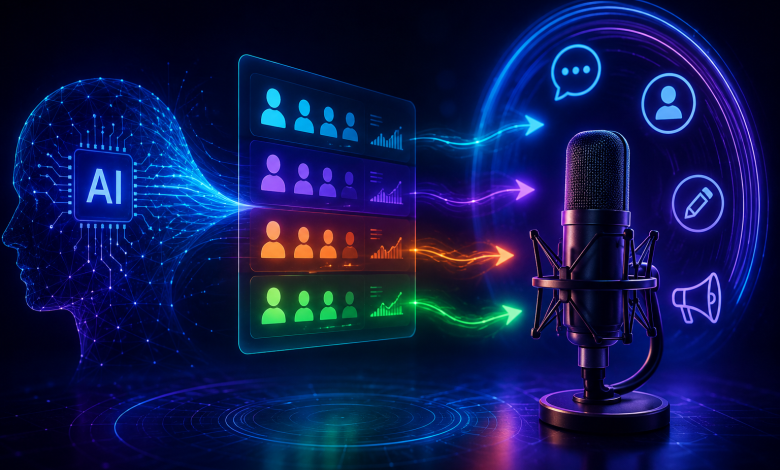
As a business owner, you have met with a broader range of audiences than you realise. But manually segmenting them is very tedious and time-consuming. Have you ever felt that the segmentation you do leaves something behind? Is some data missing in the final document you make?
Well, I’ve got you covered here and have found a solution that will not only increase your efficiency but also reduce the time you spend on this. Everything gets streamlined and fast. You must have guessed it; yes, I am talking about AI in modern email marketing.
You need to provide the raw data and ask the AI to segment it based on the criteria you specify. Everyone believed AI would replace people at work, but the trend is different. It is replacing spreadsheets and documents, and making things simple. AI is used to handle tasks that do not require a human brain, such as customer segmentation.
But what should be done after you get the segmentation done by AI? There ends the manual work; now comes the part where you strategize your workflow accordingly. This is exactly what we will discuss in this blog. Let us get started!
Segmentation Got Commoditized Fast
You might have seen marketers doing the whole thing manually, from filtering by purchase history, tagging customers by hand, and hoping the logic held up over time. But today, that is no longer a skill that separates good marketing teams from average ones. Now, the complete thing is different.
Experts describe an AI segmentation strategy as machine learning that groups people into marketing audiences based on behavior, attributes, and predicted intent. Also, the biggest advantage is that you do not need to resegment an audience group or an individual when their behavior changes. That is a generic feature in today’s market. It is baked into most platforms marketers already pay for.
Did you know AI improves targeting accuracy through machine learning algorithms that identify patterns that are beyond human analysis and predict future behavior from historical data? Every serious platform, from Klaviyo to Braze to HubSpot’s Breeze ecosystem, now uses AI for segmentation. Every AI platform considers features like segmentation to be a generic standard. That part of the job is basically solved.
The Real Work Starts After the Segment Exists
So, you have used AI to segment your audience and have the segmentation details with you. Now what?
Your AI vendor might not have told you this, but after that, there are still many processes to complete! A segment is just a list. It is not a message, a tone, or a reason for someone to care.
You need to turn this list of, suppose, 2000 cart abandoners into an email that showcases what your brand stands for. No AI platform can help you understand which phase your customer is in and then build a relationship with them based on this data. It requires a human brain more than a machine. How you convince a customer to purchase is a matter of your creativity, not a procedure to follow.
Research led by industry experts lands squarely on this, arguing that AI handles data processing and pattern recognition at scale, but strategic decisions about positioning, messaging, and creative execution still require human judgment. That successful segmentation now combines algorithmic precision with marketing intuition. It is a combined effort of AI + human intelligence to run a successful business.
Every marketer today will agree with the statement: “AI platforms are amazing!”But industry reports also suggest that marketers do not use AI platforms to their fullest. They do not get the exact results they expected. One reason is that many marketers do not even know how to use AI agents correctly!
This is the part that gets missed in the excitement around AI-powered marketing. A segment telling you who someone is does not tell you what to say to them, when to say it, or how many times a week they can hear from you before they unsubscribe. That judgment call, which gets applied consistently across every flow, campaign, and channel, is still fundamentally a human skill, sharpened by experience across many brands and many mistakes.
But research on AI agents indicates a shift toward agentic AI systems and tools that not only predict or generate content but also autonomously plan and execute multi-step workflows. Agentic AI can observe a customer’s behavior, determine the best next action, select the channel, and compose the message without a human in the loop. That sounds like it closes the gap between segmentation and execution entirely. Only then is human intervention not required.
But in real practice, it does not, at least not yet. An agent choosing the next best action still needs guardrails around tone, offer limits, and frequency caps that someone had to define first. Autonomous execution without a defined brand framework just produces mistakes faster. The agent can pull the trigger. It cannot decide what the brand should sound like. This complete flow is completed only with human intervention.
Why Execution Is Harder Than It Looks
Consider a real example. AI segments your list into customers who abandoned a cart in the last three days. Simple enough. Now write the actual email. Few questions worth asking are:
- Does the tone match a luxury skincare brand or a budget hardware store?
- Does the subject line create urgency without sounding desperate?
- Does the offer inside protect margin while still giving someone a reason to come back?
- Does the send time account for time zones and past open behavior?
- Does the flow logic stop sending if the customer has already purchased elsewhere in the store?
None of that is a segmentation problem. All of it is execution, and execution is where full-service email marketing agencies earn their keep. Doing this well across dozens of segments, hundreds of flows, and constantly shifting inventory is not something most in-house teams have the capacity to manage alongside everything else on their plate.
Commodity products need to prepare for automated buying behavior, while differentiated products with complex buying criteria still require investment in human expertise. Email marketing sits closer to the second category than most brands realize. The message itself is the product’s front door, and a generic AI voice at that door costs you your brand trust because a generic voice cannot convince an audience segment to purchase your product.
Brand Voice Is Not a Setting You Turn On
Even platforms explicitly built around brand voice controls acknowledge this tension. Research on AI content generation for 2026 indicates that while AI can support real-time brand voice management across assets, businesses still require regular quality checks and creative reviews based on campaign performance. Never expect consistency across every touchpoint automatically just because the tool has a brand voice feature.
That framework- the quality checks, the creative review process, the actual judgment about what sounds like your brand and what does not- is work. It takes someone who has seen enough campaigns succeed and fail to recognize the difference at a glance. This cannot be implemented by a model trained on generic email copy from thousands of unrelated brands.
Where This Leaves Ecommerce Marketers?
None of the above-mentioned facts mean AI segmentation is not useful. It absolutely is, and ignoring it would be a mistake. The point is narrower than that. Segmentation used to be the moat. Now it is the entry fee. Every competitor in your category has access to the same audience splitting capability you do. So segmentation is no longer what separates you from your competitors!
What still separates brands that grow from brands that stall is what happens in the fifteen minutes after the segment loads: the actual writing, the actual testing, the actual decisions about tone, timing, and offer structure across every single flow running at once. That layer requiring real human effort has not been automated away, and realistically, it will not be anytime soon.
So, the very factor that separates a top brand from the rest of the generic brands is how they use segmentation data. A dedicated agency partner will help you here with the right strategies that will bring in real-time sales that software can hardly manage.