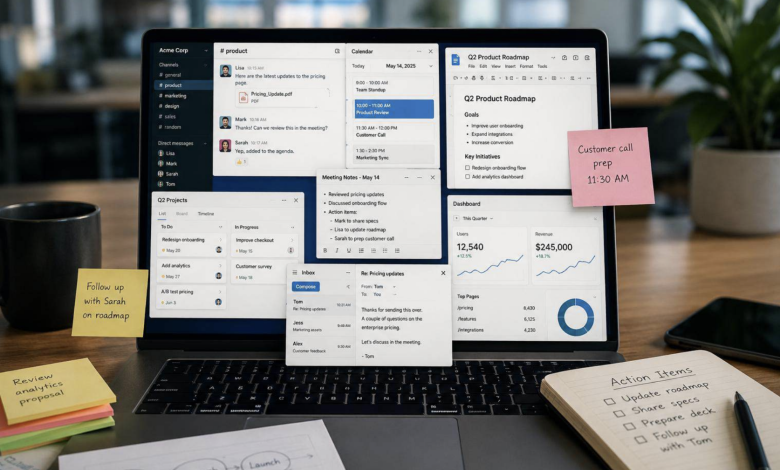
Starting With Context, Not Reconstruction
Every team has felt the difference between a meeting that starts with zero context and a meeting that starts with momentum.
In one version, the first twenty minutes are lost to “reconstruction.” What did we decide last week? Who had the latest version? Is there someone else who should be here? Should there have been a pre-read for this?
Sometimes, the team leaves the meeting more confused and frustrated than before.
In the better version, the team simply picks up where they left off.
A new person can enter the room and understand what has happened without asking everyone else to replay it. This team is not moving faster because people are working harder. Rather, they are moving faster because the work itself is carrying forward without the constant need to rehash.
That is the shift I think will define the next era of workplace AI.
The Problem With More Workplace Software
For a long time, software has been very good at helping teams create more information: more notes, more messages, more dashboards, more recordings, more documents, more threads.
The CRM requires robust entries full of data nobody ever looks at. Slack messages run parallel to email and text. Each tool captured a fragment of the work, but very few helped the work accumulate into something cohesive and meaningful that the team could actually use later.
The result was that teams had more records than ever, but still had to rebuild context over and over again. AI changes that, but only if we aim it at the right problem.
The Point of Work Is Not Another Place to Store Work
Despite what many SaaS companies are trying to sell you, the point of work is not to add another place where work gets stored.
The point is to be able to keep building with complete information. The need is for a workspace where the context of the work is readily available and obvious. What was said in a meeting, decided in a brainstorm, or assigned in a follow-up should be understood as part of the same ongoing effort.
That is what we mean by a Contextual AI Workspace: a place where your team’s work stays connected, so the context you need is there when you need it, not buried in a folder or stuck in someone’s memory.
Capture, Understand, Activate
The best way to think about this is through three simple motions: Capture, Understand, Activate.
“Capture” matters because important work rarely happens in one perfect system of record. It happens in conference rooms, customer calls, hallway conversations, planning sessions, classrooms, field work, and quick voice notes between meetings.
A team cannot build on context it never captured in the first place.
“Understand” matters because raw information is not the same as usable context. A transcript, by itself, is not a decision. A long recording that includes a plan is not itself a plan. A whiteboard full of ideas, by itself, is not a next step.
The system has to recognize what happened: what was discussed, what changed, what was decided, what still needs attention, and how it connects to what came before.
“Activate” matters because context only becomes valuable when it surfaces at the right moment, when the team actually needs it.
In a meeting, someone can simply ask what was decided last time and get an accurate answer on the spot, instead of trusting the room’s memory.
The next meeting should not begin with everyone reconstructing what happened last time. That is an unproductive time suck.
When Work Happens Outside the Meeting
This plays out differently depending on where the work is happening. Some of the most important conversations take place in a room in a design review, a planning session, or a weekly team sync.
The goal is for the team to stay focused on the conversation itself, knowing the important pieces will carry forward accurately. They should be there to check back on the moment someone needs them, rather than evaporating when the laptop closes.
But not all meaningful work happens neatly around a conference table.
A key detail surfaces in a quick side conversation. An idea comes through during a commute. A follow-up gets discussed in a hallway.
The same principle of continuity has to stretch into those moments, or context ends up living only in someone’s head. That means it is one departure or one bad week away from being lost entirely.
Making Context Useful Again
A Monday meeting can begin with the actual open question, not the archaeology of last week’s decision.
A sales team can revisit what the customer really cared about, not just what someone remembered to type into a CRM. A product team can connect a new idea to the pattern of feedback that produced it. A leader can bring a new person into a project without asking the rest of the team to reconstruct the entire history from notoriously biased and fallible memory.
The Agent Era Raises the Stakes
AI becomes most useful at work as part of the workspace itself, helping the work remain available, connected, and ready to move.
This matters more as teams hand more to agents.
An agent working from complete context compounds output. An agent working from the gaps, including the decision no one captured or the detail that lived in someone’s head, compounds the errors just as fast and far more confidently.
The teams pulling ahead will be the ones whose work builds on itself.
The teams falling behind will watch their motion multiply, decoupled from output.
Both, increasingly assisted by AI.