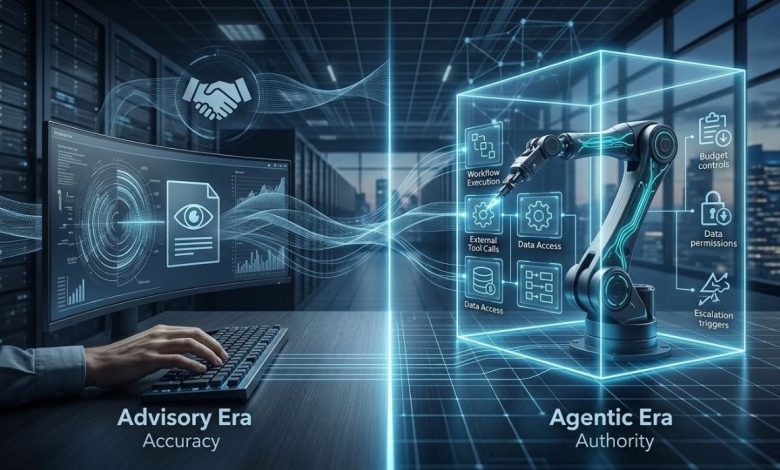
During the first era of enterprise AI, when I served as the first general manager of IBM Watson, our primary goal was demonstrating that cognitive systems could digest vast unstructured data and assist human experts. That initial wave was fundamentally advisory in nature. AI provided recommendations, summaries, and probabilistic insights, but a human was always in the loop to execute the final decision.
Two decades later, enterprise AI has crossed a profound threshold. We have entered the era of agentic AI, where systems no longer merely advise. They act, execute workflows, invoke external tools, and alter enterprise data autonomously.
This transition fundamentally shifts the definition of enterprise trust. While the first era of AI was defined by accuracy, the agentic era is defined by authority, runtime control, and verifiable evidence.
From Accuracy to Authority
In the advisory era, evaluating an AI system was relatively straightforward. Leaders asked a single core question: “Was the output accurate?”
When dealing with autonomous agents, accuracy is only the entry requirement. The crucial question shifts to authority: “Was the agent permitted to take this specific action, access this system, commit these resources, and delegate the next step?”
When AI transitions from an advisor to an authorized actor, errors cease to be mere text hallucinations. They become real-time operational events.
An unconstrained agent can alter financial records, execute transactions, share sensitive files, or trigger regulatory violations in fractions of a second. These consequences occur long before any human operator notices an issue.
Assigning legal and operational accountability becomes far more complex in an agentic deployment. Responsibility is often fractured across model providers, application developers, tool integration vendors, and enterprise deployers.
Without explicit authority boundaries, organizations will find it nearly impossible to answer who authorized a flawed action and who was responsible for halting it.
The Limits of Post-Hoc Observability
Many technology leaders attempt to address agentic risk using traditional logging and observability platforms. While post-hoc observability is necessary for forensic auditing, it is fundamentally insufficient for controlling autonomous systems.
Observability acts as a black box recorder after an accident has already occurred. A log file can document an unauthorized wire transfer or data breach, but it cannot intervene to prevent it.
Agent workflows also introduce chain-level risks that static monitoring misses. An individual step in an agent execution path may appear completely benign in isolation, yet the cumulative sequence of actions can produce a severe security or policy violation.
To safely scale autonomous agents, control mechanisms must move from post-execution logging into the active decision and execution path.
Enforcing trust requires evaluating consequential actions before they execute, allowing the system to allow, modify, escalate, or block actions in real time.
The Architecture of Runtime Control
Achieving runtime control requires a fundamental shift in how enterprises architect their AI infrastructure. It begins with establishing complete visibility into the trust posture of every AI system operating across the organization.
Leaders must know what systems exist, what data they access, what tools they can invoke, what spending authority they hold, and whether they are operating within approved behavioral and regulatory boundaries.
Before an agent is permitted to execute tasks, the enterprise must define an explicit authority envelope. This envelope acts as a digital boundary, specifying the agent’s identity, owner, approved tools, spending limits, delegation rights, and mandatory escalation triggers.
Inside the execution path, runtime controls continually assess proposed actions against this authority envelope. If an agent attempts an action that exceeds its permitted threshold, the runtime system can quarantine the action or route it to a human supervisor for approval.
Furthermore, every meaningful decision point within an agentic workflow must generate immutable, audit-ready evidence. This record must capture the context, retrieved data, policy checks, tool calls, and outcomes.
To satisfy auditors, regulators, and boards, every consequential decision must be fully replayable and defensible. Organizations must be able to demonstrate exactly what the agent knew, why it chose a specific path, and that the same decision would conform to policy under identical conditions.
Treating AI as an Autonomous Workforce
Navigating this transition requires executives to make a fundamental shift: stop treating agentic AI as conventional software and start managing it as an autonomous workforce.
Traditional software waits for a user to initiate an action. Autonomous agents can perform work continuously, make operational choices, use enterprise systems, and coordinate with other agents. That makes them less like passive tools and more like digital workers.
Digital workers need many of the same management disciplines as human workers:
- Defined roles
- Clear ownership
- Appropriate permissions
- Performance expectations
- Escalation paths
- Supervision
- Evidence of completed work
- Consequences when they exceed their authority
As an agent’s capability and operational reach increase, its controls must become stronger, not weaker. Increasing autonomy without increasing runtime control does not create innovation. It creates unmanaged authority.
Boards must move beyond vague vendor promises and demand verifiable proof of runtime control. Executive teams must be able to articulate precisely what their agents are allowed to do, what they are strictly forbidden from doing, and how quickly a rogue execution loop can be halted.
Scaling Autonomy with Confidence
Autonomous AI is a civilization-scale technology, comparable to the invention of electricity or atomic energy. The potential economic upside is extraordinary, but powerful technologies only deliver durable enterprise value once robust control systems are established.
Developing runtime controls, authority envelopes, and audit-ready evidence is not about slowing down progress. It is about providing the safety infrastructure required to move fast without catastrophic failure.
The organizations that master runtime control will not be the slowest to innovate. They will be the only ones able to scale autonomy safely.
Intelligence without control is a demonstration. Autonomy without control is a liability. Only controlled autonomy is deployable.