

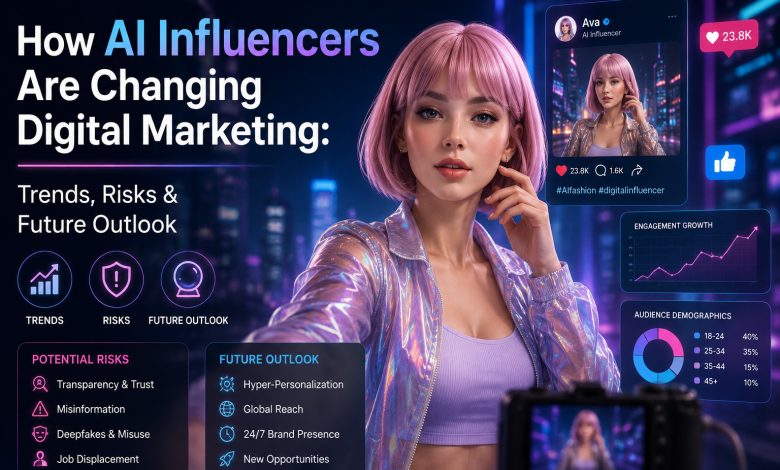
AI influencers are no longer a marketing experiment. They’re a budget line item.
The virtual influencer market was valued at $6.9 billion in 2024 and is projected to exceed $37 billion by 2030. Brands across fashion, beauty, gaming, and financial services are signing contracts with digital personas that don’t exist outside a server — and the engagement numbers coming back are outperforming human influencer benchmarks consistently enough that the industry has stopped treating this as a novelty conversation.
What’s changed isn’t just the technology. It’s the strategic seriousness with which major brands are approaching it. Virtual influencers are being written into annual marketing budgets, evaluated against the same ROI frameworks as traditional influencer partnerships, and in some cases given exclusivity deals that human creators rarely receive.
This piece covers where the market actually stands in 2026, what’s driving adoption, where the risks are concentrated, and what the next phase of this shift looks like for brands building their influencer strategy now.
What AI influencers actually are in 2026
Worth being precise about this because the term covers more than most people realise.
An AI influencer is a digitally created persona that produces content, engages with audiences, and enters into brand partnerships — without a human being behind the face. Some are fully computer-generated from the ground up. Others are built on real people who license their likeness to be replicated and scaled. A few exist somewhere between those two things, with human creative direction driving an AI-generated visual identity.
The most well-known examples — Lil Miquela, Aitana Lopez, Imma — have been around long enough now that their existence barely registers as unusual. Lil Miquela has over 2.5 million Instagram followers and has worked with Prada, Calvin Klein, and Samsung. Aitana Lopez, created by Barcelona-based agency The Clueless, reportedly earns up to $11,000 per month from brand deals alone. These aren’t novelty projects anymore. They’re revenue-generating assets.
The numbers behind the shift
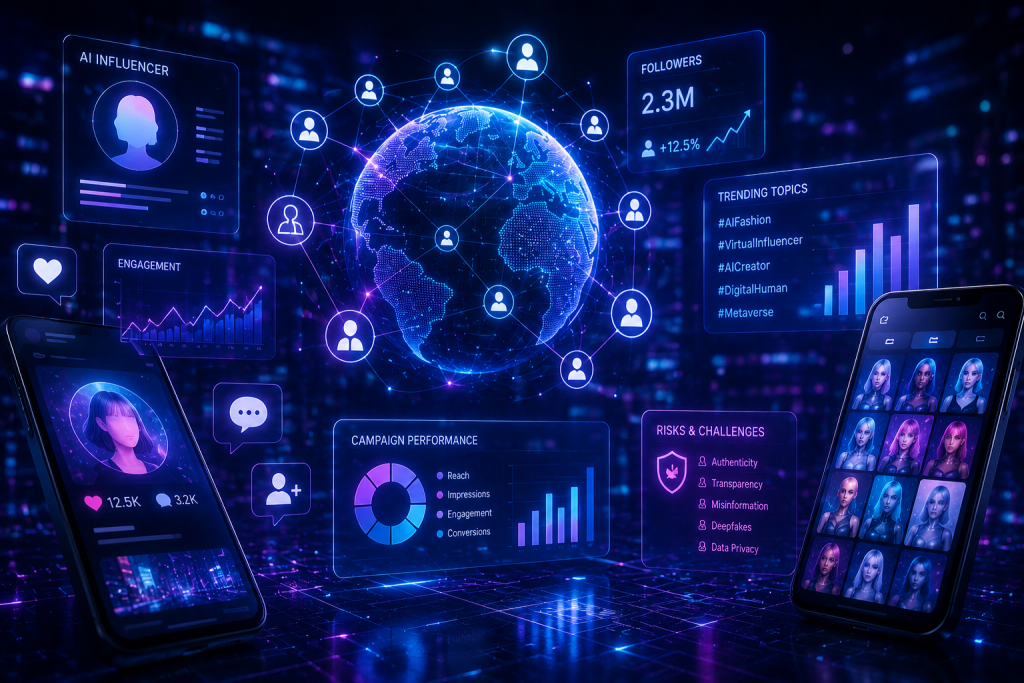
The virtual influencer market was valued at around $6.9 billion in 2024 and current projections put it on course to exceed $37 billion by 2030 — a compound annual growth rate that most established marketing categories would find difficult to match.
Engagement rates are the number that keeps coming up in brand conversations, and they’re genuinely surprising. Virtual influencers on Instagram average engagement rates of around 2.84%, compared to approximately 1.72% for human influencers in equivalent follower tiers. That gap is consistent enough across enough studies now that it’s hard to dismiss as statistical noise.
The reason most commonly offered is parasocial in nature — AI influencers are perceived as aspirational without being threatening, idealised without being unattainable in the specific way that makes audiences feel inadequate rather than inspired. They also don’t have bad days, don’t post something regrettable at 2 am, and don’t get photographed outside a nightclub looking human in ways brands didn’t sign up for.
For a deeper look at the data behind where this market stands right now, the AI influencer statistics breakdown at Call Your Girlfriend covers the numbers in detail — including engagement benchmarks, brand adoption rates, and where the growth is actually concentrated by platform and industry.
Where brands are actually using them
Fashion and beauty adopted earliest and remain the dominant categories, which makes sense — both industries run on aesthetic idealism and AI influencers are nothing if not aesthetically controlled. But the categories expanding fastest into this space in 2026 are more surprising.
Gaming companies have moved aggressively into AI influencer partnerships, partly because their audiences index younger and have grown up with a more fluid relationship to digital personas. The distinction between a virtual influencer and a game character is less meaningful to a twenty-two-year-old than it is to a forty-five-year-old marketing director.
Financial services are experimenting more than most people realise — particularly in markets where regulatory constraints make human influencer partnerships complicated. An AI influencer can be scripted precisely enough to stay within compliance boundaries in ways that human influencers, however well briefed, can’t always guarantee.
Healthcare and wellness brands have moved cautiously but consistently. The appeal is control over messaging combined with the ability to run always-on content at a scale that human influencer partnerships can’t match economically.
What’s actually driving engagement
The engagement advantage of AI influencers isn’t random and understanding what’s producing it matters for brands thinking about how to use these partnerships strategically.
Consistency is the first factor. AI influencers post regularly, maintain a coherent aesthetic across months of content, and don’t go through the visible evolution of identity that human influencers naturally experience over time. For brands that need long-term consistency of message, that reliability has real value.
Audience projection is the second factor and it’s more psychologically interesting. Research on parasocial relationships suggests that audiences project more freely onto AI influencers than human ones because there’s less biographical information to constrain the projection. A human influencer has a hometown, a family, opinions about things that have nothing to do with your brand. An AI influencer has exactly as much backstory as its creators chose to give it. That controllability shapes audience engagement in ways that are still being mapped.
The third factor is exclusivity of attention. AI influencers don’t have competing brand deals in the way human influencers do. They can be contracted exclusively, their content can be geofenced to specific markets, and their persona can be adjusted — within limits — to match different audience contexts. That flexibility has operational value that brands are starting to price into their decision making.
The risks that aren’t going away
None of this means AI influencers are a straightforward win, and the brands that have moved fastest have also been the ones to encounter the specific failure modes most clearly.
Trust and disclosure is the first and most persistent issue. Regulatory pressure on disclosure requirements for AI-generated content has increased significantly across the EU, UK, and several US states. The FTC has updated its guidance on endorsement disclosure to specifically address AI personas. Brands that don’t get ahead of this are building campaigns on ground that’s actively shifting under them.
The uncanny valley problem hasn’t been solved — it’s been managed. There are audiences for whom AI influencers remain fundamentally unsettling, and the data on this breaks sharply along demographic lines. Audiences over forty show significantly higher discomfort with AI influencer content than audiences under thirty. For brands with cross-generational audiences, a strategy built around AI influencers needs to account for this segment explicitly rather than hoping the numbers average out.
Authenticity scalability is a tension that hasn’t been resolved. The engagement advantage of AI influencers partly depends on audiences treating them as genuine personas rather than marketing vehicles. As AI influencers become more common and more obviously commercial, that suspension of disbelief requires more active maintenance. The platforms that built their audiences on novelty are having to work harder to sustain engagement as novelty becomes the baseline.
Deepfake adjacency is a reputational risk that nobody in the industry talks about loudly but most people in it think about privately. As the technology for creating convincing digital personas becomes more accessible, the cultural context around AI-generated faces gets more complicated. Brands associated with AI influencers are implicitly associated with that broader technology landscape, and that association carries risk that’s difficult to price in advance.
What the platforms are doing
Instagram, TikTok, and YouTube have all updated their policies on AI-generated content and virtual influencers over the past eighteen months, and the direction of travel is consistent — more disclosure requirements, more labelling, more friction between AI content and the algorithmic promotion that human creators receive by default.
TikTok introduced mandatory labelling for AI-generated content in 2024 and has been refining what counts as AI-generated in ways that affect virtual influencer content directly. Instagram has moved more slowly but the direction is the same. YouTube’s approach has focused on monetisation — AI-generated channels face different monetisation thresholds than human creator channels, which affects the economic model for AI influencer content that lives primarily on that platform.
None of this is a death knell for the category. But it does mean the easy early period — when AI influencers could operate in the same algorithmic environment as human creators without distinction — is ending. The brands that built strategies around that environment need to be building for the one that’s replacing it.
Where this is actually heading
The next significant shift in AI influencers isn’t about image quality or follower counts. It’s about interactivity.
The current generation of AI influencers produces content that audiences consume passively — posts, videos, stories. The next generation is being built around real-time interaction. AI personas that can respond to comments, engage in DMs, participate in live sessions, and maintain relationship continuity with individual followers over time. The technical infrastructure for this exists. The platforms are figuring out what to do with it. Brands are watching very carefully.
This shift matters because it changes the nature of the value proposition. A passive AI influencer is a content production asset. An interactive AI influencer is something closer to a relationship asset — a branded persona that maintains ongoing individual relationships with audience members at scale. That’s a different category of marketing tool and it carries different implications for how brands think about audience relationships, data, and the ethics of what they’re building.
The brands thinking seriously about AI influencer strategy right now are asking a question that goes beyond engagement rates and disclosure compliance. What do they owe the audiences who engage with these personas genuinely — and what happens when those audiences eventually understand the full extent of what they’ve been engaging with?
That question doesn’t have a clean answer yet. But the brands working through it now are better positioned than the ones that aren’t.