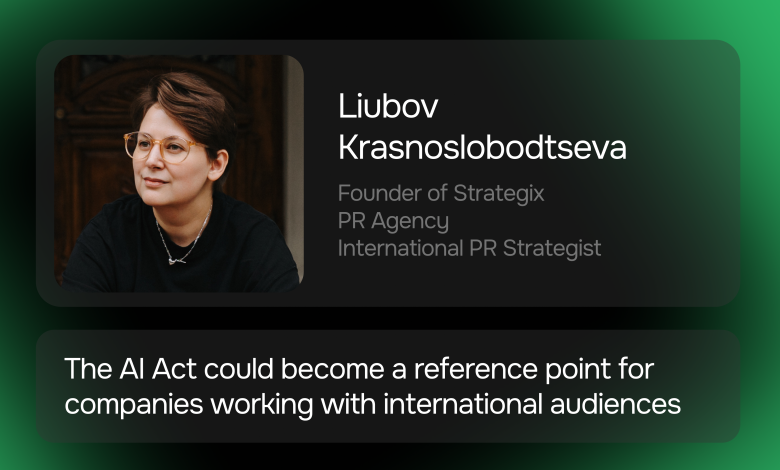
International media strategist and founder of the PR agency Strategix, Liubov Krasnoslobodtseva, explains why legal compliance with the EU AI Act isn’t enough to earn market trust, and how companies should build communication around AI.
Starting August 2, 2026, the transparency requirements of the EU AI Act come into force, obligating companies, in certain cases, to inform users when they are interacting with an AI system and to label AI-generated or AI-modified content. The new rules are designed to ensure users understand when content has been created or altered using artificial intelligence. For most companies, this means not only legal analysis, risk assessment, and updated internal policies, but also a rethink of their approach to communications. But is legal compliance alone enough to preserve the trust of customers and partners?
We spoke about this with Liubov Krasnoslobodtseva, an expert with 16 years of experience in journalism, PR, and crisis communications, and head of the international PR agency Strategix, which recently unveiled an innovative approach to business promotion. The agency takes an integrated approach, combining reputation PR, marketing, and branding into a single strategic process, helping founders, experts, and businesses build reputation and scale across markets in the US, Europe, and Asia. Liubov is also an honorary member of the Association of Electronic Commerce and Digital Marketing (ECDMA), serves on the jury of the Best in Business Award (BIBA) 2026, and publishes her own articles on strategic PR.
The EU AI Act: Why Regulation Is Becoming a Question of Trust
The EU AI Act is the first large-scale legislative approach to regulating artificial intelligence, introducing mandatory rules for managing AI-related risks. The European Union adopted the law to establish uniform rules for the development and use of AI systems, protect citizens’ rights, and ensure the safe rollout of the technology. The law follows a risk-based approach: the greater the potential impact of AI on people’s lives and rights, the stricter the requirements for its use.
The strictest requirements apply to high-risk AI systems, such as those used in hiring, credit assessment, education, healthcare, and biometric identification. Many of these requirements will take effect later, with deadlines for a number of systems pushed to 2027–2028. Even so, the direction of regulation is already clear: governments are steadily moving toward more transparent and accountable use of artificial intelligence, and for companies, it’s largely a matter of time.
“The European approach is gradually setting a new standard for how companies should explain their use of AI to customers, partners, and the market. Just as GDPR once shaped global approaches to data handling, the AI Act could become a reference point for companies working with international audiences,” says Liubov Krasnoslobodtseva of the new law.
AI Compliance Is Becoming a Public Matter
From a communications standpoint, these changes mean that AI compliance is no longer solely the legal department’s job. Simply meeting the letter of the law isn’t enough, since people need to understand when and how artificial intelligence is influencing decisions that affect them. Otherwise, even a company that is fully compliant on paper risks losing its audience’s trust.
“Companies need more than legal compliance: they need PR that builds trust. The first protects against regulatory risk; the second protects against reputational risk,” explains the founder of Strategix.
For example, if an AI system rejects a resume, affects a credit decision, or responds to a customer support inquiry, people need to understand what actually happened and why that decision was made. Without those explanations, a sense of unfairness sets in, even when the company hasn’t broken any laws.
“All these explanations are usually buried in a 30-page privacy policy. But which of us, as ordinary users, actually reads documents like that, written in fine print and legal jargon?” asks Liubov Krasnoslobodtseva rhetorically. In her view, users shouldn’t have to decipher this themselves. It’s on companies to follow the rules and explain how they use AI in plain language.
Silence Is a Reputational Risk Too
Many companies are wary of speaking publicly about AI governance, fearing that discussing potential risks might draw unwanted attention to weaknesses in their AI practices. In reality, though, the absence of clear, consistent communication creates an information vacuum.
That vacuum rarely stays empty. It gets filled by journalists, users, competitors, former employees, or by a crisis itself, which forces the company to explain its actions not on its own terms and in a calm setting, but under public pressure. In that scenario, the business loses its ability to shape the narrative and explain the principles guiding its use of AI.
“In AI communications, silence rarely looks neutral. It often looks like the company has something to hide,” Liubov Krasnoslobodtseva stresses. She adds that a willingness to speak openly about processes, limitations, and oversight mechanisms comes across as a sign of responsibility rather than weakness. At least, that’s how most audiences perceive it, based on her experience running Strategix.
Responsible AI No Longer Works Without Proof
“We use artificial intelligence responsibly.” “We’re committed to ethical AI principles.” “Our AI is human-centered.” These days, phrases like these increasingly backfire: the more often a company repeats them without specifics, the more it looks like there’s nothing behind the words.
Liubov Krasnoslobodtseva believes that as interest in AI governance grows, trust increasingly depends on companies demonstrating how their stated commitments actually play out in practice. For that, she proposes a 4P model:
- Policy — what rules and principles govern the company’s use of artificial intelligence.
- Process — what oversight mechanisms are in place.
- People — who is responsible for decision-making and human oversight.
- Proof — what external evidence exists to back up the company’s stated principles. This can include independent audits, certifications, public reports, expert evaluations, open communication in the media, or clear documentation for customers.
PR Should Work Alongside Legal, Not After It
The PR team shouldn’t be brought in only at the final stage, once the legal department has already produced a dense document that’s mainly intelligible to internal specialists. According to Liubov Krasnoslobodtseva, communication around artificial intelligence should begin as early as the AI strategy is being developed.
“A legal document protects the company. A communication strategy protects the relationship between the company and the market. PR’s job is to translate compliance language into something customers, investors, partners, and the broader public can actually understand. And yes, AI transparency today is an advantage, not a burden,” the expert explains.
As an example, she points to Microsoft’s strategy of publicly building out AI governance and regulatory compliance through customer-facing resources, including its Trust Center. The company shows that risk management, process transparency, and responsible AI principles can be part of open communication with the market, not just internal legal documentation.
When AI Gets It Wrong, the Brand Answers for It
In 2022, an Air Canada customer asked the company’s chatbot whether he could get a refund on a ticket due to a death in the family. The bot told him yes, he could file a claim later and get his money back. He did exactly that. Air Canada then refused the refund and tried to distance itself from the information given by the chatbot, but a tribunal ruled that the company was responsible for the information on its own website, regardless of whether it came from a static page or a chatbot.
Liubov Krasnoslobodtseva points to this case as a clear illustration that a brand can’t hide behind its own technology. “If an AI assistant gives a customer the wrong information, the audience doesn’t treat that as a technology glitch. Instead, responsibility attaches to the brand that deployed the tool and made it part of the customer experience,” she explains.
She notes that the Air Canada chatbot story is just one example among many similar scenarios. Misleading AI-generated content, a biased recommendation, a data leak caused by an automated decision, a deepfake incident, or simply a gap between what a company claims about Responsible AI on its website and how the technology actually behaves with a real customer: any of these can deal the same kind of blow to a company’s reputation.
What Should Companies Do About All This?
Despite all the attention on the EU AI Act, the law itself doesn’t introduce anything fundamentally new to the market. Rather, it codifies a trend that has been building globally for some time: companies need to use artificial intelligence responsibly and talk openly about it with customers, partners, and the public. Preparing for the new requirements, then, is worth treating as an opportunity to build more transparent communication with your audience.
Liubov Krasnoslobodtseva recommends that companies using or planning to adopt AI start working now on three fronts:
- Audit your AI usage. Identify exactly where AI tools are being used across the company, what decisions they make, what data they process, and at which touchpoints they interact with customers, employees, or partners.
- Prepare clear explanations for each key AI system. Ask yourself a simple question: could someone without a technical background understand where AI is being used, why it’s needed, and what role a human plays in the process? If the answer is no, it’s worth preparing simple, clear explanations ahead of time for your website, customer service channels, support teams, and other communication channels.
- Develop an AI Crisis Communication Protocol. Even when an AI system is functioning correctly from a legal standpoint, users may not understand how or why a particular decision was made. That’s why companies need to prepare communication scenarios in advance for errors, disputes, or negative audience reactions.
Liubov Krasnoslobodtseva’s main piece of advice for businesses: stop hiding behind complex technical terms and legal language that blur accountability. “Trust isn’t built on slogans — it’s built on a willingness to explain who makes the decisions, how oversight works, and where the proof is,” she says. PR, she adds, is exactly what turns compliance from an internal requirement into a trust signal the market can actually read.