Here’s what surprised me most after tearing apart hundreds of thousands of buyer-to-AI conversations at 1mind. Buyers tell the machine things they’d rarely tell a human. They name the competitor sooner. They give a real budget number instead of a safe range. They ask the blunt question about risk or implementation instead of circling it for three calls. And it happens before a rep is ever on the phone, on the buyer’s own schedule.
Why? Because the moment a human enters the room, the buyer starts performing.
What Buyers Say to a Superhuman
Talking to a person, a buyer manages tone, status, leverage, and the clock. That’s a lot of theater for one procurement question. Take the human out and the performance drops with it. With AI, buyers get blunt. “That’s dumb, tell me the next thing” is the kind of line they’d never say to your rep’s face. Competitors get named flatly. Budget stops getting hedged.
You can see it in how they talk. The average buyer turn with our AI runs about six words, closer to a search query than a sentence, and the buyer drives the questions. On a live call the rep carries 40 to 72% of the talk time. With AI it’s nearly even. Four things distort a human conversation and vanish with AI: social performance, power dynamics around budget and mandates, the 30-minute time pressure that forces buyers to triage their questions, and lossy memory. What you’re left with is a purer signal. Less filler. More directness. Intent sitting in the open for you to read.
That signal told us two things. First, depth predicts a real lead. The deepest conversations convert at roughly 3.6x the rate of the rest, and a buyer who reaches six or eight turns qualifies at nearly double the rate of one who taps out at three. Second, buyers now arrive more researched than your website assumes.
They’ve done the evaluation inside their AI tools before they land on your page, so when a decision-stage buyer hits an awareness-stage website, a form fill, a “book a demo,” a chatbot that taps out in two turns, they bounce. Most teams still optimize for the classic 5% of the market that’s in-market. In our data, 27% of website buyers arrive already in decision or commitment mode. More than a quarter of the room is ready to move, and most sites are built to make them wait.
That gap is exactly what 1mind was built to close. Our superhumans meet those buyers on the website with a real conversation, going as deep as they want to go, answering the blunt questions and running the live demo, then handing off to a human at the right moment. You capture the depth, the signal, and the 27% who came ready, rather than greeting them with a receptionist pointing at the calendar.
The Other Problem: Most Sales Calls Don’t Have a Sales Engineer
The median ratio of account executives to solutions engineers in B2B sales is roughly 4:1, and in some organizations it runs as high as 10:1. Most live sales calls simply have no technical backup in the room.
When a buyer asks a hard question and the AE can’t answer it, the call stalls on “let me get back to you.” According to Sales Insights Lab, that phrase gives a deal roughly a 1-in-100 chance of recovering momentum. There just aren’t enough sales engineers to put one on every call.
What We Built Ride-Along to Do
This is the problem we built Ride-Along to close, and it’s worth being precise about what that means, because “AI sales assistant” gets used to describe very different things. Most website chatbots are qualifiers: they ask for a name and email, and stall out the moment a question goes off-script, usually within a couple of exchanges. A whisper-copilot listens quietlyand feeds suggested lines to the rep, invisible to the buyer. Neither one is actually in the conversation.
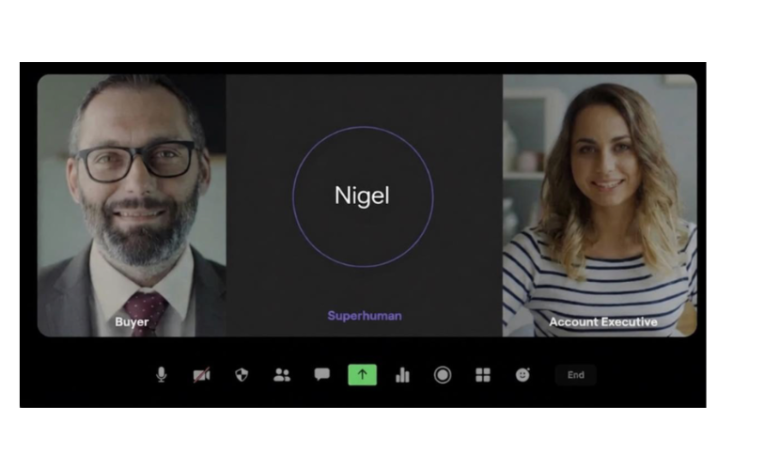
Ride-Along is neither of those. It joins live Zoom, Teams, and Meet calls as a visible, named participant, the buyer sees it on the attendee list and can talk to it directly, the way they’d talk to a sales engineer sitting in the room. It answers complex technical questions, presents slides, runs live product walkthroughs, and handles objections in real time. In our data, actually doingsomething live on a call, running a demo or a lookup instead of just describing it, drives 5.4x the engagement of description alone.
More than 70 enterprises, including HubSpot, are already using it: 2x-5x conversion lift, 62% shorter sales cycles, six-figure deals closed with no humans in the loop. Every AE gets a sales engineer on every call now, not just the calls big enough to justify pulling one in.
Two Different Problems, Same Direction
Our research is about buyers on their own, before a rep shows up. Ride-Along is about the rep already on the call, stuck on a question they can’t answer. Different moments in the deal. Same fix: put the AI closer to the conversation.
What This Means for Buyer Trust
Buyers trust AI for the parts that don’t need a person: pricing, technical specifics, whether the product does the thing they asked about. It’s consistent, and it doesn’t have a number to hit that might color the answer. Ride-Along’s answers are constrained to verified company data, with guardrails built in specifically to keep it from making something up. By design, it speaks when called upon rather than jumping in, and enterprises can also run it in a fully silent-listening mode for the calls where they’re not ready to hand it the floor.
What buyers still want a human for is everything past the facts: whether this vendor actually understands their situation, who’s accountable if the deal goes sideways, how flexible the company will be under pressure. An AI doesn’t answer that convincingly, and Ride-Along isn’t built to try. The trust splits along that line: facts to the AI, the stuff with real stakes to a person.
What This Means for Reps
If buyers are willing to show their hand early to an AI, a lot of sales playbooks are already behind. Most of them assume a buyer reveals budget, competitors, and real concerns slowly, over several calls, coaxed out by a rep. In our data, 27% of engaged buyers arrive already in active evaluation or decision mode, not the 5% “cold” default most teams still plan around. Gradual reveal just slows a buyer like that down.
And if a live AI sales assistant is handling the technical questions, the rep isn’t burning the call trying to remember pricing edge cases or last quarter’s competitive positioning. That time goes into the actual objection and the politics of a deal with five stakeholders in it, the part of the job nobody was going to automate anyway.
What Leaders Should Actually Do With This
Start by mapping where buyers currently go quiet or vague with a rep. Those are the exact points where an AI sales assistant, deployed before a human gets involved, should be designed to engage.
Before expanding an AI’s speaking role on live calls, make sure the product and competitor knowledge behind it is solid. A visible participant that gets something wrong in front of a buyer is worse than no participant at all.
Bring the sales team into the rollout early. An AI sales assistant that surfaces more of what a buyer actually thinks, and hands the rep a technical backup on every call, is a tool the team should want. We’d start it as a visible co-pilot, expand its speaking role as the results hold up, and keep a feedback loop running so reps can flag when it got something wrong.