Carbon data is becoming business infrastructure
AI is going to become a core part of carbon management because the data challenge has simply become too big, too fragmented and too fast-moving for manual processes to keep up. But speed is only part of the answer. Producing carbon data fast is not the same as producing data that can be trusted; credibility depends on robust methodology, quality inputs and expert judgement working together. And that combination is harder to replicate than it looks.
The businesses that get the most value from AI will be those that use it to make better decisions faster, not those that use it to automate accountability away.
Carbon data is no longer just something companies report. Increasingly, it is something they have to make decisions with. It now affects procurement, product design, logistics, supplier engagement, customer tenders and regulatory exposure. As CBAM creates direct carbon cost implications for importers and sustainability reporting rules increase scrutiny of corporate data, businesses need faster and more reliable visibility over emissions. AI can help, but only if it is used to support expert judgement, not replace it.
AI can help solve the carbon data bottleneck
Carbon reporting used to look backward.
A footprint was calculated after the fact, filed, and forgotten until the following year. That model no longer fits how businesses operate. Companies want and need emissions data that helps them choose suppliers, redesign products, manage risk and answer their customers, in close to real time.
Many businesses have data that is good enough to produce a footprint, but not good enough to guide decisions. That is the gap carbon management now needs to close in order to deliver carbon reduction at scale.
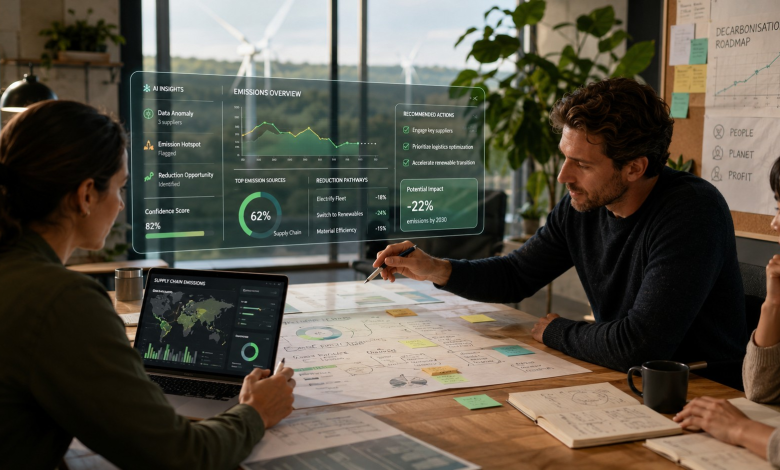
The reason carbon work has been so slow is that the underlying data is scattered. It lives across invoices, spreadsheets, ERP systems, procurement records, logistics files and supplier questionnaires, rarely in the same format twice. This is precisely the kind of problem AI is suited to. It can structure messy inputs, map them to the right emissions factors, flag anomalies, identify what is missing and surface the hotspots that matter, far faster than any team working by hand.
Its value is not that it magically makes carbon accounting easy. It reduces the drag of data handling so sustainability teams can focus on interpretation and action.
Speed without rigour is not progress
Credible carbon data requires the right methodology, quality inputs, and expert judgement applied at the right moments, assessing whether supplier data is credible, whether an outlier is an error or a real issue, and whether a reduction pathway is operationally viable. Ask anybody who works in sustainability and they will tell you there’s a lot of uncertainty in the data. It’s the peoplewho turn that data into something that can implement change.
The strongest approach to carbon management is neither traditional consultancy nor fully automated software. Consultancy alone cannot match the speed and scale the problem now demands. Automation alone cannot do the part that actually matters: the human work of changing a business. That work is where carbon management succeeds or fails. It means knowing which trade-offs make sense in a client’s context, setting targets that are credible and ambitious without tipping into the naive, and bringing procurement, finance and operations along, because a target nobody believes in is unlikely to drive real change. Above all, it means embedding sustainability into the commercial decisions that shift the dial, rather than leaving it parked in a report.
AI can show where the emissions sit. It cannot tell a CFO how to rebuild a category strategy, or convince a board to accept a margin trade-off. The model that works pairs technology’s speed, scale and structure with experts who validate the inputs, challenge the outputs, and turn data into decisions a business will act on. This is the real difference between carbon reporting and carbon management. Reporting produces a document; management produces decisions. And decisions have to hold up – to auditors, to regulators, and to the commercial reality they are meant to guide.
The future is AI-powered, not AI-only
AI will become a core part of sustainability work because the alternative – doing it all by hand – no longer scales to the speed and scrutiny businesses face. But faster outputs are only valuable if they can be trusted, and trust does not come from fluency. It comes from evidence, traceable data, and human judgement that can be held accountable.
Businesses that treat AI as a replacement for expertise will produce carbon data that moves quickly and falls apart under examination, exactly when the stakes are highest. The ones that use AI to strengthen expert judgement, rather than sidestep it, will be better placed to make claims that withstand scrutiny,
The future of carbon management is AI-powered, but it must remain human-accountable.