
Generative AI is steadily transforming enterprise content production. What began as a creative experiment has evolved into a strategic capability that supports marketing, sales, training, customer engagement, and internal communications. As organizations invest more heavily in AI-powered content creation, the conversation is shifting beyond model performance toward a broader question: how can enterprises adopt AI video in a way that is scalable, secure, and aligned with business objectives?
Among the technologies attracting industry attention is Seedance 2.5. Rather than viewing it simply as another AI video model, many enterprise teams see it as an opportunity to review their production strategies and prepare for the next stage of AI-assisted video creation. The organizations that gain the most value from emerging technologies are often those that strengthen their internal processes before introducing new platforms into production.
AI Video Is Becoming an Enterprise Capability
Enterprise demand for video continues to grow across nearly every business function.
Marketing teams need more campaign assets across multiple channels. Product teams require updated demonstrations as features evolve. Human resources departments rely on video for onboarding and employee learning, while customer success teams increasingly use visual content to improve product adoption.
Meeting these demands with traditional production alone is becoming difficult. As a result, AI video is moving from an experimental tool to an operational capability that supports everyday business activities.
This shift changes how organizations evaluate new technologies. Instead of focusing only on visual quality or generation speed, enterprise leaders are asking whether AI can improve collaboration, shorten production cycles, and integrate into existing business operations.
Business Objectives Should Come Before Technology
Technology should support business strategy—not define it.
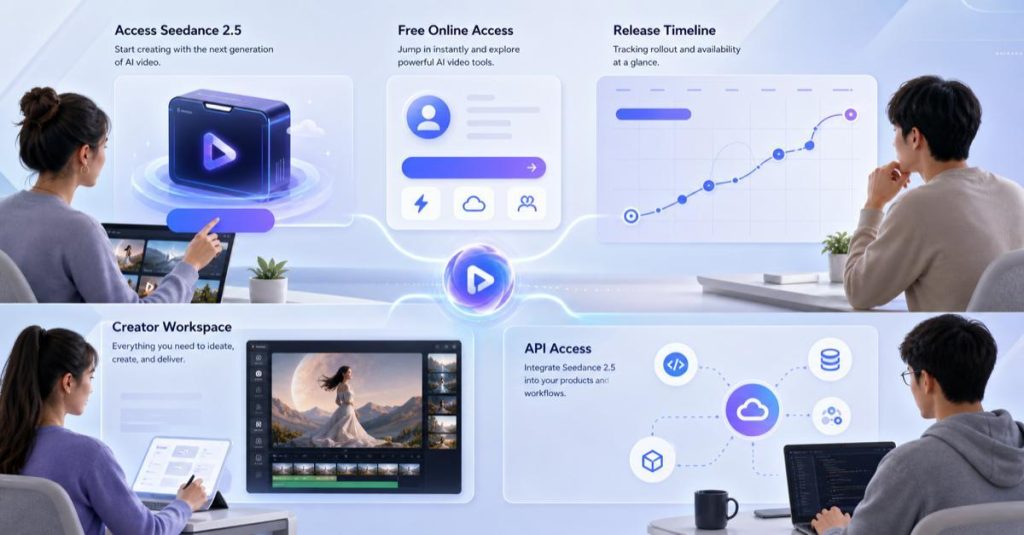
Before evaluating any AI video platform, organizations should establish clear objectives. These goals may include reducing production time, increasing content output, improving localization, supporting product education, or maintaining consistent branding across global markets.
When business priorities are clearly defined, evaluating new technology becomes more objective. Teams can compare solutions based on measurable outcomes such as efficiency, cost reduction, collaboration, and content consistency instead of relying on feature lists or promotional demonstrations.
For organizations following the development of Seedance 2.5, this planning stage offers an opportunity to align future AI initiatives with long-term business goals rather than reacting to short-term industry trends.
Governance Should Be Built Before Deployment
As AI becomes part of enterprise content operations, governance becomes just as important as technology.
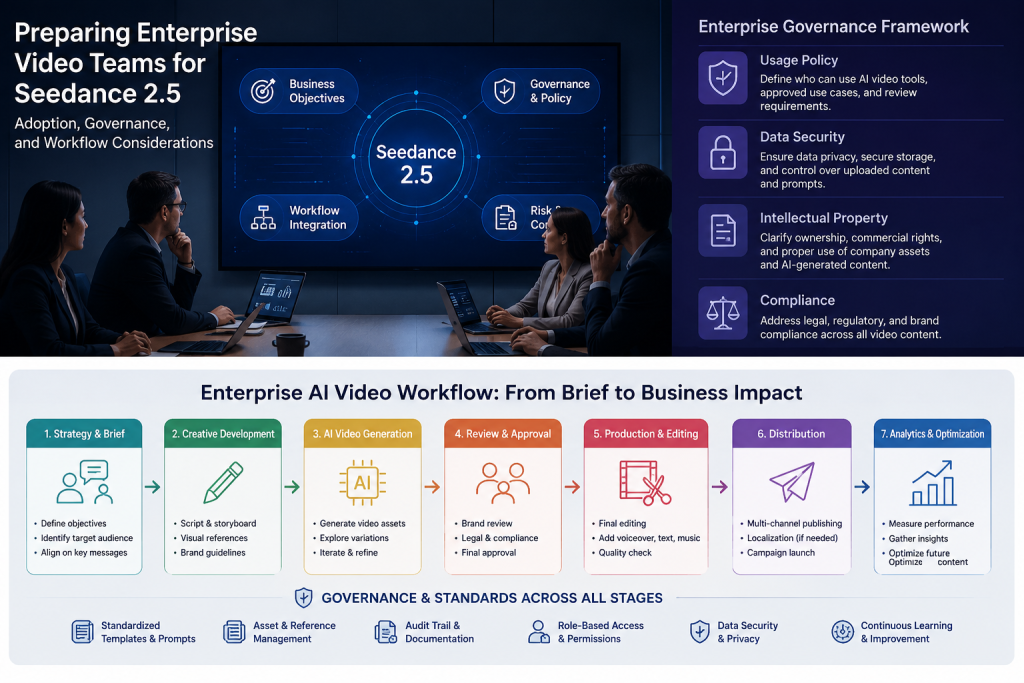
Unlike individual creators, enterprises must consider intellectual property, regulatory compliance, brand protection, information security, and accountability throughout the production process. Introducing AI without a governance framework can lead to inconsistent approval standards, duplicated work, and unnecessary legal or operational risks.
A practical governance framework should clearly define who is responsible for approving AI-generated content, which business scenarios are appropriate for AI-assisted production, how creative assets should be managed, and how production activities should be documented.
Governance should not be viewed as a barrier to innovation. Instead, it provides a consistent structure that allows creative teams to experiment responsibly while ensuring that enterprise standards remain intact.
Standardizing Enterprise Workflows
Successful AI adoption depends on workflow integration rather than isolated productivity gains.
Enterprise video production usually involves multiple departments working together. Marketing establishes campaign objectives, creative teams develop concepts, brand managers review visual consistency, legal teams verify commercial suitability, production teams finalize deliverables, and analytics teams measure performance after publication.
AI should strengthen these connections instead of creating separate production processes.
Organizations preparing for enterprise AI adoption should document shared workflows, define review responsibilities, establish version-control practices, and standardize project documentation. These operational improvements create long-term value regardless of which AI platform is eventually adopted.
A structured workflow also makes it easier for teams to scale production, onboard new employees, and maintain consistent quality across different business units.
Evaluate More Than Video Quality
One of the most common mistakes during technology evaluation is focusing exclusively on visual output.
High-quality videos are important, but they represent only one aspect of enterprise adoption.
When assessing Seedance 2.5 video quality, organizations should consider a broader set of criteria, including production efficiency, workflow compatibility, creative consistency, governance support, editing flexibility, and long-term operational scalability.
A platform that produces visually impressive videos but requires significant manual coordination may ultimately deliver less business value than one that integrates smoothly into existing enterprise processes.
Developing standardized evaluation criteria before testing allows organizations to make technology decisions based on operational impact rather than first impressions.
Preparing Organizations for Long-Term Adoption
Technology evolves quickly, but organizational capabilities create lasting value.
Rather than treating AI adoption as a one-time implementation project, enterprises should establish a continuous improvement process. Governance policies should be reviewed regularly, production standards should evolve alongside business needs, and lessons learned from pilot projects should be shared across departments.
Equally important is investing in people. Marketing specialists, creative professionals, legal advisors, IT teams, and business leaders all need a shared understanding of how AI supports enterprise objectives. Training should focus not only on using new tools but also on maintaining quality standards, documenting production decisions, and encouraging cross-functional collaboration.
Organizations that strengthen both their teams and their operational processes are better prepared to adapt as AI technology continues to mature.
Conclusion
The next generation of AI video technology represents more than a new production tool. It reflects a broader shift in how enterprises create, manage, and scale digital content.
For organizations preparing for the arrival of Seedance 2.5, the priority should not be chasing individual features or early access. The greater opportunity lies in building strong governance, standardized workflows, measurable evaluation frameworks, and collaborative production processes that can support sustainable AI adoption over time.
As enterprise AI continues to evolve, the organizations that invest in operational readiness today will be in the strongest position to evaluate new technologies confidently and transform AI video into a reliable business capability.