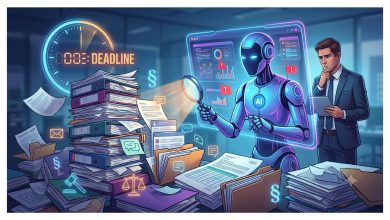
AI is everywhere in software right now – it can feel like it is being introduced into every part of the development process, creating the impression that it has already been transformed.
But for most delivery teams, that is not quite what is happening. While 95% of developers are already using AI coding assistants in some form, only a small part of the delivery cycle is actually spent coding – with most time still going into design, testing, integration and decision‑making. The tools are improving quickly, but teams are still working out where they are genuinely useful across the wider delivery process.
The challenge now is to focus less on what AI could do, and more on where it is actually useful.
Where AI is delivering genuine value
There are areas where AI is already proving useful, and they tend to have one thing in common: the work is repetitive and easy to review, with clear expectations for what “good” looks like.
Generating test cases is one example, supporting repetitive development tasks is another. In both cases, the output follows known patterns, which makes it easier for teams to check what AI produces. This has a direct impact on delivery.
When routine work is reduced, teams can spend more time reviewing outputs and making decisions, rather than producing everything manually. This shifts effort without removing responsibility. Teams using AI tools to generate a wider range of test scenarios in less time, are finding it a helpful way to cover more cases than they might otherwise reach.
That does not remove the need for testing discipline, but it does change how that work is done.
In practice, this means teams should focus on using AI where results can be checked easily, rather than applying it across everything at once, and being served poor quality results.
How teams are learning to use AI effectively
One of the clearest lessons from teams working with these tools is that output quality depends heavily on input quality. A vague prompt more often than not produces something insufficient – a clear prompt produces something far closer to what is needed.
That sounds straightforward, but in practice it changes how teams operate.
Prompting is becoming a shared practice, with teams starting to document what works, reusing prompts across projects, and refining them over time. This shifts attention away from the variety of tools and more onto how each tool is used.
Whilst the AI era has well and truly arrived, many teams are still in early experimental phases to understand what tool works best for their requirements, and the space is becoming even more saturated as new tools are introduced to the market daily.
Consequently, some are using multiple AI solutions at the same time, without a clear understanding of how each one should be used to get the best results. This can create more friction than it eliminates, as time is spent switching between tools and comparing outputs rather than improving how work gets done.
So when done well, teams are finding that consistent ways of using AI tools are more effective than constantly introducing new ones to plug any gaps.
Why the fundamentals matter more, not less
Alongside these changes, one thing has become clear: strong engineering practices cannot be replaced by AI. If anything, they become more important. Clear structure, best practice and attentive oversight are more critical than ever to control how these tools are built and maintained. If those foundations are weak, AI will scale the problem just as quickly as it could scale productivity.
Additionally, there are reliability concerns – AI generated outputs can appear correct while still containing errors or gaps. This is why teams need to be deliberate and selective about how and where they use these solutions, rather than applying a blanket approach and hoping for the best.
This is why many teams are reinforcing existing ways of working rather than changing them completely. Code reviews, testing and collaboration still all matter – the subtle change comes in with teams now reviewing both human-written and AI generated outputs.
Use AI deliberately, not by default
AI is often lauded as a tool that will speed up your workflow, but speed loses any competitive advantage if not paired with accuracy and good judgement.
The teams seeing the most value from AI are not the ones moving fastest, but the ones being most intentional. They start with specific use cases, apply AI where outputs can be reviewed, and reinforce shared standards rather than bypassing them.
For teams working out where AI fits, the priority is clarity over speed. Used thoughtfully, AI can support better delivery decisions. Used indiscriminately, it simply scales uncertainty. AI has the capacity to change how software work is done, but the responsibility to maintain quality of output remains firmly with the teams building and using it.