Every week another AI vendor promises autonomous planning, self-healing supply chains, or intelligent procurement.
While these advancements are exciting, they have also created a misconception that AI’s ultimate goal is to replace human decision-makers.
After leading Oracle Supply Chain transformations across manufacturing, distribution, maintenance, inventory, and planning for more than two decades, I have reached a different conclusion.
The future of supply chain AI is not autonomous decision-making.
It is Human-Centered Decision Intelligence.
Organizations that achieve the greatest value from AI are not those that remove people from decisions. They are the ones that redesign decision-making so AI and people work together, each contributing what they do best.
Supply Chains Are Decision Systems
Supply chains are often described as networks of suppliers, factories, warehouses, transportation providers, and customers. In reality, they are networks of decisions.
Every day, organizations make thousands of operational decisions:
- Should production be rescheduled because of a material shortage?
- Should inventory be reallocated between distribution centers?
- Should demand forecasts be adjusted following a market signal?
- Should maintenance be performed now or deferred until the next production window?
- Should procurement qualify an alternative supplier?
Each decision affects cost, service, customer satisfaction, working capital, operational efficiency, and business risk.
Traditionally, these decisions have depended on historical reports, planner experience, spreadsheets, and periodic planning cycles. That approach worked when supply chains were relatively stable.
Today’s environment is fundamentally different.
Global sourcing, geopolitical uncertainty, changing customer expectations, labor shortages, sustainability objectives, and increasing product complexity have made supply chain decision-making exponentially more difficult.
The challenge is no longer collecting data.
The challenge is making better decisions from that data.
This shift is already underway across the industry. According to McKinsey, organizations adopting AI across supply chain operations have reported improvements in forecast accuracy, inventory optimization, and planning productivity, demonstrating that AI creates the greatest value when it augments human decision-making rather than replacing it. These results demonstrate that AI delivers the greatest value not by replacing planners, but by helping them make better decisions with greater speed and confidence.
AI Changes the Speed of Insight, Not the Ownership of Decisions
Artificial Intelligence excels at processing information at a scale impossible for humans.
Modern AI systems can continuously evaluate millions of transactions, identify subtle demand shifts, recognize supplier performance trends, detect abnormal inventory movements, predict equipment failures, and simulate thousands of planning scenarios within minutes.
This capability fundamentally changes how organizations discover opportunities and risks.
However, insight alone does not constitute a business decision.
AI can identify that supplier performance is deteriorating.
It cannot determine whether that supplier should be retained because of a long-term strategic partnership.
AI can recommend reducing inventory.
It cannot fully evaluate the commercial implications of disappointing a key customer during a product launch.
AI predicts.
People decide.
That distinction is critical.
Decision Intelligence Is the Missing Layer
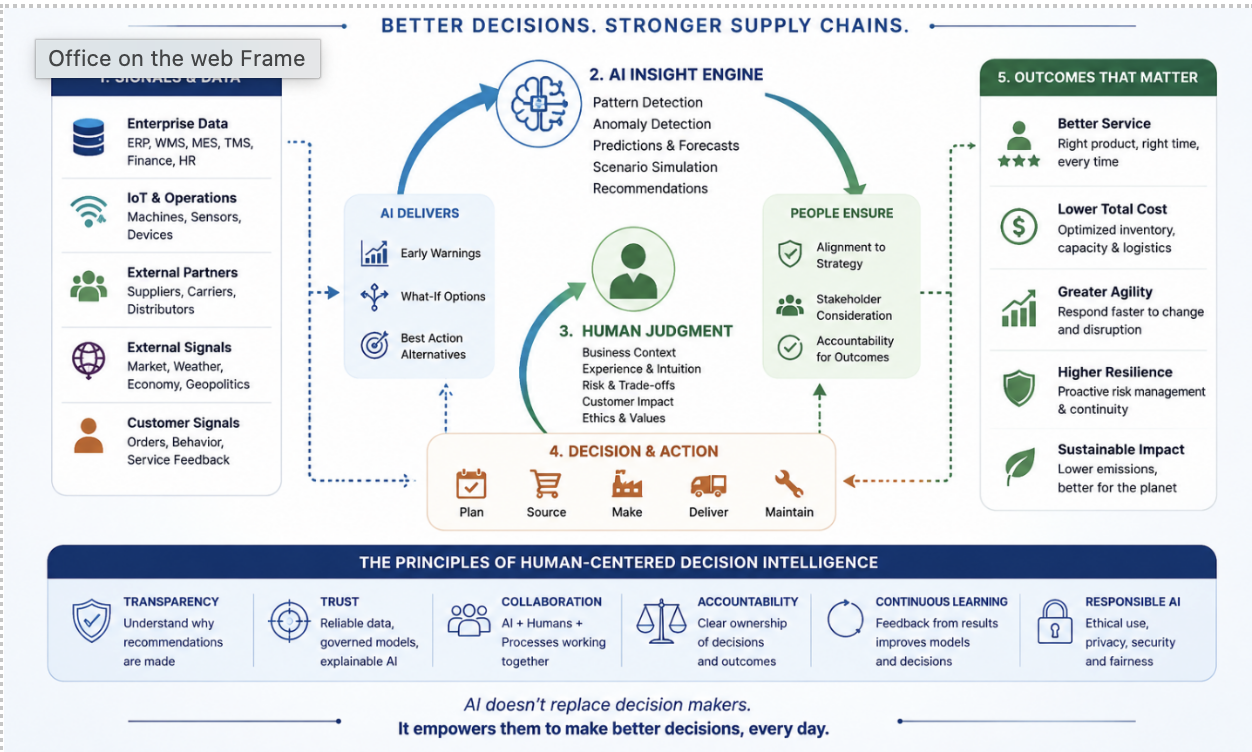
Figure 1. AI analyzes enterprise and external data to generate insights and recommendations, while human decision-makers apply business context, strategic judgment, and accountability to deliver better supply chain outcomes.
Many organizations focus on AI models while overlooking decision design.
Decision Intelligence combines data, analytics, AI, business rules, governance, and human judgment into a structured decision process.
Instead of asking,
“Can AI automate this process?”
organizations should ask,
“How can AI improve the quality, consistency, and speed of this decision?”
This shift fundamentally changes AI implementation.
Rather than replacing planners, AI becomes an intelligent advisor that continuously monitors business conditions, identifies exceptions, evaluates alternatives, and recommends actions.
Human experts remain responsible for understanding business context, balancing competing priorities, and approving critical decisions.
In practice, this challenge becomes even more apparent during enterprise AI implementations.
During multiple Cloud supply chain transformation programs, I observed that planners rarely rejected AI because they distrusted the algorithms themselves. More often, they questioned how AI-generated recommendations aligned with customer commitments, inventory strategies, production constraints, and broader operational realities. Once recommendations became transparent, explainable, and supported by business context, user confidence increased significantly, leading to higher adoption and more effective decision-making.
This partnership creates significantly better outcomes than either humans or AI working independently.
Where Human-Centered AI Delivers the Greatest Value
Demand Planning
Demand planners spend significant time collecting data, validating forecasts, and reconciling multiple versions of demand.
AI automates much of this analytical work by identifying demand anomalies, recognizing seasonality changes, and incorporating external signals such as weather, promotions, and market events.
Instead of replacing planners, AI allows them to focus on customer behavior, commercial strategy, and exception management.
Inventory Optimization
Inventory decisions involve far more than mathematical optimization.
Reducing inventory may improve working capital but increase customer risk.
Increasing inventory improves service but raises carrying costs.
AI evaluates thousands of stocking scenarios almost instantly.
Supply chain leaders evaluate whether those recommendations align with customer commitments and business priorities.
Manufacturing Operations
Modern manufacturing environments continuously generate operational data through ERP, MES, IoT devices, quality systems, and production equipment.
AI identifies emerging bottlenecks, predicts capacity constraints, and recommends schedule adjustments.
Production leaders determine whether operational realities justify implementing those recommendations.
Predictive Maintenance
AI models can identify equipment degradation weeks before failures occur.
Maintenance supervisors must still determine the optimal maintenance window while balancing production schedules, labor availability, and customer commitments.
AI predicts failure.
People manage business impact.
Procurement and Supplier Risk
AI continuously monitors supplier performance, geopolitical events, logistics disruptions, financial indicators, and market signals.
Procurement professionals evaluate strategic relationships, contractual obligations, and sourcing alternatives before acting.
Supplier relationships cannot be managed by algorithms alone.
Why Fully Autonomous Supply Chains Remain Unrealistic
The concept of a fully autonomous supply chain is attractive.
However, supply chains operate within business environments that involve uncertainty, conflicting objectives, changing regulations, and human relationships.
Algorithms optimize measurable variables.
Business leaders optimize enterprise outcomes.
These are not always the same.
Organizations that pursue automation without governance often experience declining trust in AI recommendations, increasing manual overrides, fragmented planning processes, and growing dependence on unofficial spreadsheets.
Automation simply accelerates existing decision logic.
If the underlying assumptions are flawed, AI scales poor decisions faster than ever before.
Building Trust Through Explainable AI
One of the greatest barriers to enterprise AI adoption is trust.
Supply chain professionals will not rely on recommendations they cannot understand.
Explainable AI addresses this challenge by making recommendations transparent.
Decision-makers should understand:
- Why was this recommendation generated?
- Which variables influenced the prediction?
- What alternatives were considered?
- What business risks exist?
- How confident is the model?
Transparency transforms AI from a mysterious black box into a trusted decision partner.
The Rise of AI Agents
The next generation of enterprise AI extends beyond predictive models.
AI Agents are beginning to orchestrate workflows across ERP applications by proactively monitoring business events, gathering information, recommending actions, and assisting users within operational processes.
In Oracle Cloud Supply Chain, for example, AI Agents are evolving into digital assistants that support planners, buyers, inventory managers, and maintenance teams by surfacing exceptions and streamlining routine activities.
Even so, these agents should augment—not replace—human expertise. Their greatest value lies in reducing repetitive analysis and enabling professionals to focus on higher-value decisions that require judgment, collaboration, and accountability.
Leadership Must Redesign Decision-Making
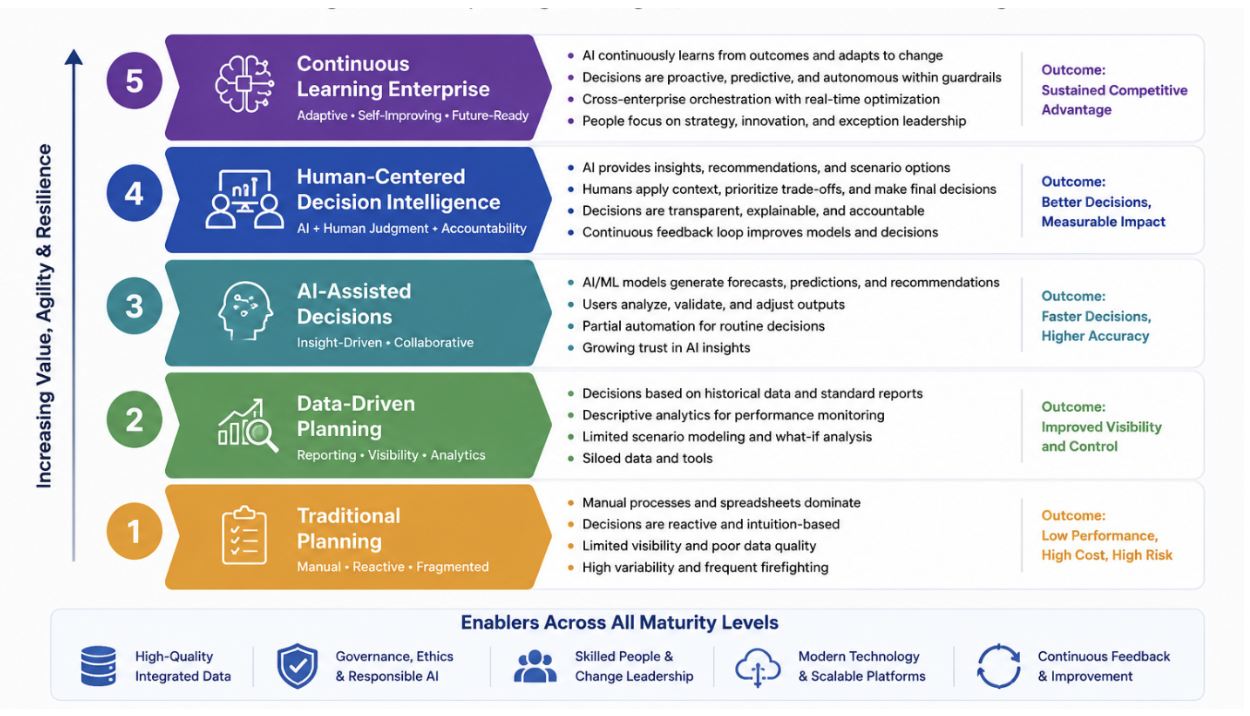
Figure 2. Supply Chain Decision Intelligence Maturity Model. Organizations evolve from reactive planning toward Human-Centered Decision Intelligence by combining AI capabilities with governance, explainability, and human accountability.
Successful AI transformation is not primarily a technology initiative.
It is an organizational redesign effort.
Leaders should begin by identifying high-value decisions rather than high-volume transactions.
For each critical decision, organizations should define:
- What information AI should analyze.
- Which recommendations AI should generate.
- When human approval is required.
- How outcomes will be measured and fed back into continuous learning.
This creates a decision framework where technology enhances accountability instead of replacing it.
Conclusion
The future of supply chain AI will not be measured by how many people it replaces. It will be measured by how much better organizations make decisions.
Human-Centered Decision Intelligence recognizes that AI and people possess fundamentally different strengths. AI excels at analyzing complexity, identifying patterns, and generating recommendations at extraordinary speed. Humans contribute business context, ethics, strategic thinking, collaboration, and accountability. Together, they create decisions that are faster, smarter, and more resilient than either could achieve alone.
The highest-performing supply chains will not be fully autonomous—they will be intelligently augmented. Organizations that embrace this philosophy will move beyond simply implementing AI. They will build decision ecosystems where intelligent systems generate insights while people provide judgment, oversight, and accountability.
Ultimately, customers, regulators, shareholders, and employees do not hold algorithms accountable. Customers don’t blame algorithms. Boards don’t hold AI accountable. Shareholders don’tpromote machine learning models. They hold leaders accountable.
That is why the future of supply chain AI is not artificial intelligence alone—it is Human-Centered Decision Intelligence, where AI accelerates insight, people provide judgment, and together they create resilient, high-performing supply chains.
The organizations that succeed in the AI era will not be those with the most sophisticated algorithms. They will be those that build the strongest partnership between artificial intelligence and human expertise, transforming technology into better decisions and sustainable business outcomes.
Srinivasan Narayanan, FBCS, is an Oracle ACE Associate, Supply Chain Transformation Leader, and AI practitioner with over 25 years of experience leading global Oracle Cloud ERP and AI-enabled supply chain transformation initiatives. An international conference speaker, researcher, and author, his work focuses on Human-Centered Decision Intelligence, AI-enabled supply chains, and enterprise digital transformation.