
Every major technological shift in history has been framed as the event that would finally break the labor market. The printing press, the steam engine, the automobile, the computer.
Each time, economists panicked, workers protested, and politicians promised protection.
Each time, the economy adapted, new categories of work emerged, and more people were employed afterward than before.
AI feels different. This time, the argument goes, we’re not just automating physical labor or routine tasks – we’re automating thinking itself. And if machines can think, what exactly are humans for?
It’s a fair question. But most people are looking at this the wrong way.
Not All Jobs Are Created Equal
To understand where AI actually threatens employment, you need to think about two dimensions simultaneously.
The first is obvious: how much will AI impact this job? Some roles like radiologists, software developers, and contract lawyers involve exactly the kind of pattern recognition, data processing, and document generation that AI handles exceptionally well. Others like electricians, plumbers, and physical therapists require physical interaction with the world and human judgment in unpredictable environments that AI cannot yet replicate. Every job sits somewhere on that spectrum.
The second dimension is less obvious, and it’s where most analysts stop too early: price elasticity. How does demand for this service respond when its price drops? If AI makes something dramatically cheaper and faster, does the world want more of it or does the world just want the same amount, but cheaper?
This second dimension is key.
The Matrix
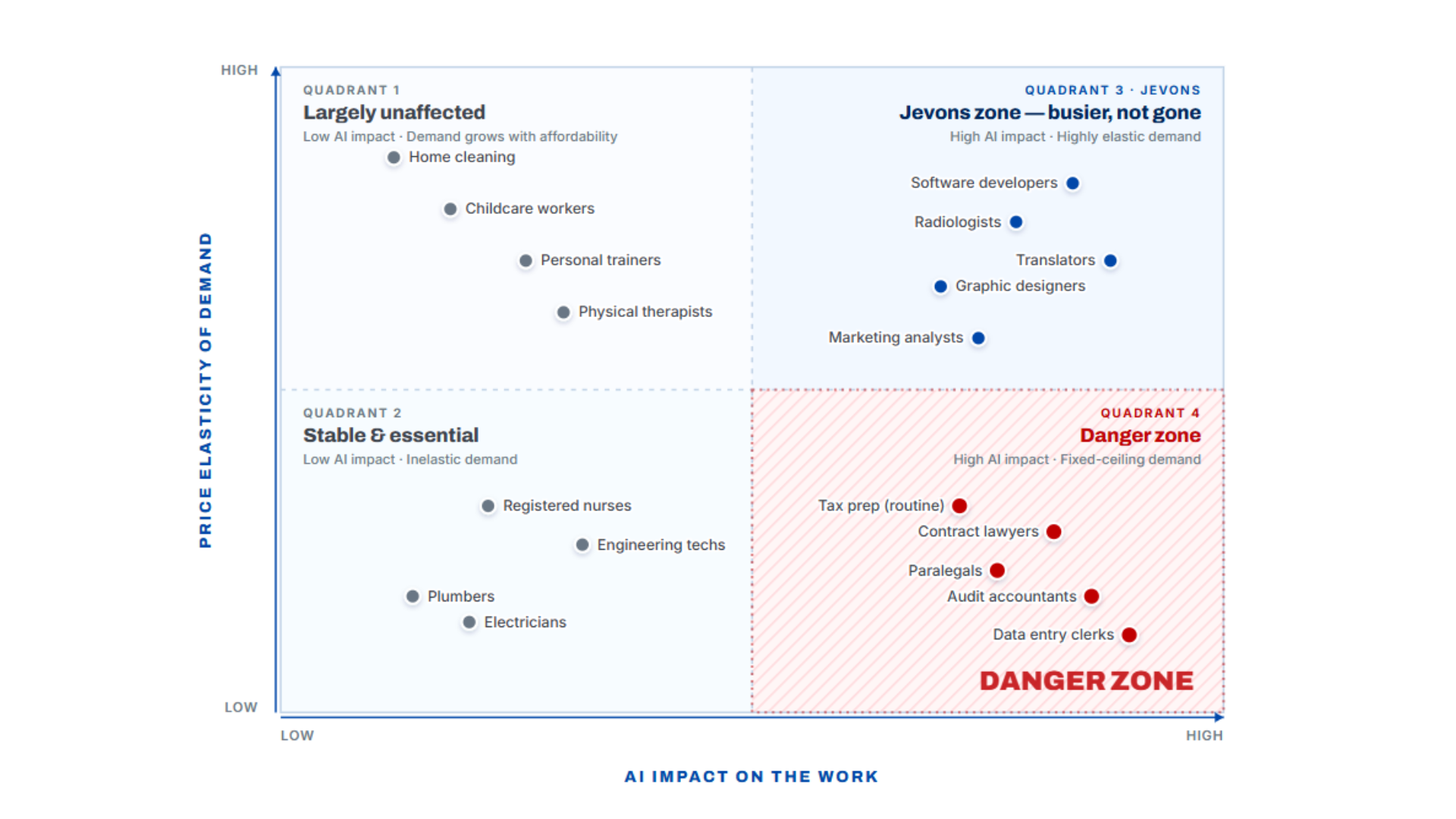
Imagine a simple grid. Left to right: least to most impacted by AI. Bottom to top: low to high price elasticity. This gives you four quadrants, and only one of them is truly dangerous.
Top left — low AI impact, high elasticity. Childcare. Home Cleaning. Personal training. AI doesn’t touch these much and demand grows as costs drop. Largely irrelevant to this argument.
Bottom left — low AI impact, low elasticity. Nurses. Plumbers. Engineering technicians. AI won’t replace the diagnosis or the repair, and you weren’t going to hire two plumbers just because the price dropped. Another safe zone.
Top right — high AI impact, high elasticity. These are jobs where AI will dramatically reduce cost and effort, and where lower prices will unleash demand that was previously suppressed. More on these in a moment. This is the third safe quadrant but these jobs will be dynamic with AI impact.
Bottom right — high AI impact, low elasticity. This is the danger zone. These are jobs where AI will do the work faster, cheaper, and often better, but where demand simply will not grow in response to lower prices. The work gets done with fewer humans. No new demand absorbs the displacement.
Zone 4: The Danger Zone Is Narrower Than You Think
Consider the annual financial audit. A large accounting firm spends months combing through financial records, flagging discrepancies, producing reports. AI will compress that timeline dramatically and reduce the cost significantly.
But here’s the thing – no company is going to commission a second annual audit just because the price dropped. Regulatory requirements are what they are. The demand ceiling is fixed by law and custom, not by price. Fewer accountants will do the same amount of work.
Contract law faces the same structure. AI is already producing first drafts of standard agreements faster than any associate. Costs will fall. But companies don’t sign more contracts because contracts got cheaper. The volume of commercial activity drives contract demand, not the price of legal services. Fewer lawyers, same number of contracts.
These jobs are genuinely at risk. Not because AI is magical, but because the economics are unfavorable. Lower cost, flat demand, fewer humans needed. The math is simple.
Zone 3: Jevons Paradox and the Case for Optimism
In 1865, the English economist William Stanley Jevons observed something counterintuitive. As steam engine efficiency improved dramatically, he expected coal consumption to fall. After all, if a train could use less coal and achieve the same results, demand for coal should drop. Instead, it exploded. More efficient engines made coal-powered production cheaper, which made it accessible to more industries, which drove total coal consumption far higher than before the efficiency gains. Jevons Paradox: efficiency improvements increase, not decrease, total resource consumption when demand is elastic.
AI is about to do this to an enormous number of skilled professions.
Take radiology. Today, if you hurt your arm and your doctor recommends an X-ray at $300, you might reasonably decide to rest it for a week and see what happens. The price is a genuine barrier.
Now imagine AI makes medical imaging dramatically faster, easier to interpret, and cheaper, say $100. Suddenly the calculation changes. At that price point, you get the X-ray. Your doctor catches the hairline fracture. You get proper treatment instead of six weeks of unnecessary pain.
This isn’t hypothetical. Suppressed medical demand is a real and documented phenomenon. Price is a significant factor in whether people seek diagnostic care, particularly for non-emergency conditions. AI releasing that price pressure doesn’t eliminate radiologists – it creates a wave of demand that was always there, waiting for the cost to drop.
Software development tells the same story. Every organization with a development team has a backlog. Features that would genuinely improve products or operations, automations that would save hours every week, integrations that would eliminate manual processes – all sitting in a queue because development capacity is finite and expensive.
AI-assisted development doesn’t replace developers. It lets the same developers work through a backlog that has been accumulating for years, while the backlog simultaneously grows because now more things feel achievable.
In both cases, Jevons Paradox does its work. Efficiency rises, cost drops, latent demand activates, total volume increases. The humans don’t disappear – they get more done.
The Inductive Bet
Here is what I know: every previous wave of automation displaced specific categories of work and created new ones that nobody predicted in advance. The farmers who feared the tractor couldn’t have imagined the automotive industry. The factory workers displaced by robotics couldn’t have predicted software development as a mass profession.
I don’t know what new categories of work AI creates. Neither does anyone else, including the people who sound most confident about it. What I know is that the pattern has held across two centuries of technological disruption, and the inductive case for it holding again is strong.
Just as the sun has risen in the east and set in west every day. Does that mean it will continue to do so?
The danger zone is real and specific. The people in it deserve honest acknowledgment, not false reassurance. Contract lawyers and accounting auditors facing AI-driven displacement need to plan accordingly.
But the so-called apocalypse – the broad collapse of knowledge work, the end of human economic relevance – that requires believing this wave breaks a pattern that has never broken before.
It’s possible. It’s not the way I would bet.
What This Means
The jobs most people worry about losing – the technical, analytical, skilled professional roles – are largely in the elastic quadrant. Their cost will drop and their demand will explode. The radiologist, the software developer, the engineer: busier, not obsolete.
The real casualties are narrower: high-impact, low-elasticity roles where demand has a fixed ceiling and AI simply does the work with fewer humans.
Identify which quadrant your career sits in. That’s the only analysis that matters.
The economy will find a way. It always has.
The question is whether you’ll be positioned to benefit from it – or whether you’ll be the annual audit.