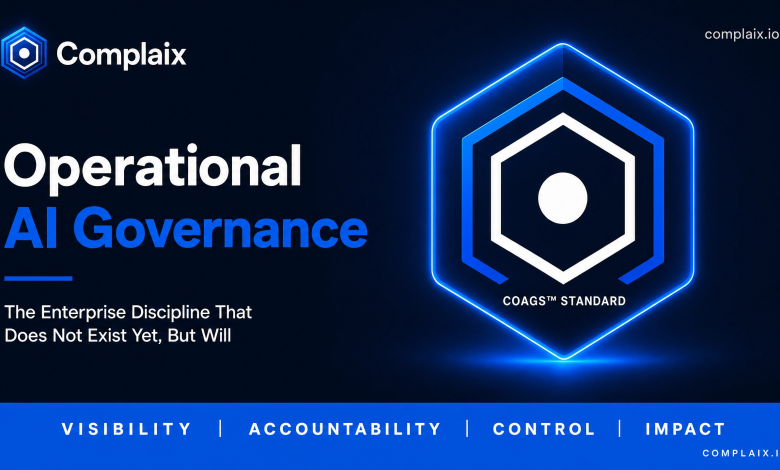
Most enterprises are still treating AI governance as a document exercise. The ones ahead of regulators, auditors, and their boards in 12 months are the ones building the operational layer now.
The Shift Nobody Has Made Yet
AI governance is about to go through the same transformation that information security went through a decade ago: from a compliance checkbox to an operational discipline embedded in how organisations run.
Think about what information security looked like before that shift. Organisations had security policies. They had annual audits. They had a document that said what they intended to do. What they did not have was continuous monitoring, live threat detection, incident response infrastructure, or board-level visibility into what was happening across their systems.
Then the shift happened. Security became operational. And every serious organisation built the infrastructure to match.
AI governance is at that same inflection point right now. Most enterprises have a policy. Most have a framework. Very few have the operational infrastructure to make that governance real, continuous, and demonstrable. That is the gap, and it is the most significant unaddressed risk in enterprise AI today.
What Operational AI Governance Actually Is
Operational AI Governance is not a framework. It is not a policy document. It is the infrastructure layer that sits between your AI governance intentions and your actual AI operations. It is the system that makes governance happen every day, not just at audit time.
It answers the questions that matter in practice:
Where is AI deployed across your organisation right now?
Who is accountable for each AI-influenced decision?
What risks are active and what is being done about them?
Can you demonstrate your governance posture to a regulator, an auditor, or your board today, not in six months when the review cycle completes?
Most organisations cannot answer these questions. Not because they lack intent, but because they lack the operational infrastructure to make governance real.
Why We Built Complaix
When we looked at the market, we found tools for writing AI policies, massive enterprise GRC platforms with AI modules bolted on, and a growing library of frameworks and guidance documents. What we did not find was a platform built specifically for the operational layer: the continuous, live, day-to-day infrastructure that makes governance more than a document.
So, we built it. We developed COAGS™ (Complaix Operational AI Governance Standard), the first structured framework for Operational AI Governance, and built the Complaix OS platform to operationalise it. Not as a compliance tool. As an operational system.
What Makes This Different
Most governance approaches treat AI as something to be documented. We treat it as something to be operated.
Complaix is built around four pillars.
Visibility: knowing where every AI system is deployed across the organisation.
Accountability: establishing clear human ownership for every AI-influenced decision.
Control: embedding governance into daily workflows so it runs continuously, not periodically.
Impact: measuring the actual outcomes AI is creating so governance can be reported, not just claimed.
These are not complicated concepts. They are the same principles good management applies to any business function. The difference is that nobody had built the infrastructure to apply them specifically to AI, until now.
Why Now
The EU AI Act, ISO 42001, and FCA AI principles are creating a compliance deadline. But the real shift is not regulatory. It is operational. Organisations do not just need a policy. They need continuous visibility into where AI is deployed, clear human accountability for every AI-influenced decision, and live evidence they can put in front of a regulator tomorrow.
That infrastructure does not exist in most enterprises today. The organisations building it now will be the ones ahead of the curve. The ones waiting will be building under pressure, in response to something that has already gone wrong.
Operational AI Governance is not a future discipline. It is the missing layer in every enterprise AI strategy that exists today. The frameworks are in place. The question is whether the operational infrastructure to make them real will follow.
That is the work that matters now.

Lucas Daidimos is the Founder and CEO of Complaix, the operational AI governance platform for regulated industries. Complaix developed the COAGS™ Standard and built the Complaix OS to help organisations implement Operational AI Governance in practice. Learn more at complaix.io.