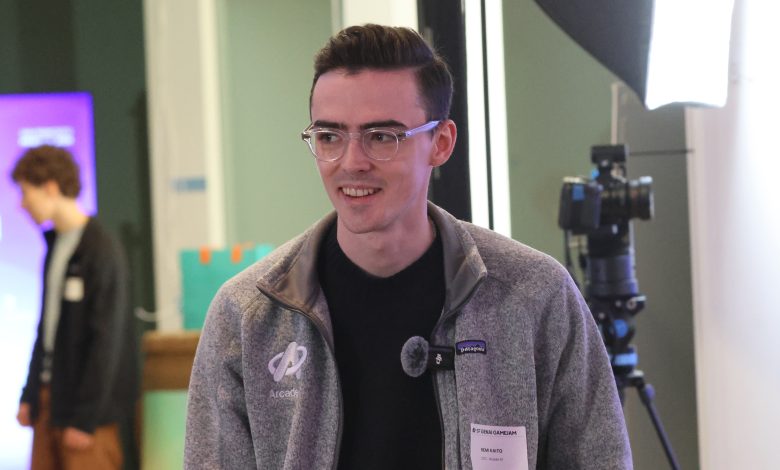
Remi Mouton started his first company at only 15 years old, building custom Minecraft experiences for a community he knew well because he was part of it. A decade later, he is co-founder and CEO of Arcade AI, a browser-based game engine that uses AI to let anyone create and share games without writing code or installing anything. His ten-person team works between Paris and San Francisco, and the platform has passed 10,000 users in early access, with a waitlist several thousand deep and around 100 new creators onboarding each week.
Mouton argues that the conversation around AI in creative industries has fixated on production speed while overlooking the question that actually decides what people play, share, and return to. When we asked him what the headlines are missing, his answer was one word: fun. We spoke with him about why games have been the hardest medium for AI to crack, what Arcade’s users make when the production barrier drops, and why he expects the middle of the creative market to get squeezed over the next five years.
You’ve built Arcade AI on the premise that gaming is about to go through the same production shift that hit photography, video, and music. What is the pattern that connects those earlier shifts, and where is gaming actually different?
The pattern is always the same: a creative medium moves from being controlled by people with production access to being shaped by people with creative instinct.
Before YouTube, creating a show required a team, capital, equipment, distribution, and access to a broadcast channel. Then the smartphone and the internet collapsed that barrier. It created a lot of low-quality content, of course, but it also created an entirely new entertainment economy, with world-class creators in every niche.
I believe gaming is going through the same shift, but gaming is different because a game is not linear content. A video, a song, or a photo is something you consume. A game is a system you operate. The creator is not just producing one finished piece of content; they are designing rules, feedback loops, interactions, edge cases, player choices, and emotional moments that can unfold in many different ways.
That is why gaming has been slower to democratize. The production barrier is not only “Can you make the assets?” or “Can you write the code?” It is “Can you create a system that is fun when another human being touches it?” That is the real shift Arcade is trying to unlock: not just letting more people generate game content but helping creative people build playable systems.
Why has gaming been the hardest creative medium for AI to crack?
Gaming is probably the hardest creative medium because it sits at the intersection of almost every other medium. A game can need writing, art direction, 3D assets, animation, music, sound design, code, physics, multiplayer, progression, economy design, UI, and performance optimization and all of these pieces have to work together in real time.
But the deeper challenge is not just technical. The deeper challenge is the gap between taste and execution.
A lot of people have great creative taste. They know what feels cool, what world they want to build, what kind of experience they want players to have. But that does not automatically make them game creators. A good creator is not always a good game designer, because games require thinking in systems. You have to understand what the player will do, what they will try, where they will get bored, where they will feel rewarded, and why they will come back.
That is the problem Arcade is built around. AI can reduce the technical layer, code, assets, mechanics, deployment, but the more interesting question is how you help someone develop game creation instincts. The engine should handle more of the technical execution and good game development practices, so the person can focus on the design instinct: what is fun, what is social, what is surprising, and what makes people want to play again.
What is the most important shift in AI and creative industries that the current headlines are missing?
Fun.
Most of the conversation around AI in creative industries is about productivity: making things faster, cheaper, or easier. That matters, but I think it misses the point. In entertainment, the final output does not win because it was efficient to produce. It wins because people care about it, share it, return to it, or feel something from it.
The same is true for the creation process itself. We have spoken with more than 200 users, have several thousand people on the waitlist, and are onboarding around 100 new early-access users every week. Across those conversations, one thing comes back again and again: generating code is not enough.
People do not want creation to feel like filling out a technical form and waiting for an output. They want interaction. They want play. They want personalization. They want the process of creating a game to feel almost like playing a game.
That became one of the clearest product signals for us. We shifted toward building our own engine with creation mechanics that feel more like a mix of Minecraft, Garry’s Mod, and The Sims than a traditional AI code-generation tool. The goal is not just to let people generate a game. It is to make the act of building feel alive, tactile, and fun, with an AI companion that helps you create in a more interactive, almost Tamagotchi-like way.
We are still in early access, but the signal is already very clear: people do not just want AI to create for them. They want AI to help them create in a way that feels alive, personal, and fun.
The other thing we see constantly is the demand for deeply personal worlds. People do not just want generic AI-generated games. They want to create worlds that feel like them: adding their pets, creating NPCs inspired by themselves or their friends, building places, characters, and stories that connect to their own lives.
That is the shift I think people are missing. AI-native creative tools will not only make production more accessible. The best ones will make creation itself more fun, more interactive, and more personal. They will help people discover what is actually fun, not just what is technically possible.
Arcade’s users are creating and sharing games in the browser with no install and no code. What have you learned from that user base about what people actually make when the production barrier collapses?
What we have learned is that when the production barrier collapses, people do not only try to recreate traditional games. They start mixing ideas that would normally never be put together.
That is one of the most interesting things about AI-native game creation: the creation space feels almost unlimited. One pattern we see in user conversations is that people naturally combine references that would normally never be put together. They do not just say, “I want to make a Pokémon-style game.” They describe ideas that are much more personal and strange: creatures inspired by their own pets, mixed with mechanics from racing games, shooters, horror games, or completely different genres.
These are not always finished public games yet, but they are very strong signals about what people want to create when the barrier drops. The ideas are often personal, specific, and a little weird, but that is exactly what makes them interesting.
That changed how we think about Arcade. It cannot just be an engine for building known game formats. It has to support strange combinations, personal references, and genre remixing from the beginning.
In a traditional studio environment, many of those concepts would probably never survive the production process. They would be considered too niche, too weird, or not commercially obvious enough. But when anyone can build and test quickly, those strange combinations become possible. People can create games around their own references, their own humor, their own friends, their own animals, and their own worlds.
That changes what user-generated games can become. It is not just a cheaper version of traditional game development. It is a remix culture for playable experiences. People can take inspiration from games they already love, combine genres, personalize characters, and invent mechanics around ideas that would have been too small or too unusual to justify a full production team.
That is why I think the future of AI-native game creation will produce a lot of surprising formats. Some will be weird, some will be low-quality, but some will be genuinely new and fun because they come from combinations that traditional production would never have allowed.
What do most founders building consumer AI get wrong?
They focus too much on access, and not enough on creative guidance.
People already know, more or less, that AI can help them create almost anything. There are AI tools for building apps, generating short films, creating images, composing music, writing stories, designing characters, and producing code. The question is no longer only, “Can I make this?” The harder question is, “How do I make it good?”
That is where I think many consumer AI founders miss the real problem. They assume the main barrier is technical. But for most people, once the technical barrier starts to fall, the creative barrier becomes much more visible. Where do I start? What should the first version look like? How do I design a level? How do I make the first thirty seconds fun? How do I turn a personal idea into something other people can understand, play, and enjoy?
In games, this matters even more. Someone might have a very personal idea: a world inspired by their pets, their friends, their humor, or a strange mix of genres they love. That personal starting point is powerful, but it is not enough to make a good game. The product has to help shape it into something playable, structured, and emotionally strong.
So, I think the next generation of consumer AI companies will not win by simply saying, “We let anyone create.” They will win by helping people become better creators. The product has to preserve the user’s personal vision, but also guide them through the creative decisions that make the final experience good.
Accessibility opens the door. Creative guidance turns the idea into something worth sharing.
Five years out, which parts of the creative economy get reshaped most by AI-native production tools, and which parts hold up better than people expect?
Every creative industry will be completely reshaped.
The biggest change is that technical execution will stop being the main barrier to entry. Today, a lot of creative industries are still protected by production complexity: knowing the tools, hiring the team, understanding the pipeline, having the budget, and being able to execute at a professional level. AI-native production tools will progressively remove a large part of that barrier.
That does not mean everything becomes good. It means many more people will be able to reach a baseline level of quality. The same way UGC changed video, I think AI-native UGC will change games, film, animation, music, and interactive entertainment. Over time, user-generated content will become more powerful, more personalized, and much higher quality.
We are already seeing early signals of this in music. AI-generated songs are no longer just technical demos; some are reaching real audiences and millions of listens online. That does not mean AI replaces great artists, but it shows how quickly the baseline of production can move when creation tools become accessible to anyone.
But I do not think big productions disappear. I think the bar for them becomes much higher.
Large studios will no longer be able to win just by making a “good” film or a “good” game. If millions of people can produce high-quality creative work with AI, then the largest studios will need to justify their existence by creating something truly exceptional: stronger IP, deeper worlds, cultural moments, and experiences that feel impossible to replicate.
You can already see the beginning of that in gaming with the way the biggest franchises are positioned. The largest studios will not win only through graphics or technical execution. They will win when they can create scale, world-building, cultural relevance, and the feeling that a release is a true event.
So, the future is not that professional production disappears. The future is that average professional production becomes much less valuable. The middle of the market gets compressed. Small creators become much more capable, and the biggest studios have to become extraordinary.
In five years, the creative economy will not just be cheaper or faster. It will be more polarized: millions of AI-native creators on one side, and a smaller number of major studios that survive because they own powerful IP and create experiences that are genuinely unique.