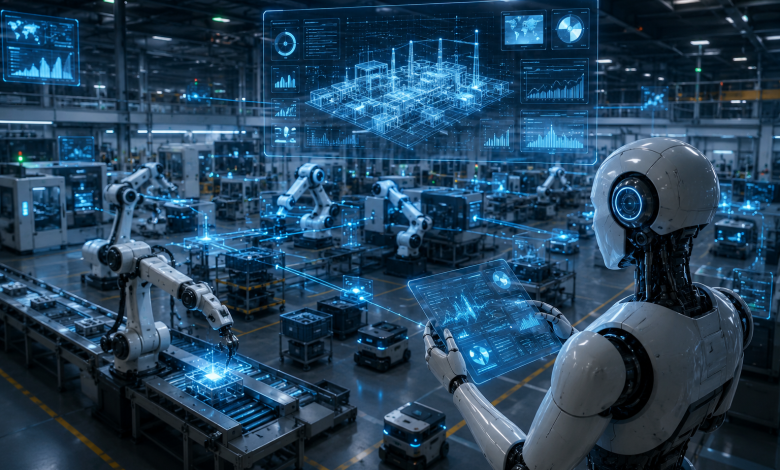
Most factories struggle because automation in their systems is reactive and not predictive. Rule-based systems wait for a trigger and provide a fixed response. Agentic AI breaks that pattern. It does not wait for instructions, perceives the industrial environment, reasons through hard constraints, and takes goal-directed actions. These actions are deployed across software and hardware ecosystems.
This is the key differentiation. Traditional AI is reactive, and, in comparison, the use of agentic AI in manufacturing is more goal-oriented. Think of it as an autonomous digital coworker that runs an entire end-to-end workflow, holds its objective steady, and rewrites its own strategy the moment the floor throws a disruption at it.
This article focuses on what agentic AI in manufacturing is, how it works, and most importantly, what the use cases are that you need to know.
What is Agentic AI in Manufacturing?
Agentic AI in manufacturing is a goal-driven autonomous system that independently makes decisions, plans, and executes multi-step workflows across operational systems. The development of agentic AI in manufacturing creates a goal-driven autonomous system that independently makes decisions, plans, and executes multi-step workflows across operational systems.
How does Agentic AI actually run a Factory?
Agentic AI stops managing isolated tasks and starts running a continuous observe-reflect-plan-act loop. Autonomy comes from several integrated layers, each doing one job.
LLMs as the reasoning engine
The Large Language Model is the orchestrator, the brain of the stack. Hand it an ambiguous goal like “optimize the production schedule for energy efficiency,” and it decomposes that into executable sub-tasks, then picks the exact external tools or APIs each step needs. No human breaks the goal down. The model does.
Multi-Agent Systems and the SISNA cycle
One AI rarely runs a real plant. Manufacturing uses Multi-Agent Systems, where specialized agents collaborate under the Sense, Interpret, Score, Negotiate, Act(SSNA) protocol. It is a structured, AI-driven framework for intelligent, adaptive decision-making. Agents ingest sensor data continuously, calculate task urgency, and then negotiate over shared resources like machine availability or technician time before they execute.
A single predictive maintenance workflow can put an orchestrator agent, a monitoring agent, a scheduling agent, and a safety guardian agent in the same room, arguing it out.
Semantic grounding via the Asset Administration Shell
AI models sometimes guess or make things up. In a factory, a bad guess isn’t just annoying; it is dangerous. The Asset Administration Shell (AAS) stops these dangerous guesses. It acts as a digital profile attached to physical machines. Instead of letting the AI guess, the AAS tells it exactly what is going on by providing:
- Exact technical details about the machine.
- Real-time data from sensors.
- Strict safety limits that cannot be crossed.
Because the AI has this factual data, it always knows exactly how the machine is running and how to keep it safe.
Tool integration via Model Context Protocol
Legacy systems are not on the same page. To help meet this need, a new integration pattern, the Model Context Protocol (MCP), is becoming more popular. Even though not standard for all factories, MCP provides a standard to securely read SCADA platforms, query databases, and update MES and ERP systems in real time, thus significantly reducing the need for a custom-coded connector to be created for every individual tool.
Deterministic execution
AI is probabilistic, so it never touches low-level machine registers directly. That restriction is deliberate. Instead, the agent proposes actions through secure execution layers like OPC UA Methods, which carry validated, hard-coded safety logic inside the factory’s Programmable Logic Controllers. Ask for a temperature or speed setting outside the safe range, and the machine rejects the command. No negotiation.
Mandatory Human-in-the-Loop governance
Autonomy has a ceiling, and in high-stakes manufacturing, that ceiling is enforced. Cryptographic approval gates restrict the AI from proposing plans. No physical machine actuates until a human explicitly authorizes it. That structural constraint keeps accountability and final oversight with the operator, where critical operational decisions belong.

Agentic AI vs. Traditional Automation in Manufacturing
Here is a comparison of how agentic AI and traditional automation differ in manufacturing.
| Capability | Traditional RPA | Predictive Analytics | Agentic AI |
| Core Behavior | Follows strict, pre-defined rules step-by-step. | Analyzes historical data to forecast future outcomes. | Pursues open-ended goals through multi-step reasoning. |
| Autonomy Level | Executes only what it is explicitly programmed to do. | Provides insights, but requires a human to take action. | Makes and executes decisions independently to reach the goal. |
| Handling the Unexpected | Halts operation and requires human reprogramming. | Flags the anomaly and waits for human intervention. | Evaluates the new context and adapts its approach. |
| Primary Output | A completed, repetitive administrative task. | A statistical probability or recommended action. | An executed business outcome, plus learning for next time. |
The takeaway for an operations leader is simple. Automation finishes tasks you’ve already mapped. An agent chases an outcome you care about and works out the steps itself. Different categories of tools. And it asks for a different kind of trust.
Top Agentic AI Use Cases in Manufacturing That Drive Real ROI
The use cases worth your time all share a tell. Each hits a decision that’s slow and reactive and costs money, usually because somebody’s stuck babysitting it. Five have outgrown the demo and actually run in production now.
Predictive Maintenance Orchestration
It is not the loss of a factory when a machine malfunctions, but the losses that occur after. Agentic AI addresses this problem because it acts as a complete response loop and not just an indicator of a malfunction to wait for human intervention. In case there is a wear alert, the AI system will assess the probability of risk, schedule production downtime, procure a spare part from the inventory, and generate the job ticket.
Unplanned Downtime Reduction
Scheduled maintenance doesn’t cost a factory money; an unscheduled stop does. Agentic AI changes the way operations are performed, from firefighting to elimination. The agent continually monitors machine telemetry, such as vibration and thermal drift, to determine when a machine is about to fail, automatically reschedules active jobs to healthy machines, and arranges that the machines get the maintenance window before the line ever slows down.
Spare Parts Inventory Optimization
Capital tied up in dormant spare parts is wasted, but a missing part during a breakdown is catastrophic. The inefficiency lies in static minimum-maximum ordering rules. Agentic AI bridges this gap by connecting live machine wear data with supplier lead times. It dynamically models failure probabilities and autonomously orders the exact parts needed just in time, slashing carrying costs while guaranteeing the right component is ready when the wrench turns.
Adaptive Supply Chain and Procurement
Procurement teams aren’t slow because they’re careless. They’re slow because the signals arrive faster than spreadsheets can absorb them. Agentic frameworks watch supplier risk, tariff shifts, and commodity prices in real time. They pull pricing from vendor quotes, check it against internal cost models, update ERP cost sheets, draft RFQs, and re-issue purchase orders on their own.
Production Rescheduling During Supply Disruptions
Not a single order is delayed when a materials shipment is delayed; the whole floor is delayed. No one can make up a schedule by themselves at the pace that human planners need. If a port strike or vendor delay occurs, the AI agent then compares the raw materials available with the delivery priority and re-schedules the entire assembly line dynamically, ensuring the machines are fed and throughput remains stable.
Autonomous Quality Control and Defect Mitigation
Catching a defect after the batch ships is the expensive way to learn. Agentic AI ingests defect reports and computer vision data, classifies each anomaly against industry standards, and writes the compliance report automatically. Spot a critical deviation, and the system corrects upstream machine parameters itself: temperature, timing, mixing speed, before the batch is lost.
Vision-Based Defect Detection
Human inspectors don’t miss flaws because they lack skill; they miss them because eye fatigue sets in at line speeds. Agentic AI pairs high-speed camera feeds with autonomous reasoning. It doesn’t just flag a micro-fracture or a misaligned seam—it instantly isolates the defective unit, logs the specific visual anomaly, and sends recalibration parameters to the upstream machinery to stop the error from repeating on the next pass.
Engineering and Product Development Acceleration
Engineering delays rarely come from the design. They come from everything that has to stay in sync around it. AI agents pull structured data from technical documents and drawings, validate it, and push updated Bill of Materials versions across every connected system. They also generate design alternatives and run complex virtual simulations before anything physical gets built.
Energy and Resource Optimization
Energy-intensive plants don’t overspend because they run hot. They overspend because they run blind to the grid. Agentic AI aligns production with external grid pricing, demand, and environmental targets in real time. It shifts heavy loads into off-peak or green windows and makes micro-adjustments to hardware without cutting total output.
Dynamic Production Scheduling
Scheduling agents orchestrate work-in-progress status, machine utilization, inventory, and labor capacity continuously. When a disruption hits, the system recalculates priorities and re-sequences the assembly line instantly, keeping throughput on target.
Workforce Intelligence and Automated Reporting
Factory leaders don’t lack data. They drown in it, scattered across maintenance logs, quality records, and supervisor updates. Agentic AI pulls across all those systems and generates shift summaries, WIP updates, and compliance records on demand. The hours once spent compiling reports go back to running the floor.
What the Data Shows About Agentic AI Adoption?
Ambition isn’t the bottleneck in industrial AI this year. Execution is, and the gap between the two is the real story. Writing the cheque is the easy part. Embedding the system into daily operations is the grind that separates leaders from spenders. The plants pulling ahead aren’t the ones spending the most. They’re the ones who fixed the data foundation before scaling anything on top of it.
- A McKinsey survey of operations leaders found that most have invested in AI, yet only 2% have fully embedded it across operations. The same work puts 23% of manufacturers at the stage of scaling agentic AI somewhere in the enterprise, with another 39% still experimenting.
- Deloitte’s 2025 Smart Manufacturing survey of roughly 600 executives tells a parallel story: plenty of pilots, far fewer deployments that reach the facility or network level.
- Gartner predicts 60% of supply chain disruptions will resolve without human intervention by 2031. Read that as a direct signal of where autonomous decision-making is headed on the floor.
The Agentic AI Manufacturing Roadmap: From Pilot to Autonomous Factory
You don’t buy your way into an autonomous factory. You earn it in stages, and skipping one is exactly how the budget evaporates. The sequence that holds up in practice runs in four steps.
1. Data infrastructure readiness
Before you deploy the agentic AI in manufacturing, your operational data should be clean and structured. Without accurate data, the agentic AI systems will be trained on information that does not support your automation goals.
2. Single-agent pilots
Pick one tight, high-ROI use case, like predictive maintenance or vision quality on a single line. Prove the loop works. Earn organizational trust before going wider.
3. Multi-agent coordination
Deploy agents across functions like maintenance, scheduling, and supply chain, and share context under an orchestrator that coordinates them. This is where the compounding value starts.
4. Autonomous factory
Deploy human-in-the-loop operations, where your employees set objectives and govern exceptions while agents run the routine decisions. The timeline for these deployments needs to be conservative because the constraint was never the model. It was adoption, integration, and trust.
What Are the Challenges of Agentic AI Deployments in Manufacturing
Most agentic failures aren’t the model’s fault. They’re organizational and infrastructural, and they keep surfacing in the same five shapes. Naming them upfront is the cheapest insurance a program can buy.
- Data infrastructure unreadiness. Starve an agent of clean, live data, and it becomes dead weight. You can’t run an autonomous system on a foundation built for monthly reporting.
- The OT/IT integration gap. The average factory is a quilt of SCADA boxes and PLCs built decades ago for stability and isolation, not real-time sharing or anything resembling AI reasoning. Bridging that divide is the single biggest barrier, and it’s where most deployments lose momentum without specialized AI development services to architect secure communication between legacy SCADA systems and modern LLMs.
- Unclear business value definition. “Deploy agentic AI” isn’t an objective. “Cut unplanned downtime on line three by 30%” is. Vague goals produce pilots that can’t prove they worked.
- Change management and workforce readiness. Operators who don’t trust the agent will override it, at which point it’s worth nothing. Adoption is the variable that decides outcomes. Capability seldom is.
- Governance and safety guardrails. Autonomous action on a physical floor needs clear boundaries, audit trails, and escalation rules from day one. Bolt them on late, and the program either stalls in review or creates risk nobody owns.
The fix isn’t more technology. It’s laying the foundation before reaching for the autonomy, which is exactly what the staged roadmap above is built to enforce.
Conclusion
Agentic AI in manufacturing isn’t a faster version of the automation you already run. It changes who makes the routine call on the floor, and that shift is why it’s harder to adopt and worth more when it lands. Predictive maintenance, quality control, supply chain optimization, scheduling, and energy management all have production-proven agentic deployments today. The differentiator was never the algorithm. It’s whether your data, your integration, and your governance are ready to let an agent act.
Author Bio:
Prashant Pujara
Prashant Pujara is the CEO of MultiQoS, a leading software development company, helping global businesses grow with unique and engaging services for their business. With over 15+ years of experience, he is revered for his instrumental vision and sole stewardship in nurturing high-performing business strategies and pioneering future-focused technology trajectories.