Enterprise software is entering its next major transition. The decisions organizations make about artificial intelligence today will determine whether AI becomes a true operating advantage or simply another layer of digital assistance added to already complex systems.
Across industries, enterprise software vendors are racing to add generative AI capabilities to their platforms. Copilots, chat interfaces, content generators, and recommendation engines are quickly becoming standard features. These tools can help users find information faster, summarize data, and complete routine tasks with less effort.
But that is not the same as operational transformation.
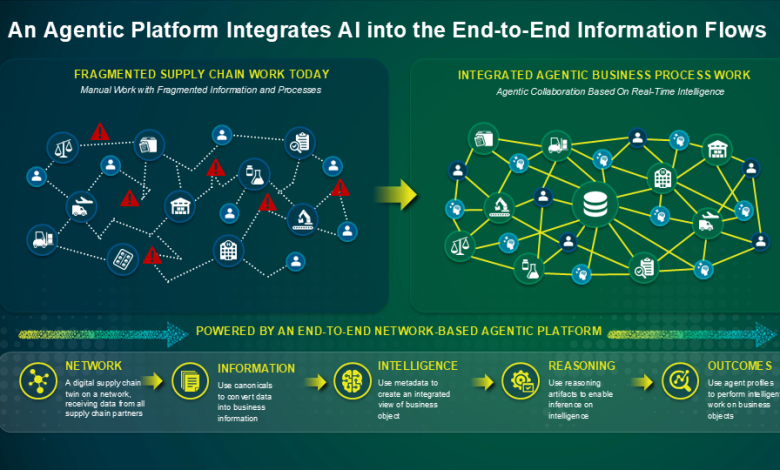
The challenge is that much of today’s enterprise AI is being added to platforms that were never designed to support always-on operations by continuously managing and performing work. These systems can help people understand what is happening, but they still depend on people to keep cross-company work moving.
A shipment is held because the required documentation is missing. A supplier changes a delivery date, but the update does not reach the teams that need to respond. A production plan is disrupted because a material availability signal arrives too late. An invoice cannot be settled because the purchase order, receipt, shipment record, and pricing agreement do not match.
In each case, the business does not simply need another summary, alert, or dashboard; it needs work to be performed based on knowledge and intelligence required to make decisions.
That is the next frontier for enterprise software. The future will not be defined by systems that only assist users. It will be defined by agentic operating models where governed agents become first-class participants that augment human teams and provide specialized digital expertise across business operations.
The Limits of Bolt-On AI
Most organizations are approaching AI the same way they have approached past technology shifts, adding new capabilities to existing platforms and expecting significant gains in productivity, efficiency, and decision-making.
In the near term, that approach can be useful. A customer service representative can ask an AI assistant to summarize an account history. A supply planner can ask for a list of open exceptions. A finance analyst can use AI to compare invoices against contract terms.
These improvements reduce time spent searching, reading, and preparing information. But they do not fundamentally change the operating model or create a sustainable competitive advantage.
In most enterprises, work still depends on people moving between applications, comparing records, interpreting business rules, contacting partners, escalating issues, and deciding what should happen next. AI may help them move faster, but it does not fundamentally change the burden of coordination.
That burden is becoming harder to sustain. Enterprise operations now span more systems, teams, partners, geographies, regulatory requirements, and customer commitments than ever before. A single business event can have consequences across planning, procurement, manufacturing, logistics, finance, compliance, and customer service.
When a supplier misses a confirmed delivery date, the issue is not limited to one purchase order. It may affect production schedules, inventory projections, customer allocations, transportation plans, revenue expectations, and service commitments. When a shipment arrives short, it may trigger claim activity, replenishment decisions, invoice holds, compliance review, and customer communication.
Traditional enterprise platforms were built to digitalize records, standardize processes, and help users work more efficiently. It was a major leap forward, but it still left people responsible for bridging the gaps between systems, partners, and business functions.
Bolt-on AI does not solve that structural problem. It makes the existing model easier to navigate, but it does not change the model itself.
From Assistance to Participation
The next generation of enterprise software requires a different operating model that supports always-on operations and human-agent collaboration.
In an agentic model, AI agents are not peripheral assistants sitting beside the platform. They are governed digital teammates within business processes, with defined roles, permissions, rules, escalation paths, and operating boundaries. They can monitor business activity, interpret context, evaluate options, and perform approved work on behalf of the business.
This is the difference between AI that helps a person identify an exception and AI that helps resolve the exception before it disrupts downstream activity.
Take, for example, an allocation-controlled customer order. A traditional system may surface the order status, a dashboard may highlight an inventory constraint, and a copilot may summarize relevant customer or product information. But determining the right response still requires coordination across allocation rules, inventory commitments, open orders, customer priority, approved substitutions, and supply constraints.
In an agentic operating model, a governed agent can evaluate the same situation in context. It can identify the discrepancy, compare the order against allocation rules, assess inventory commitments, determine whether substitutions or partial fulfillment are permitted, notify stakeholders, and either take the approved next step or escalate when human judgment is required.
Context, Knowledge, and Inference Are Critical
Agentic enterprise software is not simply software with an AI interface. It requires a platform architecture designed for intelligent, governed execution.
Agents also need business context, not just access to isolated data. Enterprise operations are networks of related business objects—including orders, inventory, shipments, invoices, forecasts, approvals, exceptions, and service commitments.
Using inference, agents can determine what information is needed, access the appropriate business context, and evaluate actions within approved business guardrails.
For example, a late shipment is not simply a transportation issue. It may affect customer orders, warehouse releases, carrier appointments, delivery commitments, and revenue recognition. The platform must provide the semantic understanding required to reason across those relationships.
A deductions analyst reviewing a short-paid invoice may need to compare contract terms, delivery records, shipment quantities, proof of delivery, pricing agreements, and customer claims. A governed agent can evaluate those relationships, identify missing information, prepare a recommended response, and escalate unresolved exceptions when necessary.
This is where many AI initiatives will succeed or fail. Without trusted operational context, agents may generate plausible recommendations that are incomplete, inconsistent, or unsafe to act upon. With the right context, governance, and controls, agents can move from generating suggestions to performing work.
Business-Configurable Agents Enable Scale
For agentic systems to scale across the enterprise, organizations need a practical way to define what agents are responsible for, what decisions they can make, and where human oversight is required.
This is where business-configurable agent design becomes important for building an elastic workforce. Rather than requiring developers to build every operational workflow from scratch, business teams should be able to define agents using a structured model that specifies the agent’s intent, objectives, tasks, decisions, and rules.
Consider an order evaluation and acceptance agent used in commerce operations. Its intent may be to validate customer orders for allocation-controlled products. Its objective is to maximize compliant fulfillment while preventing over-allocation and inventory imbalance.
The agent’s tasks might include reviewing customer demand against allocation commitments, evaluating approved returns activity, and assessing downstream transactions that could affect fulfillment. Based on that analysis, the agent can determine whether an order should be fulfilled as requested, partially fulfilled, rejected, or escalated for human review. The agent’s actions are governed by explicit business rules and guardrails. It cannot exceed allocation entitlements, override approved policies, or make decisions outside its authorized scope, and every action remains fully auditable.
This approach allows organizations to translate operational knowledge into specialized digital expertise that can be applied consistently and at scale. Instead of relying solely on custom software development or informal institutional knowledge, enterprises can define how routine operational work should be performed and continuously refine that behavior as business conditions evolve.
The Transformative Value of Agentic Operations
The cost of getting AI wrong is not simply missed productivity. It is the loss of shareholder value, market share, profitability, and competitive advantage.
Every delayed order decision, unresolved invoice discrepancy, shipment exception, supplier change, inventory mismatch, or missing document creates downstream work. Teams investigate, reconcile, escalate, coordinate, and communicate across functions and trading partners. As delays accumulate, so do the business consequences: service risk, excess inventory, avoidable cost, compliance exposure, revenue leakage, and customer dissatisfaction.
This is where the value of agentic operations becomes measurable. Agentic platforms do not simply help users understand operational complexity; they reduce the time, effort, and cost required to act on it.
Recent research from BCG, McKinsey, and Deloitte suggests that agentic AI and intelligent agents can accelerate business processes by 30% to 50%, reduce low-value work by 25% to 40%, improve operational responsiveness, and unlock productivity gains beyond traditional automation initiatives.
Similarly, TraceLink research indicates that organizations adopting more agentic approaches to operational execution can achieve 20% to 30% inventory reductions, 10% to 20% improvements in working capital, and 15% to 20% productivity gains.
These results matter because most operational processes are constrained not by a lack of data but by the human capacity required to continuously interpret information, coordinate across stakeholders, and determine what should happen next.
The opportunity extends beyond efficiency. Organizations can reduce exception backlogs, shorten cycle times, improve decision consistency, and free skilled employees to focus on higher-value work. More importantly, they can prevent operational delays from compounding into larger business problems.
As organizations become more effective at coordinating and performing work across processes and enterprise boundaries, the impact can extend to broader business outcomes. TraceLink research suggests these operational improvements can translate into 5% to 10% revenue growth and a 2x to 3x increase in EBITDA.
Companies that wait will continue to layer tools onto the same human-dependent operating model with only incremental improvements and technical debt. Companies that embrace agentic operations can redesign how work gets done. The long-term advantage will not come from giving every employee an AI assistant. It will come from deploying governed digital labor that participates directly in business operations and keeps work moving continuously.
That is the real cost of waiting: competitors will not simply move faster. They will thrive with a fundamentally different operating model while others are still trying to survive legacy approaches.