For years, brands have been told to digitise everything.
Build the app. Launch the platform. Create the virtual showroom, add a chatbot, make it immersive. And now, make it AI.
Some of it has created genuine value. A lot of it has simply created more things for audiences to ignore.
The problem isn’t the technology itself, it’s that the technology keeps arriving too late, or for the wrong reason. AI is still being treated as a marketing add-on. It becomes “the AI bit” rather than something that genuinely improves the experience.
Live experiences deserve better than that.
Rich and responsive
The most interesting opportunity for Generative AI and real-time rendering is not to make physical experiences feel more digital, but to make them richer and more responsive. This technology has the capacity to transform how we plan and build experiences long before an audience walks into the room. That’s where the AI application needs to move.
A great live experience is not a collection of moments stitched together. It’s a living system where audience flow, content, spatial design, lighting, sound, data, interaction and emotion all need to work in unison. When they do, the experience feels effortless.
This is where AI and real-time technologies can become genuinely useful. Not as decoration, but as tools for orchestration.
Imagine planning a major brand experience and being able to walk a client through the space before it exists. Not a static render and not a fly-through. A responsive simulation, one where you can test how people move through it, see where the energy drops, where queues form, and where a story point gets missed. You can explore different audiences and watch how the journey changes for each. You can help both the client and the creative team to understand your vision.
That matters because one of the hardest parts of live experience is alignment. Everyone thinks they understand the idea, but they’re often picturing a slightly different version of it. Real-time visualisation closes that gap early, when there’s still time to shape things.
Generative AI helps with the messy early stages of creative development, too. Not by replacing creative thinking, but by accelerating exploration.
Connection through character
What if the space responded differently to a VIP audience versus a public one? What if content is adapted around weather, location or live data? What if the story could be experienced through a host, a screen, a spatial interface or a conversational character? These production questions are pivotal to creating an engaging experience, and AI gives teams a faster way to work through them.
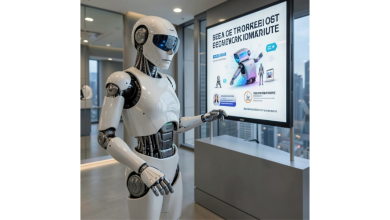
Part of this is experimenting with real-time characters, MetaHumans and AI voice agents. The interesting part isn’t that a digital character can talk, but what happens when a character becomes part of the experience system. When it can respond to a guest, shifting in tone and bringing a brand world to life. That’s when it stops being a novelty and can change how live storytelling works.
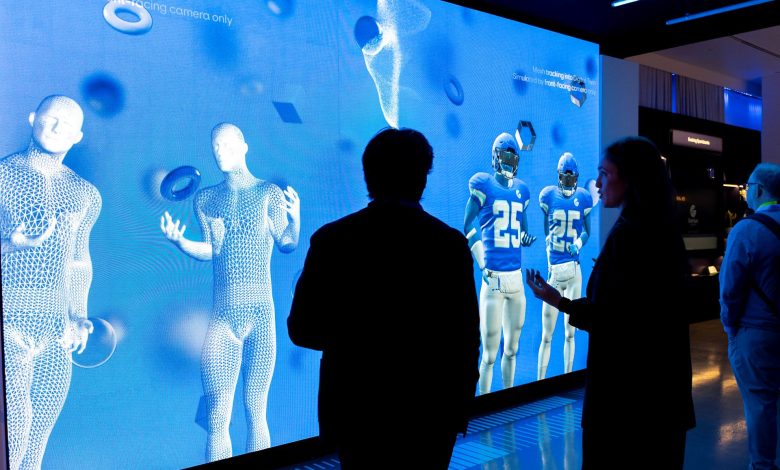
In a data-rich environment like a sports showcase, conversational AI could help visitors interrogate live information in natural language, rather than asking them to decode a dashboard or sit through a fixed presentation.
For more cultural spaces, an AI guide might help visitors ask better questions without taking attention away from the objects themselves. In a luxury automotive environment, AI and real-time rendering could help someone experience a product or commissioning choice in a context that actually feels personal.
The value of tech as craft
When a team truly integrates AI into experiences, the value isn’t “look, AI”, it’s “this experience understands what I need right now.”
That distinction matters.
Not every live experience needs to be adaptive and not every brand world needs a voice agent or a generated visual layer. Some experiences are powerful because they’re simple, crafted and fixed. A heritage brand might need technology to support the story, not perform over the top of it. The job is knowing where technology should speak and where it should stay quiet.
For CMOs and innovation leaders, “how do we use AI?” is the wrong question. It’s too broad, and it usually leads to gimmicks. The better question is where can intelligence make this experience clearer, more useful, emotional, or memorable? Sometimes the answer is in the public-facing moment, but often it’s behind the scenes.
The strongest uses of AI in live experience may be the ones audiences barely notice. That’s not technology as a trick. That’s technology as craft.
Creating living systems
The next great brand worlds won’t be built as campaigns. They’ll behave like living systems, designed, tested and refined through intelligent tools. They’ll use real-time technologies to make ideas visible sooner and AI to respond to people with more relevance and less friction.
And at their best, they’ll make the technology feel invisible, leaving the audience with something far more valuable than a clever demo: a live experience that feels coherent, human and alive.