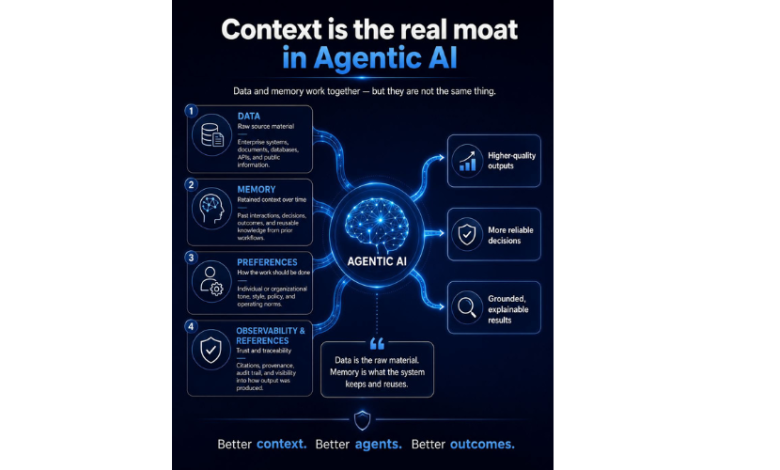
The race to deploy agentic AI has produced a familiar fixation: which model is best. Enterprises benchmark, vendors compete and technology leaders debate whether the edge lies with one foundation model or another. That conversation misses the point. As AI moves from answering questions to taking actions – drafting work product, making recommendations and orchestrating complex workflows – the quality of the output will increasingly depend not on which model sits at the center, but on the quality of the context wrapped around the agent.
Context is the harness. And most organizations haven’t built one yet.
What Context Actually Means
Context in agentic AI isn’t a single input. It’s a layered operating environment assembled from four distinct sources.
The first is data – the raw material that grounds an agent in reality. This includes enterprise systems, internal documents, databases, APIs, public information and trusted knowledge bases. An agent operating without relevant, timely data is functionally blind. It’s work product will be confident, coherent and wrong.
The second is memory – retained context accumulated over time. Prior interactions, decisions made, outcomes reached, feedback received and reusable knowledge from previous workflows all constitute the institutional memory an agent draws on to avoid repeating mistakes and to improve with use. Without memory, every engagement starts from zero. With it, the agent compounds.
The third is preferences – the operating norms that define how work should be done, not just what work should be done. Individual style, organizational policy, risk appetite, tone, templates, business rules, approval rules and workflow conventions all belong here. These are the constraints and signals that separate a generic output from one that is actually deployable. A draft that ignores legal review thresholds or a recommendation that contradicts established risk policy isn’t useful, regardless of how technically accurate it is.
The fourth is observability – the capacity to understand why something was produced, where information came from, which sources were used and how a decision was made. This is the accountability layer. In regulated industries and high-stakes environments, explainability isn’t a nice-to-have. It is the prerequisite for trust.
Why This Architecture Matters Now
Agentic AI is a fundamentally different paradigm from the AI most enterprises have deployed to date. A chatbot retrieves and responds. An agent plans, acts and iterates. That shift in capability creates a corresponding shift in risk – and a corresponding shift in what “good” looks like.
Prompting alone cannot carry the weight of enterprise-grade agentic workflows. Retrieval augmented generation (RAG) helps, but retrieval is only one slice of context. Automation frameworks add efficiency without adding judgment. What’s needed is a contextual operating layer that integrates all four elements – data, memory, preferences and observability – into a coherent environment the agent can reliably reason against.
The organizations building that layer now are quietly developing a durable advantage. Not because they have access to better models – those models are broadly available – but because they have invested in the infrastructure that makes models useful inside their specific operating context.
Context Is a Strategic Asset
Most discussions of enterprise AI strategy focus on model selection, compute infrastructure and integration architecture. Those decisions matter. But they are table stakes. The organizations that will sustain an advantage in the agentic era are the ones that treat context itself as a strategic asset – something to be curated, maintained and continuously improved.
That means investing in knowledge infrastructure, not just AI tooling. It means building feedback loops that allow agents to improve with use. It means encoding organizational knowledge – policies, preferences, norms and institutional history – in forms that agents can actually leverage. And it means putting observability at the foundation, so that every output can be audited, explained and trusted.
The model is the engine. Context is everything else. Better context produces better agents. Better agents produce better outcomes. That equation, more than any benchmark, will determine who wins.
Author Bio:
Toni Nijm is Chief Product Officer at Anaqua, a global leader in intellectual property management. With over 20 years of experience in IP law, technology, and SaaS innovation, Toni is passionate about building solutions that transform how IP professionals work.