In June 2026, Anthropic suspended Fable 5 — banned by a US export-control order and unavailable overnight — and the industry’s reaction was almost a reflex: well, guess we wait for the next one. That instinct — that frontier capability is always something handed down to you on someone else’s schedule — is the assumption worth questioning.
There’s a Fable 5 alternative that doesn’t wait for it. OrcaRouter’s Routing DSL is a bet on the opposite proposition: that you can build the frontier instead of waiting for it, reconstructing Fable 5–level output from the models you can still get.
A Fable 5–level endpoint, out of the box
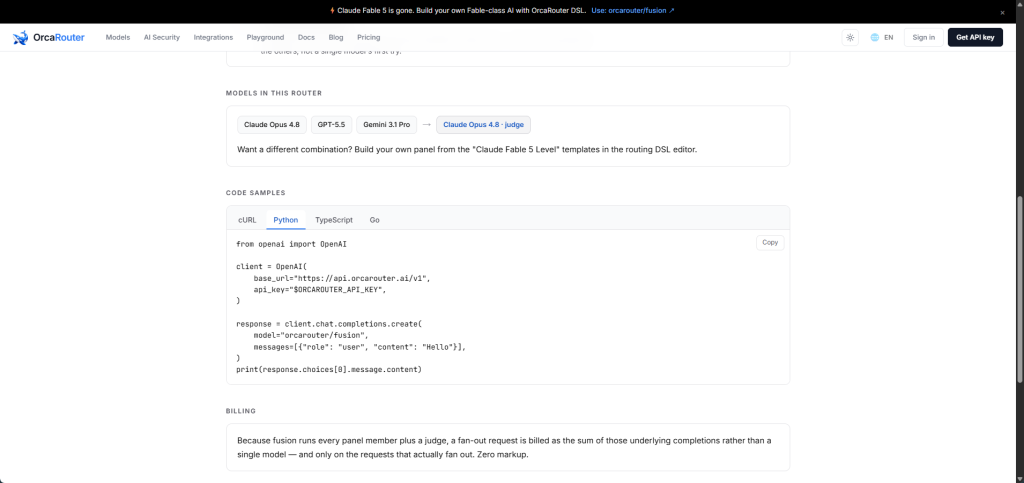
You don’t have to build any of this yourself to get the result. OrcaRouter ships the whole panel-composition strategy as a ready-made endpoint: set your model to orcarouter/fusion and you get Fable 5–level output out of the box — a pre-tuned Routing DSL that fans out to a panel of strong models and picks the best answer for you, with nothing to configure. It’s a drop-in, OpenAI-compatible endpoint — you point your app at OrcaRouter and use your OrcaRouter key, and your existing code keeps working unchanged across 200+ models, with no token markup.
A fan-out request is billed as the sum of its panel members plus the judge — only on the requests that actually fan out, and with zero markup.
That’s the out-of-the-box path. The deeper point is about posture — here’s why it matters.
Two years of one default
For about two years, “stronger AI” has been functionally synonymous with “the next bigger checkpoint.” Progress arrived as releases. You waited, a lab shipped, you upgraded, you waited again. It was a comfortable rhythm, and it trained a whole industry to treat capability as something you receive rather than something you construct.
But a second line of progress has been getting clearer the whole time, mostly out of the headlines: instead of chasing a single bigger breakthrough, orchestrate the models you already have into a system that collaborates and checks itself. On this line, capability stops being a model you’re handed and becomes a structure you design. The interesting unit of progress is no longer the checkpoint — it’s the topology.
A restricted checkpoint is a supply problem
That reframes what just happened to Fable 5. When a top model has its access tightened — restricted, pulled, gated by policy — what you’re facing is a supply problem: the best capability got scarcer. And orchestration is a supply answer.
The claim is precise and worth stating carefully: it’s not that any single model is Fable 5, and it’s not a reproduction of a specific weight set. It’s that Fable 5–level output — the thing you actually wanted — no longer has to depend on access to one particular, gated checkpoint. If the capability can be reconstructed from models you can get, then one vendor’s access decision stops being able to take that capability away from you.
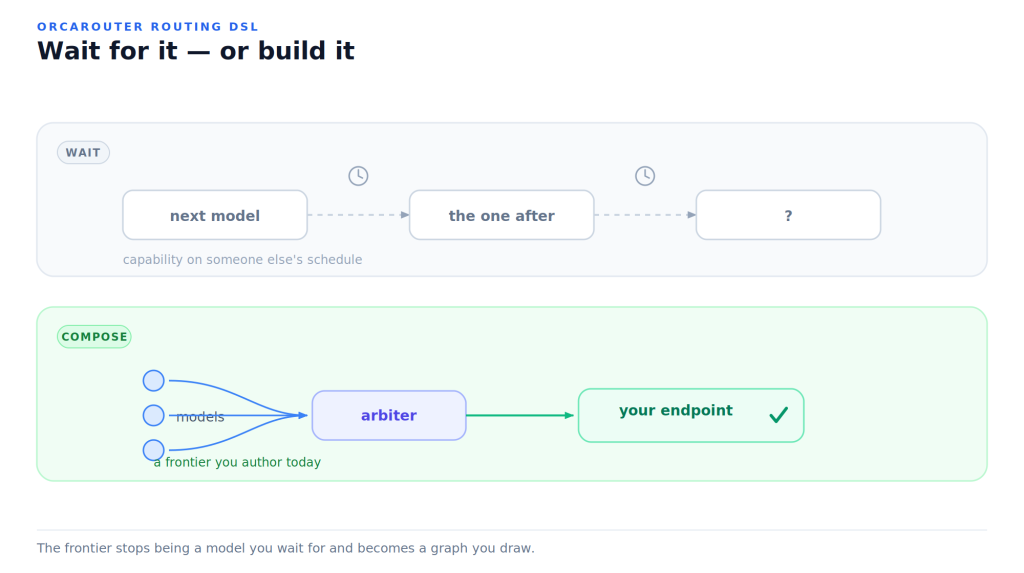
Wait for the next model, or compose a Fable 5 alternative now with OrcaRouter
The control dimension
There’s a second reason this matters beyond raw availability: ownership. A composed endpoint is something you control end to end. You write the rules. You choose which models sit on the panel. You set the arbiter and the fallback cascade. You can reproduce it exactly, audit every routing decision, and change it whenever you want.
Contrast that with depending on a single vendor’s checkpoint. There, your product’s capabilities live behind someone else’s release calendar, pricing decisions, and access policy — all of which can change without your input, as Fable 5 just demonstrated. When the frontier is a topology you author, your roadmap stops being hostage to events you don’t control. That’s not only a resilience argument; it’s a strategic one. Teams that internalize “we compose capability” will be structurally less fragile than teams whose plans assume continued access to one specific model.
The quiet shift in where the edge lives
Put these together and you can see a migration in where competitive advantage comes from. It used to be largely about selection — which model did you pick? Increasingly it’s about orchestration — how well do you combine the models everyone can access? Two teams with the identical model menu can now produce meaningfully different quality and cost profiles purely through how they route, fan out, arbitrate, and fall back. The DSL is where that skill gets expressed and accumulated.
This is a healthier place for the industry to compete, too. “Who has exclusive access to the biggest model?” is a game almost no one can win and that concentrates power narrowly. “Who orchestrates available models best?” is a game open to any competent engineering team, and it rewards understanding over access.
What composition doesn’t promise
Honesty cuts both ways, so it’s worth being clear about the limits. Composition doesn’t conjure a capability none of your models possess — if every model on the panel is blind to a domain, the panel is blind too; diversity only helps when the members genuinely differ. Fan-out also adds latency and spend on the requests it touches, which is exactly why you gate it by difficulty and watch it in shadow mode rather than fanning out everything. And a panel is only as good as its arbiter: a weak selector can pick the wrong answer even when a right one is present. None of this undercuts the thesis — it sharpens it. Orchestration is an engineering discipline with knobs and trade-offs, not a magic wand, and treating it that way is what makes it dependable in production.
Build, don’t wait
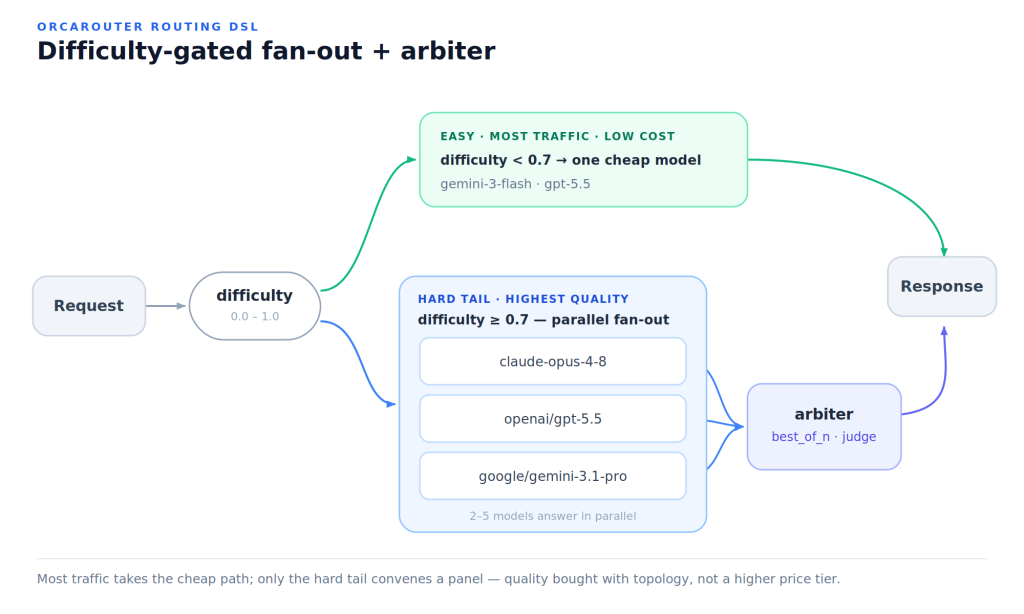
The frontier as a graph you author: difficulty routing, fan-out, arbiter
None of this requires a research lab. With OrcaRouter you express the orchestration in YAML, with CEL conditions: route by difficulty and task, fan out to a panel on the hard tail, add a judge and a fallback, and tune for cost, latency, or quality. Then de-risk it with the boring-but-essential machinery — lint, dry-run, shadow mode, and a canary slider with one-click rollback — so putting multi-model orchestration on production traffic is controlled rather than a leap of faith.
The deeper change is one of posture. For two years the frontier was a thing you waited for and a model you hoped would stay available. It needn’t be either. The frontier can be a graph you draw — one that doesn’t disappear when a single model does — and you can start drawing it today: docs.orcarouter.ai/routing/routing-dsl.