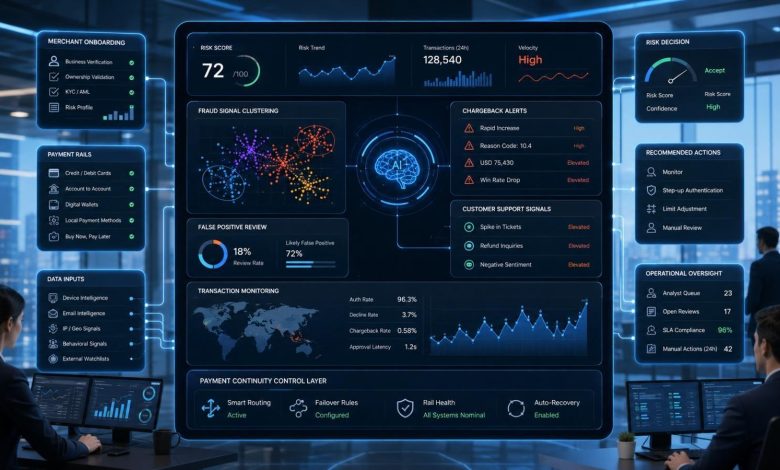
AI is changing how online merchants understand payment risk.
For years, many merchants treated payment risk as a set of separate problems: fraud prevention in one tool, chargebacks in another, onboarding documentation in a folder, customer complaints in a support system, and provider reviews as something that only happened after a problem. That fragmented model is becoming less useful.
High-risk online merchants now operate in a more connected environment. A spike in failed payments can signal fraud, billing confusion, poor customer experience, or weak customer verification. A chargeback may indicate real criminal activity, but it can also reveal unclear cancellation terms or slow support. A provider review may not be triggered by one event, but by a pattern across disputes, refunds, descriptors, transaction geography, and customer behaviour.
AI does not remove payment risk. But it can change how early merchants see it.
The shift: from isolated rules to connected risk signals
Traditional payment risk management often relies on rules. Block this country. Review this transaction size. Flag this device. Reject this velocity pattern. Stop this card after too many attempts.
Rules still matter. But rules alone can struggle when a merchant grows across markets, adds payment methods, or serves customers whose behaviour does not fit a simple pattern.
AI systems can help by connecting signals across the customer journey: checkout behaviour, account history, payment retries, refund requests, support contacts, chargeback reasons, delivery timing, device behaviour, email patterns, and merchant category risk. Instead of treating each event as isolated, AI can help identify patterns that suggest whether the business is seeing fraud, friendly fraud, billing confusion, operational failure, or a provider-appetite issue.
This matters most for high-risk merchants because their payment problems are rarely one-dimensional. Subscription platforms, relationship platforms, travel businesses, regulated digital services, trading-related platforms, crypto-ready merchants, and other online businesses with elevated underwriting sensitivity often face several risk factors at once.
The practical value of AI is not only faster detection. It is better context.
AI risk management needs governance, not just automation
The danger is assuming that AI should automatically decide what happens to every transaction or merchant account.
In payment risk, automation without governance can create new problems. A model may block legitimate customers, misread unusual but valid behaviour, or overreact to a temporary spike in disputes. It may also create compliance or fairness concerns if nobody can explain why certain customers, regions, or merchant types are treated differently.
This is why AI governance matters. The NIST AI Risk Management Framework was designed to help organisations manage risks to individuals, organisations, and society associated with AI systems. In 2026, NIST also released a concept note for an AI RMF Profile on trustworthy AI in critical infrastructure, reinforcing that AI-enabled capabilities need practical risk-management controls in sensitive operating environments.
Payment systems may not all be classified as critical infrastructure in the same way, but the principle is relevant: AI used in payment risk should be mapped, measured, managed, and monitored. Merchants should understand what a model is used for, what data feeds it, who reviews exceptions, how false positives are handled, and whether decisions can be explained.
For high-risk merchants, the best use of AI is not “let the model decide everything.” It is “use the model to make risk visible sooner.”
The first dashboard should not be fraud-only
Many merchants start with fraud detection. That is understandable, but incomplete.
A serious AI-assisted payment risk dashboard should look beyond fraudulent transactions. It should connect fraud, chargebacks, refunds, failed payments, onboarding status, customer support, cancellation behaviour, and settlement issues.
A merchant expanding into the US, for example, may see rising disputes. A fraud-only model may treat those disputes as an attack. But a broader model might reveal that disputes cluster around trial conversions, unclear descriptors, unsupported customer support hours, or delayed refund responses. That difference matters because the solution is different.
If the problem is organised fraud, the merchant may need stronger device intelligence, velocity checks, identity verification, or manual review. If the problem is billing confusion, the merchant may need clearer renewal notices, descriptors, cancellation flows, or support scripts. AI is useful when it helps distinguish between these causes.
That is especially relevant for subscription and relationship platforms. A user who cannot recognise a renewal or reach support may go directly to the card issuer. The signal appears inside payment systems, but the root cause may sit inside customer experience.
Card-network monitoring makes dispute signals more important
Disputes and fraud signals are not just internal metrics. They can affect how payment partners view a merchant.
Visa’s 2025 Visa Acquirer Monitoring Program fact sheet explains that Visa monitors fraud, dispute, and enumeration levels each month and identifies acquirers or merchants that exceed VAMP thresholds. The programme consolidates fraud and dispute monitoring into a single global structure, with updated requirements effective from June 2025.
For merchants, the implication is clear. Fraud and chargeback signals can become scalability issues. A merchant may believe it has a customer-service problem, but the payment ecosystem may see a risk pattern.
AI can help here if it is used early. Instead of waiting until a provider asks questions, merchants can monitor dispute drivers by cohort, product type, traffic source, geography, billing cycle, support delay, and payment method. That gives management a better chance to fix the operational cause before it becomes a payment-continuity problem.
ACH and account-to-account rails are also becoming more risk-aware
AI-assisted risk management should not focus only on card payments.
Many online merchants use or consider bank-based payments, ACH, account-to-account transfers, or other rails alongside cards and wallets. These rails have different dispute and return mechanics, but they are not outside the fraud conversation.
Nacha’s 2026 fraud monitoring rule changes show the broader direction. Nacha describes the rules as part of a larger risk-management package intended to reduce successful fraud attempts and improve recovery of funds after fraud occurs. Phase 1 became effective in March 2026, while Phase 2 becomes effective in June 2026.
The message for merchants is not that every business suddenly needs an expensive AI system. It is that payment risk is becoming more data-driven across rails. If a merchant uses cards, ACH, wallets, local methods, and alternative payment options, risk signals should not live in separate operational silos.
An AI-supported risk view can help connect suspicious signups, failed debit attempts, refund spikes, chargebacks, abnormal account behaviour, and customer complaints before they become separate crises.
AI can reduce false positives, but only if merchants measure them
Fraud prevention has a classic trade-off: reduce fraud too aggressively and legitimate customers are blocked; loosen controls too much and fraud losses rise.
High-risk merchants feel this trade-off more sharply because they often face stricter provider monitoring. The business may be tempted to reject anything unusual. But false positives also create losses: abandoned orders, failed subscriptions, blocked returning users, reduced approval rates, and support complaints.
AI can help identify more precise risk patterns. But merchants need to measure whether the model is improving outcomes. That means tracking not only fraud stopped, but also legitimate customers rejected, manual-review outcomes, customer complaints after declines, approval rates by segment, and changes in dispute ratios.
A model that reduces fraud by blocking too many valid customers may look successful to a risk team and harmful to a finance team. Payment risk management should therefore involve risk, finance, product, and customer support together.
AI-assisted underwriting can help merchants prepare earlier

AI is also changing how merchants prepare for payment-provider conversations.
Underwriting has always included business documents, ownership, processing history, website review, policies, product category, geography, expected volume, refund handling, and chargeback risk. What is changing is the ability to organise these signals earlier.
A merchant can use AI internally to review website consistency, identify unclear refund language, flag missing policy pages, summarise support themes, detect chargeback patterns, and create a cleaner onboarding file before approaching payment partners.
This is not legal advice or guaranteed approval. It is operational preparation.
For merchants reviewing high-risk payment infrastructure, WiseAlt helps assess provider suitability, onboarding documentation, payment continuity, and risk factors before businesses approach payment partners. WiseAlt is not a PSP, acquiring bank, payment gateway, card processor, law firm, or compliance authority.
For subscription, content, relationship, and dating platforms, WiseAlt can also support planning around payment infrastructure for subscription platforms, where recurring billing, customer support, dispute prevention, and provider appetite often interact.
AI should support human escalation, not replace it
The most useful AI systems in payment risk do not remove human judgement. They make escalation more intelligent.
A model can cluster disputes by cause. It can show that one campaign produces more refund requests than another. It can identify that a geography has higher failed-payment rates. It can suggest that support delays correlate with chargebacks. It can prioritise suspicious accounts for review.
But the decision to change a billing flow, adjust a refund policy, pause a traffic source, apply manual review, or prepare a backup payment route still requires business judgement.
That is especially true for high-risk merchants. A blunt automated decision can reduce one risk and create another. Blocking too many users may reduce fraud but damage revenue. Accepting risky traffic may grow sales but trigger provider scrutiny. Over-automating refunds may reduce support pressure but increase abuse. Under-communicating with customers may preserve margin temporarily but increase chargebacks.
AI is valuable when it helps management see these trade-offs clearly.
The new payment risk stack
The next generation of payment risk management will not be one tool. It will be a stack.
That stack may include:
- transaction monitoring;
- identity and device intelligence;
- customer support analytics;
- chargeback reason analysis;
- refund and cancellation tracking;
- provider-monitoring dashboards;
- policy and website review;
- manual-review workflows;
- payment-continuity planning.
AI can connect these layers, but merchants still need governance. They need to know what is automated, what is reviewed, what is escalated, and what is reported to management.
The merchants that benefit most from AI will not be those that buy the most tools. They will be the ones that define the right questions:
- Which risk signals predict future disputes?
- Which customer journeys create avoidable payment complaints?
- Which traffic sources create disproportionate chargebacks?
- Which support delays become payment events?
- Which payment methods need separate monitoring?
- Which provider-review triggers should management see early?
These questions turn AI from a technology trend into a practical payment-continuity asset.
Final operating principles
AI is changing payment risk management because it allows merchants to connect signals that were previously separated. Fraud, disputes, failed payments, support delays, refunds, onboarding issues, and provider reviews can now be understood as parts of one operating system.
For high-risk online merchants, that creates an opportunity. Better visibility can reduce surprises, improve provider readiness, support chargeback prevention, and protect payment continuity.
But AI is not a shortcut around payment fundamentals. Merchants still need clear policies, responsible customer communication, fraud controls, support capacity, underwriting documentation, and realistic provider expectations.
The best approach is not to ask whether AI can approve more transactions. It is to ask whether AI can help the business understand payment risk early enough to act before the payment ecosystem acts for it.