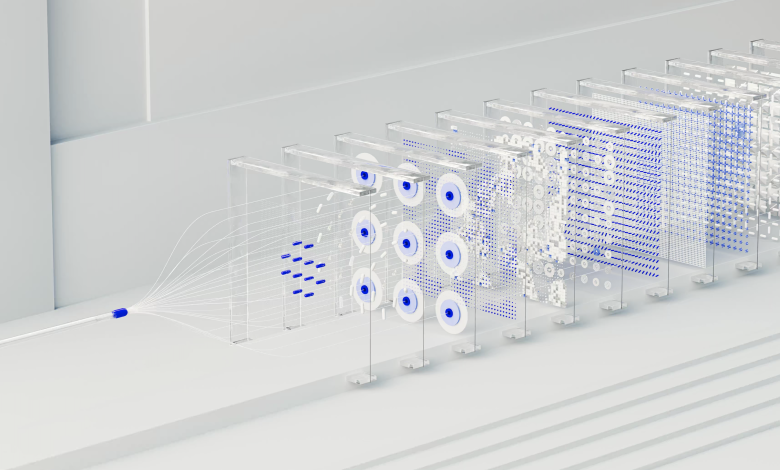
Enterprises are moving from using AI for simple tasks to deploying more autonomous agents. That shift is an architectural selection event at the data layer.
In the Cambrian Explosion, life did not improve linearly. The environment changed, new pressures emerged, and whole body plans disappeared. The survivors carried body plans that matched the new constraints. Better messaging did not save a mismatched architecture.
For context, a “body plan” is “the fundamental set of morphological, developmental, and structural features common to many members of an animal phylum. It acts as a ‘blueprint’ defining an organism’s symmetry, tissue layers, segmentation, and limb disposition, primarily determined during embryonic development.” Think of it as the architecture diagramme of the present.
Enterprise data infrastructure is approaching the same line. As teams move from copilots to autonomous agents, they are crossing from human-paced analytics into machine-paced decision loops. Many stacks that looked stable last year are already showing signs of stress. The old body plan works right up to the day it does not.
The hardline is architectural, not incremental
Most enterprise technology adoption plans describe a smooth path from assistants to workflows to autonomy. That framing misses the break point that matters. Autonomous agents change the shape of the workload at the data layer.
One user prompt expands into retrieval, decomposition, validation, ranking, and follow-up queries, all executed in parallel. What appears to be one question from a person becomes a burst of concurrent analytical work from software. The user sees a single answer box, but the system processes multiple queries in seconds.
Legacy systems were tuned for periodic reports, pre-modelled questions, and patient humans. This is where older assumptions collapse. Agentic systems run continuous loops and immediately punish delay.
The concurrency cliff is now a product issue
Teams often assume dashboard performance means agent readiness. I have watched this fail repeatedly in production. The dashboard works, leadership assumes the foundation is ready, then the first autonomous workflow exposes queueing and latency cliffs.
Queue depth rises first. Then p95 and p99 inflate. Then teams add caches and pre-aggregation layers to contain cost and latency, and the agent starts operating on stale or partial state.
Treat it as a mismatch in body plan. Tuning buys time; it does not swap in a new body plan.
Throughput alone does not solve this. Agentic workloads require high concurrency and low query latency simultaneously. A platform can finish large jobs overnight and still fail when an wagent needs many fast decisions while a user waits.
Data fidelity is the second hardline
The first hardline is performance under concurrent load. The second is evidence quality.
For years, enterprises made rational tradeoffs. They sampled logs, downsampled metrics, and shortened retention to control spend. Those practices worked for human-led investigation and periodic review.
Autonomous systems invert that tradeoff. Sampling is a cost optimisation for humans. For agents, it is amnesia. An AI agent investigating incidents or business anomalies does not ask for a summary chart. It correlates granular events across services, deployments, customer cohorts, and time windows.
If those events were dropped at ingest, the agent cannot reason correctly later. Missing evidence often yields confident mistakes instead of hedged uncertainty. What breaks first is usually the data path behind the model, long before the model itself gives out.
Why warehousing and observability are converging
Many enterprises still split business analytics and operational telemetry into separate stacks. The same event gets copied twice, transformed twice, and interpreted by two teams with different semantics. A sync layer attempts to reconcile the gap after the fact.
This is operationally expensive even before AI. Under autonomy, it becomes a direct reliability risk. Copilot-era systems answered humans. Agentic systems negotiate with physics.
An API timeout is a platform signal and a revenue signal in the same moment. A checkout error is both an incident and a business event. Agents need those contexts together, not stitched together hours later.
The old boundary between data warehousing and observability was understandable in a slower era. It is becoming an avoidable tax in this one. This convergence is now visible across industry narratives on AI-driven data workloads, including AI is redrawing the database market.
What modern database systems must deliver
If autonomy is the direction, platform requirements need to be explicit. These are baseline properties for machine-paced workflows.
Concurrency without collapse
Systems must sustain bursty parallel queries with predictable latency. Fast single-query demos are irrelevant if concurrency creates queue storms.
Real-time ingest and immediate queryability
Fresh events must become queryable within seconds. Agent loops running on delayed data make wrong decisions faster.
Full-fidelity economics
If the default cost posture requires dropping data, autonomy quality degrades by design. Granular event retention needs to be economically viable, not an exception path.
Unified semantics across business and operational events
Agents require shared context across product telemetry, transactions, and infrastructure signals. Semantic fragmentation creates reconciliation overhead and low trust.
Governed machine interfaces
Natural-language UX matters, but production autonomy runs on APIs, policies, and audit trails. Query paths must be machine-native and policy-aware.
Agent observability as core infrastructure
Every autonomous action should be traceable. Teams need to inspect what was queried, what evidence was used, what policy applied, and why an action happened.
A readiness test enterprises can run this quarter
Most teams do not need another abstract strategy deck. They need a repeatable systems test.
Choose one high-value workflow where a single prompt fans out into many concurrent queries and ends in an action a human cares about. Run it on production-scale data with realistic concurrency and realistic freshness expectations. Architecture debt stays hidden until the environment starts moving faster than your release cycle.
Measure p95 and p99 latency, decision completion rate, error modes, and cost per completed workflow. Then inspect failure points directly: freshness lag, queue contention, context gaps, policy bottlenecks, or audit blind spots. A vendor deck is never a stress test.
As a reference, both NIST and Google point to system-level trust and tool reliability under real constraints, in the NIST AI Risk Management Framework and the Google Agents Whitepaper.
The Cambrian question
In the Cambrian period, species did not adapt to environmental pressures. They either adapted to the new constraints or disappeared.
The same dynamic is hitting data infrastructure now. Architectures optimised for batch-era economics and human-paced analysis are colliding with autonomous systems that ask more questions, faster, with less tolerance for delay or missing evidence.
Set aside vendor narrative for a quarter. The load-bearing question is whether your data architecture can withstand machine-paced decision-making over the next year (and then five years). Extinction rarely works as a referendum on quality. More often, it tracks a mismatch with new conditions. Selection pressure does not care about your product roadmap.
Trilobites did not vanish because they were weak. They vanished because the rules of survival changed. This is the Cambrian moment we are facing. We can cross it deliberately now, or cross it under pressure (or by incident) later.