



Offers Read and Write Access to Hot and Cold Storage With no Application Code Changes, Delivering up to 90% Savings in Storage
ALEXANDRIA, Va., June 18, 2026 /PRNewswire/ — pgEdge, the leading open source enterprise Postgres company, today announced pgEdge ColdFront, a transparent data tiering solution for PostgreSQL. Unlike other alternatives, ColdFront’s cold tier is fully writable: UPDATE and DELETE work on archived rows through the same SQL the application already uses, with no code changes and no rehydration required. Older data moves automatically to Apache Iceberg in Parquet format on any S3-compatible object store at up to 90% lower storage cost. Meanwhile, the complete dataset stays readable and writable through a single Postgres table name, and cold-tier scans operate at analytical speed thanks to the DuckDB vectorized columnar engine.
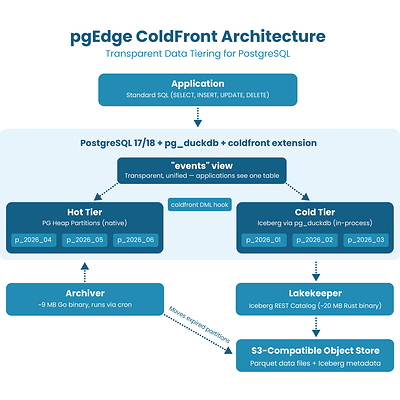
Every useful production PostgreSQL database grows over time with historical data required for analytical workloads and data retention requirements. Storage costs and operational complexity including backups, vacuum overhead, and replica lag increase dramatically, all while the current data needed for live operational OLTP applications remains relatively small. Teams respond by deleting old data, archiving to flat files that break queries, or adopting proprietary tiering solutions locking them into a vendor format for the life of the data. pgEdge ColdFront eliminates the need to make these trade-offs. Cold data moves automatically to cheap object storage, stays fully readable and writable via standard Postgres, and is stored in an open format at every layer.
A simple yet problematic example demonstrates the power and convenience of ColdFront: a GDPR deletion request against five-year-old archived data. With ColdFront. this is a single SQL statement — not a restore-to-hot, delete, re-archive, and re-verify cycle. The cold tier is writable by default.
“For years vendors have been claiming they’ve seamlessly united analytical, transactional and now AI workloads. ColdFront finally delivers for Postgres, without trade-offs and without proprietary vendor lock-in,” said Phillip Merrick, CPO of pgEdge. “ColdFront eliminates the trade-offs entirely. The application keeps the same SQL. DuckDB runs in-process for analytical speed on cold data. The cold tier is writable. And it runs on standard unpatched PostgreSQL, so no migrations are required to deploy it.”
What Sets ColdFront Apart
The only directly writable cold tier. Most tiering solutions make archived data read-only or require different code to write it. ColdFront’s cold tier is fully writable through the same Postgres table name without rehydration, special paths, or any application-level awareness of where data resides.
Analytical speed on cold data. ColdFront runs DuckDB inside the PostgreSQL process, with no separate daemon or sidecar. Cold-tier scans on Parquet data use DuckDB’s vectorized columnar engine, delivering 10-100x faster analytical performance than row-based storage on the same data. No ETL pipeline, no second system, no CDC process required.
Zero application changes. ColdFront intercepts SQL at the extension layer. Applications continue using SELECT, INSERT, UPDATE, and DELETE against the same table name. No refactoring, no ORM changes, no new data access patterns. The tiering is a property of the deployment, not the application’s SQL.
Fully open source at every layer. ColdFront runs on stock upstream PostgreSQL 16, 17 and 18, not a proprietary fork. Cold-tier data is standard Apache Iceberg (Parquet on S3), readable by Spark, Trino, DuckDB, Snowflake, or Databricks with no ColdFront dependency. If you stop using ColdFront, your hot data is still a PostgreSQL table, and your cold data is still standard Iceberg files on S3. pg_dump, backups, logical replication, and existing operational tooling work unchanged.
Built-in partition lifecycle management. The working set of hot data is controlled with one single configuration parameter hot_period. An optional additional parameter retention_period can be used to automatically drop cold data after the specified time period. ColdFront pre-creates future partitions ahead of writes and retires old ones with DETACH CONCURRENTLY on stock PostgreSQL — no blocking DROP, no manual intervention. It works standalone as a pure partition manager with no cold tier required, and tables can be upgraded to full tiering later without re-modeling.
Up to 90% storage cost reduction and less complex operations for cold data. S3 object storage costs roughly 90% less than SSD-backed PostgreSQL storage. Smaller hot-tier databases also mean faster backups, faster restores, lower replica overhead, and reduced managed-service bills.
Naturally distributed via Spock. In a pgEdge Spock multi-master cluster, cold data on S3 is accessible for reads and writes from every node simultaneously, providing a compelling scaling solution for workloads that require either extremely high throughput or high availability. Hot data replicates via Spock; cold data lives in shared object storage, so clusters replicate only the working set and query the full history from any node. The bakery protocol, formally verified in TLA+, serializes Iceberg commits across nodes with no 409 conflicts and no application-level retry — validated at 756,000 rows per second across three small nodes with 90 million rows.
“Database teams are paying SSD prices for data they almost never touch, while spending real engineering time managing what to keep, what to delete, and how to recover old data when the business needs it,” said Dave Page, CTO of pgEdge. “ColdFront handles the full lifecycle automatically. The application keeps using the same SQL and the storage bill drops by up to 90%. We validated it at 756,000 rows per second across a multi-node cluster with 90 million rows. That is what production actually looks like.”
AI-Ready Data Infrastructure
AI and ML pipelines need access to the full depth of an organization’s data, not just the recent working set. Training runs, RAG retrieval, feature engineering, and agentic analytics all query historical data that traditional PostgreSQL deployments either delete or archive to inaccessible formats.
In decoupled mode, ColdFront turns PostgreSQL into a stateless compute front-end over Iceberg: New compute nodes spin up against the same catalog and object store in seconds with no data sync required. AI agents and ML pipelines connect via standard PostgreSQL drivers and query terabytes of history without a separate system. Combined with the pgEdge Agentic AI Toolkit — MCP Server, RAG Server, Vectorizer, and Docloader — ColdFront provides a complete data backbone for agentic AI in regulated environments where data sovereignty is not optional.
Who or What Benefits?
- SaaS and IoT time-series workloads. Applications generating millions of events per day keep the recent working set in PostgreSQL for dashboard and alerting queries. The archiver automatically moves older partitions to Iceberg. Storage costs drop up to 90%; historical trend queries span both tiers through the same SQL with no changes to the application.
- Regulated industries with long retention mandates. Financial services, healthcare and government teams with 7-10 year retention requirements store cold data in Apache Iceberg, an open vendor-neutral format that remains readable by any Iceberg-capable tool regardless of future vendor decisions. Compliance queries and deletion requests run through the same SQL interface.
- Analytics without a dedicated data warehouse. Product and BI teams run aggregations, cohort analysis, and trend queries over cold Parquet data using DuckDB’s columnar engine running in-process inside PostgreSQL. No more massive data warehouse vendor bills and no ETL pipeline, no CDC, no separate analytics system to build or maintain.
Three Operating Modes
ColdFront supports three storage modes plus a standalone partition manager, configurable per table, all coexisting in the same database:
- Tiered (hot + cold): Recent data stays in PostgreSQL heap partitions. A lightweight archiver moves older partitions to Iceberg on a configurable schedule and expires cold data past its retention period. Best for OLTP-heavy workloads with a strong recency pattern.
- Decoupled (Iceberg-only): The entire table lives in Iceberg from row one. PostgreSQL becomes a stateless compute front-end, enabling elastic compute scaling for AI, ML and analytic workloads without moving data to a separate system.
- Partition-only (no cold tier): ColdFront manages a partitioned table’s full lifecycle on stock PostgreSQL with no Iceberg required. Tables can start here and be upgraded to full tiering later without re-modeling.
Availability
pgEdge ColdFront is available now as a production-grade beta. Both tiered and decoupled modes work end-to-end across a fully green CI matrix covering PostgreSQL 16, 17 and 18 in vanilla and multi-master Spock mesh topologies, including physical standby reads. This is not a tech preview.
ColdFront will be bundled with pgEdge Enterprise Postgres and integrated into pgEdge Cloud within H2 2026.
ColdFront is open source under the PostgreSQL License and usable on standard community PostgreSQL. pgEdge Enterprise Postgres customers can (starting today) make use of available pre-built tested binaries and 24×7 enterprise support. Documentation, installation instructions, and reference architectures are available at https://docs.pgedge.com/coldfront and https://github.com/pgEdge/coldfront.
To learn more or get started, visit www.pgedge.com.
About pgEdge
pgEdge, the leading open source enterprise Postgres company, delivers open source, 100% Postgres infrastructure for agentic AI and enterprise applications that demand high availability, reliability, and data sovereignty. Its mission is to make it easy to build, deploy and manage enterprise-grade applications at scale on Postgres. Headquartered in Northern Virginia, pgEdge is trusted by organizations including Bertelsmann, Qube RT, Thales and U.S. government agencies. Investors include Akamai Technologies, Inc., Qube RT, Rally Ventures, Sands Capital Ventures, Grotech Ventures, and Sand Hill East. For more information, visit www.pgedge.com and follow the company on LinkedIn.
Apache Iceberg, Apache Parquet, and Apache Spark are trademarks of the Apache Software Foundation. PostgreSQL is a trademark of the PostgreSQL Community Association of Canada. All other trademarks are the property of their respective owners.
Tags: pgEdge, PgEdge ColdFront, pgEdge Agentic AI Toolkit, PostgreSQL, Postgres, pgEdge Enterprise Postgres, pgEdge Cloud, Apache Iceberg, DuckDB, agentic AI, data tiering, cold data, open source, AI, artificial intelligence, machine learning, ML, data sovereignty, OLTP
 View original content to download multimedia:https://www.prnewswire.com/news-releases/pgedge-announces-coldfront-for-postgresql-seamlessly-uniting-ai-analytical-and-oltp-workloads-302804015.html
SOURCE pgEdge
