Enterprise technology decisions are getting harder.
Engineering teams have more data than ever. Product teams have more features to prioritize. Sales teams have more competitors to track. Marketing teams have more channels to manage. Each function operates with its own metrics, its own timelines, and its own definition of success. The result is not alignment. It is fragmentation.
Most organizations respond by adding more processes. More meetings. More reviews. More documentation. This does not solve the problem. It just makes the fragmentation more expensive.
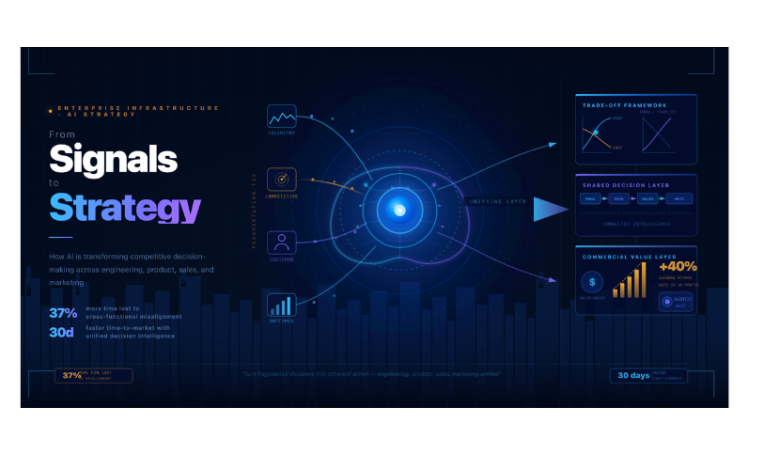
AI offers a different path. Not automation of individual tasks, but unification of decision-making across functions. When network telemetry, customer behavior, competitive signals, and business outcomes are connected in a shared intelligence layer, engineering stops guessing what product needs. Product stops guessing what sales can sell. Sales stops guessing what marketing has promised. Marketing stops guessing what engineering can deliver.
Here is what it takes to build that layer, what trade-offs to expect, and how to turn signals into strategy without creating new silos.
The Fragmentation Tax
Every enterprise pays a fragmentation tax. It is the cost of decisions made in isolation.
I have seen this tax compound across dozens of product cycles. A product team builds a feature that engineering struggles to support at scale, because engineering was not consulted on the performance requirements. A marketing campaign highlights capabilities that sales cannot defend against competitor objections, because sales was not looped into the messaging development. A pricing strategy ignores the cost structure that engineering understands but finance controls, because the two functions never shared a spreadsheet. A long-range plan assumes competitive responses that never materialize, because competitive intelligence was not part of the planning process.
None of these failures are malicious. They are structural. The data does not flow between functions. The signals do not connect. Decisions are made in isolation because the systems that enable shared understanding do not exist.
A recent study on enterprise decision-making found that cross-functional misalignment adds an average of 37% more time to strategic initiatives. Another 2025 analysis of product development cycles found that organizations with integrated decision intelligence platforms reduced time-to-market for new features by nearly 30 days per release. The fragmentation tax is not theoretical. It shows up in missed deadlines, overrun budgets, and lost opportunities.
The fix is not more meetings or stricter processes. The fix is a unified intelligence layer that connects what is happening in the network, what customers are doing, what competitors are announcing, and what the business needs to achieve.
The Unifying Layer
Think of AI as the connective tissue between functions that have never truly shared a decision framework.
Network telemetry tells you how infrastructure is performing. Customer behavior tells you what users actually do, not what they say they want. Competitive signals tell you what alternatives exist in the market. Business outcomes tell you what matters to the bottom line. Most organizations treat these as separate domains. AI makes it possible to treat them as views into the same reality.
When engineering can see which competitor benchmarks reveal performance gaps, priorities shift from interesting features to critical gaps. When product can see which features actually win deals and which objections lose them, roadmaps adjust from what is easy to build to what is hard to replace. When sales can see how pricing and packaging compare to competitive alternatives, discounting becomes strategic instead of reactive. When marketing can see which differentiators actually resonate in the field, messaging becomes precise instead of generic.
The technical implementation varies by organization, but the principle is consistent. Build a shared data layer where signals from every function are normalized, correlated, and made accessible. Then build decision interfaces that present the right signal to the right function at the right time. Engineering does not need to see every sales objection. Product does not need to see every network alert. But everyone needs to see the connections between what they control and what everyone else depends on.
In practice, this means instrumenting every decision point. When a feature is prioritized, document which signal drove that decision. When a price is changed, document which competitor action triggered the change. When a roadmap is adjusted, document which customer feedback caused the adjustment. Over time, these connections become a map of how signals flow into strategy. And that map reveals where the fragmentation is worst.
The Trade-Off Framework
Most discussions about AI in enterprise infrastructure focus on optimization. Make the network faster. Reduce the latency. Improve the throughput. These are important, but they are not where sustainable advantage is built. Competitors can match optimization over time. What they cannot easily replicate is how you handle trade-offs.
Every technology decision involves balancing competing priorities that cannot all be maximized simultaneously. Performance versus cost. Real-time responsiveness versus long-term learning. Innovation velocity versus operational stability. Customization for specific customers versus standardization for scale. Feature richness versus simplicity of management.
AI’s real value is not in eliminating these trade-offs. It is in making them visible, quantifiable, and debatable.
Consider a common enterprise scenario. A networking team wants to use AI to optimize radio resources in real time. The technical approach is straightforward. Collect telemetry, run models, adjust configurations. But the infrastructure to run these models at scale is expensive. Cloud-based AI inference carries recurring costs. The question is not whether AI can improve performance. It is whether the performance gains justify the cost, and whether customers will pay for it.
The answer requires a trade-off framework that evaluates multiple dimensions simultaneously. What is the performance uplift compared to the non-AI baseline? What is the additional cost per unit of performance gained? What percentage of customers will pay for the uplift? What is the competitive response if you do not offer the feature? What is the pricing power you gain or lose by making it a premium feature versus including it in the base license?
Frameworks like this are not one-time calculations. They are ongoing models that update as costs change, as competitors react, and as customer expectations evolve. The organization that builds this framework makes better decisions faster. The organization that does not, guesses.
A structured approach to trade-off analysis typically involves three layers. The first layer is technical: what are the measurable outcomes of each option? The second layer is economic: what are the costs and benefits in dollar terms? The third layer is strategic: how does each option affect competitive positioning and long-term optionality? Decisions that pass all three layers are usually sound. Decisions that pass only the technical layer are usually incomplete.
From Metrics to Decisions
The most underutilized asset in most enterprises is the data they already have.
Network telemetry streams from thousands of devices. Customer usage patterns logged in support systems. Win-loss data from every competitive deal. Market trends from publicly available sources. These signals sit in separate systems, owned by separate teams, analyzed on separate schedules. No one sees the full picture. No one can connect a competitor’s product announcement to a shift in customer sentiment to a decline in win rates to a gap in the engineering roadmap.
AI changes this by making correlation possible at scale.
When a new competitor product launches, an AI system can automatically flag which of your features are now less differentiated. It can identify which customer segments are most likely to defect based on historical win-loss patterns. It can recommend which engineering initiatives should be reprioritized to close the gap. It can generate battle cards for sales teams within hours instead of weeks. It can suggest pricing adjustments for deals where the competitor is likely to discount aggressively. None of this requires magic. It requires connecting signals that were already being collected but never correlated.
The implementation path starts with a signal inventory. List every source of data that influences decisions in your organization. Telemetry. Customer feedback. Sales notes. Support tickets. Competitive announcements. Market reports. Pricing data. Win-loss records. Then map which signals currently feed which decisions. The gaps in this map are where fragmentation is worst. The opportunities are where connecting signals could improve decisions.
Monetizing Intelligence
AI is not just technical. It is commercial. The same models that improve performance can drive premium pricing, license tier upgrades, and customer retention. Consider a common pattern. An AI feature reduces manual configuration efforts, it improves performance, and it reduces support tickets. These are technical metrics. The commercial question is whether customers will pay for them.
The answer depends on how you frame the value. A customer who is losing revenue due to an unstable network will pay to solve that problem. A customer who is spending hours manually tuning configuration parameters will pay to automate that work. A customer who is losing deals to competitors with better performance will pay to close the gap. The AI feature is not the product. The outcome is the product.
This shifts the pricing conversation from cost-plus to value-based. Instead of asking how much the AI infrastructure costs and adding a margin, ask how much value the customer gains and capture a fraction of it. This is harder to calculate, but it yields higher margins and stronger customer relationships.
A recent report on AI monetization found that companies offering AI-enhanced premium tiers saw license attachment rates increase by an average of 40% within 18 months of launch, with customers willing to pay 15-25% more for features that demonstrably reduced manual operations. The pattern holds across industries. AI is not a cost center. It is a profit center when positioned correctly and priced against value delivered, not cost incurred.
What Comes Next
The next frontier is agentic AI: systems that do not just recommend actions but execute them autonomously within defined guardrails.
Today, most AI systems in enterprise infrastructure are advisory. They flag anomalies. They suggest configurations. They predict failures. Tomorrow, they will act. A network AI will detect interference and change channels without waiting for a human. A security AI will isolate a compromised device without waiting for a ticket. A capacity AI will provision resources without waiting for approval.
This shift requires new governance. Who defines the guardrails? Who audits the actions? Who is accountable when an autonomous system makes a mistake? These are not technical questions. They are organizational questions. The organizations that answer them first will move faster. The ones that wait for perfect answers will be left behind.
Longer term, AI will enable self-optimizing infrastructure. Systems that learn from every packet, every outage, every resolution. Systems that predict demand before it spikes. Security that adapts to threats before they are named. The technology is not fully mature, but the trajectory is clear. The organizations that build the foundations now, unified data layers, trade-off frameworks, closed feedback loops, will capture this future. The ones that wait will play catch-up.
The Path Forward
For technology leaders, the implication is clear. AI is not just a tool for engineers or a feature for marketers. It is a decision system for the entire enterprise.
The fragmentation problem requires a shared data layer that connects every signal that influences decisions. The trade-off challenge requires frameworks that make cost-performance-value decisions explicit and quantifiable. The monetization opportunity requires pricing strategies that capture value delivered, not cost incurred. The future requires governance models that enable autonomous action without losing accountability.
The organizations that win will not be those with the smartest models or the most data scientists. They will be those that use AI to align engineering, product, sales, and marketing around shared signals and shared strategy. They will treat AI not as a feature to be added, but as the connective tissue that turns fragmented decisions into coherent action.
The technology is available. The frameworks are proven. The only question is whether leaders will build the decision architecture that makes AI valuable across their organizations, or whether they will continue to operate in silos, optimizing locally while losing globally, and wondering why their competitors are moving faster.