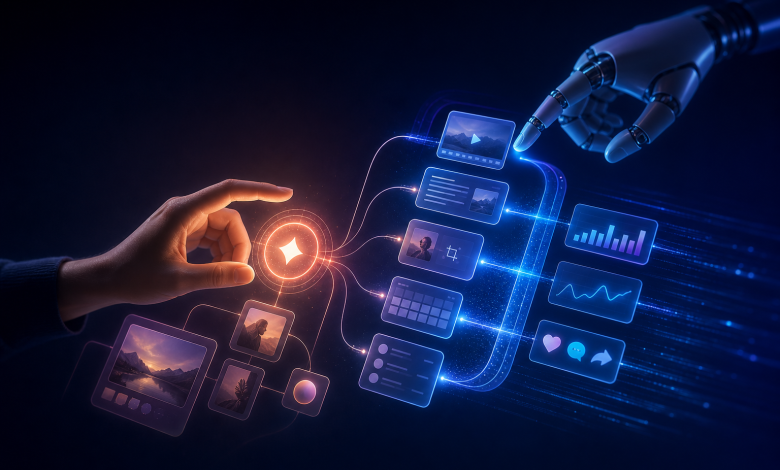
The interesting story of the last 18 months isn’t automation replacing creators. It’s the quiet redistribution of human attention from production to judgment.
For most of social media’s first decade, growing an account was a manual craft: write the caption, guess the hashtags, post at a “good” time, read the comments, repeat. As of 2026, almost every step in that loop has an AI assist sitting next to it — and the marketers who are pulling ahead aren’t the ones who automated the most. They’re the ones who figured out which steps to hand off and which to keep.
That distinction matters more than the hype suggests.
What AI actually got good at
The honest answer is “the middle of the workflow.” Drafting, summarizing, resizing, and variant-generation are now close to solved problems. Tools like Canva’s Magic Studio, Adobe Firefly, and OpenAI’s Sora have made it trivial to turn one idea into ten format variants. ChatGPT and Google’s Gemini draft caption options in seconds. Buffer, Hootsuite, Later, and Sprout Social have all folded generative features into their schedulers, so “write 30 days of posts” is no longer a weekend job.
The second thing AI got good at is reading a feed rather than just writing into it. Pattern detection across a creator’s own back catalog — which hooks held attention, which formats stalled — is something models do quickly and tirelessly. A growing layer of lightweight, free AI-powered creator tools, like the ones TopSocialBoost has been publishing, lets a creator paste in a handle or a draft and get an engagement read or a hook rewrite without opening a spreadsheet. None of that replaces strategy; it just removes the friction that used to make strategy feel expensive.
Where AI still falls short
This is where the “co-pilot, not autopilot” framing earns its keep.
AI is still poor at taste and timing-of-culture. It can generate a hook that is structurally correct and culturally tone-deaf in the same sentence. It does not know that a format is three weeks past its peak, that a sound is about to be over-used, or that a joke lands in one community and reads as cringe in another. Those judgments still come from a human who is genuinely in the audience.
It is also worth being precise about platform limits, because AI volume runs straight into them. Instagram still caps captions at 2,200 characters. YouTube’s Partner Program eligibility still sits at 1,000 subscribers plus 4,000 valid public watch hours (or 10 million Shorts views in 90 days). TikTok’s Creator Rewards Program, as of 2026, still expects a meaningful follower and recent-views threshold before payouts begin. AI can help you reach those bars faster by improving output quality; it cannot move the bars, and any tool implying otherwise is selling a story.
The workflow actually changed shape
The clearest way to see the shift is to compare where a small-team marketer spent an hour in 2023 versus 2026.
| Task | 2023 (manual) | 2026 (AI-assisted) |
| Drafting captions & variants | High effort | Near-zero effort |
| Resizing/reformatting assets | Manual, per-platform | Automated |
| Reading own performance | Spreadsheet, slow | Instant, tool-assisted |
| Choosing the idea / angle | Human | Still human |
| Reading the culture / timing | Human | Still human |
The hours didn’t disappear. They migrated — out of production and into the two rows AI can’t touch. That’s the part most “AI will replace marketers” takes miss.
So what should a creator or small brand actually do?
Three practical principles hold up well right now.
- Automate the reversible, keep the irreversible. Caption variants are reversible — generate freely. Brand voice and which campaigns to run are not — keep those human.
- Use AI to shorten the feedback loop, not to skip it. The win isn’t posting more; it’s learning faster from each post. A quick AI read on what worked last week beats a polished dashboard you check once a month.
- Treat free utilities as a sanity check, not a strategy. Engagement calculators, hook generators, and analyzers are most valuable when they confirm or challenge a human hunch in ten seconds — not when they become the strategy itself.
The 2026 takeaway
The creators and brands winning right now aren’t the most automated. They’re the ones who treated AI as a way to buy back time from repetitive production and reinvest it in judgment, taste, and consistency — the things that were always the actual job. The tools got dramatically better. The work that matters didn’t change; we just finally got help with the part that never did.
The TopSocialBoost team works on social media growth tooling and publishes free AI-powered creator utilities for marketers and creators. More at topsocialboost.com.