Headlines were created when a 2025 MIT Media Lab/Project NANDA report indicated that 95% of generative AI pilots in enterprises fail to create measurable business value, despite $30–$40 billion in investment.
You may relate to this, knowing or sensing that your organisation is struggling already with AI adoption. However, it’s very likely that the AI technology isn’t the problem; instead it’s the environment the AI is being plugged into that’s the problem.
What we’re seeing is that most AI works beautifully in isolation or in theory, but then when it’s deployed in a real workplace – that’s messy and human – suddenly its effectiveness collapses. There are problems with people and with legacy processes, conflicting systems and governance that were designed for a different era.
So, the failure to implement AI isn’t a tech problem. It’s an organisational readiness problem.
And if (like most big organisations) your workflows are stretching across half a dozen systems that don’t talk to each other; if your data lives in silos; and if approvals take weeks, months or even years – nothing intelligent is going to stay that intelligent or effective once it’s mired in that reality.
So, before getting too excited about the latest AI feature or product, it’s also important to work on readying your environment. Otherwise, you’ll be experimenting and not actually implementing.
Part 1 – the organisational friction and ‘corporate sludge’
Everybody wants acceleration, but nobody wants to admit that they’re operating in a ‘corporate sludge’ that’s slowing them down.
Tech stacks (in HR particularly) have grown through bolt-ons, acquisitions, and work-arounds – not by design. Data about an individual employee is handled by different teams, using different systems, applying their own rules, assumptions, and thresholds. Throw in a few acquisitions here and there, and the complications get really significant.
AI is not going to function well in that sludge, it prefers clarity, standards and flow. Think about the power of a good prompt versus a bad prompt. The outcome is very different.
HR tech vendors compound the problem; they love selling new features, but hate talking about interoperability and how / if things will work together. If you don’t push them, you’ll get a shiny new front end capability on top of a chaotic back end. Always challenge your vendors to work with your existing systems and platforms, thinking integration-first. Certainly before the fast rollout of their killer bot.
This is one major example, but it doesn’t just stop at HR tech – it’s about how you design all of your work and keeping it simple.
AI has the potential to reduce complexity, to standardise decisions, remove unnecessary steps, and give employees clearer answers in moments that really matter. But once it’s layered on top of fragmented systems, inconsistent rules and unclear ownership – it can’t simplify anything.
It will amplify confusion, surface contradictions and make the employee experience feel more unpredictable and uncertain.
So, what we’re starting to see is that AI reflects the organisation back to itself. Where processes are well designed and the employee’s experience is already close to the employer’s intent, AI can be a leveler – improving access, consistency, even equity and building confidence. But where work is poorly designed, AI just amplifies that poor design.
Part 2 – the human lag
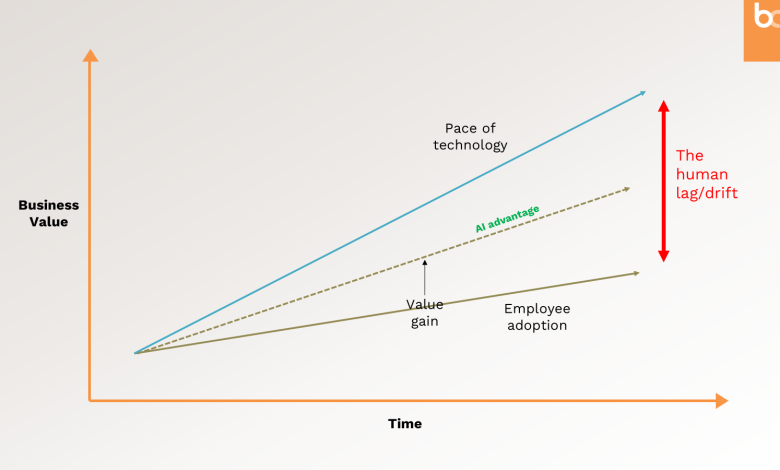
The other big risk to AI adoption over the next two years won’t be the technology itself, it’ll be human lag. In most companies large scale adoption hasn’t really happened yet – but there are already some warning signs that we need to think about.
For years, organisations have been adding systems, tools and processes faster than people can really properly absorb them. That’s created a baseline of cognitive overload that most businesses now take for granted. Think about that CRM that you want people to use. Great tech and huge potential for growth, but stuck with rubbish usage.
AI changes that equation. It moves faster, updates more frequently, and starts influencing decisions rather than just supporting tasks. The risk, however, is the lag between the pace of technology and the pace of human adoption. Not because employees are resistant, but because the experience becomes unclear. People won’t trust tools if the experience is clunky and they won’t change behavior if AI makes their work feel riskier or more confusing.
The organisations that get ahead of this will design AI around how their people actually work, reducing noise, clarifying decision points and building confidence over time. Those that don’t will be surprised when adoption plateaus, even though the technology keeps improving.
AI will only scale as fast as people can make sense of it, and that’s the constraint that most organisations are about to run into – or have done so already.
Symphony, not soloists
The organisations that will get ahead of this are the ones that set clear expectations today. Open standards, shared data models, APIs that actually work. And importantly, they’ll apply real pressure on their vendors to play together, not compete for control over the next few years. In tandem with this, they’ll give careful consideration to how their processes are designed and the experience of their people in adopting AI into their operation.
I don’t think AI success will be decided by who buys the most – or the best – tools or products. It’ll be decided by who designs the best orchestration, knowing that great AI outcomes don’t come from soloists, they come from a symphony.
AI isn’t just another tool; it can be connective tissue between your silos. But only if you dilute the corporate sludge and think carefully about the experience your people are having wallowing in it.