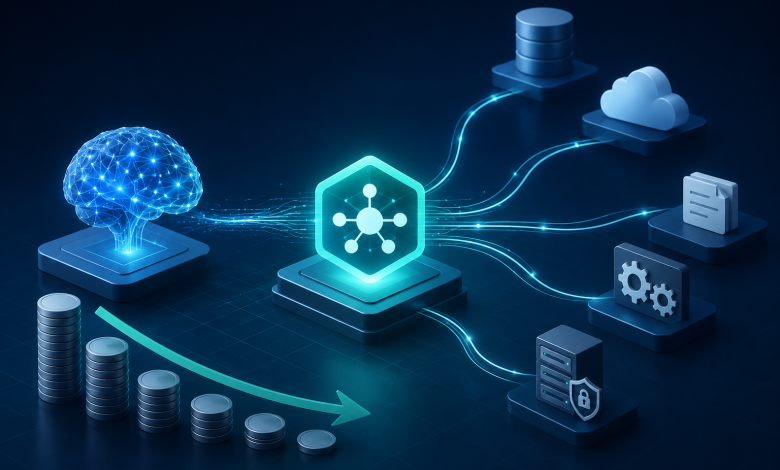
If your AI program is over budget, the model is probably not the reason, but the way you connect that model to real business systems is where your money goes. The serious part is that most enterprises dont realize this until a year or two after they deploy their enterprise AI system.
Industry research shows that 84% of enterprises report AI costs reducing gross margins by more than 6%, with integration complexity emerging as one of the biggest cost drivers. As organizations try to connect AI systems with legacy infrastructure, business applications, and fragmented data environments, operational costs often rise faster than the value AI delivers.
This growing integration burden is exactly what the Model Context Protocol (MCP) is designed to solve. By standardizing how AI systems connect and interact across enterprise environments, MCP helps reduce operational overhead and improve scalability. For business leaders, the priority is no longer deciding whether MCP works, but how quickly their organization can implement it to achieve measurable cost savings.
In this article, we will discuss the cost logic of enterprise AI with and without MCP, and provide a clear execution path. We will also see what the key considerations are to look for before integrating MCP.
Enterprise AI Cost Without MCP vs. With MCP
The cost difference between the two approaches is not subtle, and it does not stay flat over time. The gap widens with every new AI agent, every API change from a vendor, and every model upgrade your team wants to evaluate. Here is what the two architectures actually look like on a budget line.
Without MCP: The Multiplied Integration Cost
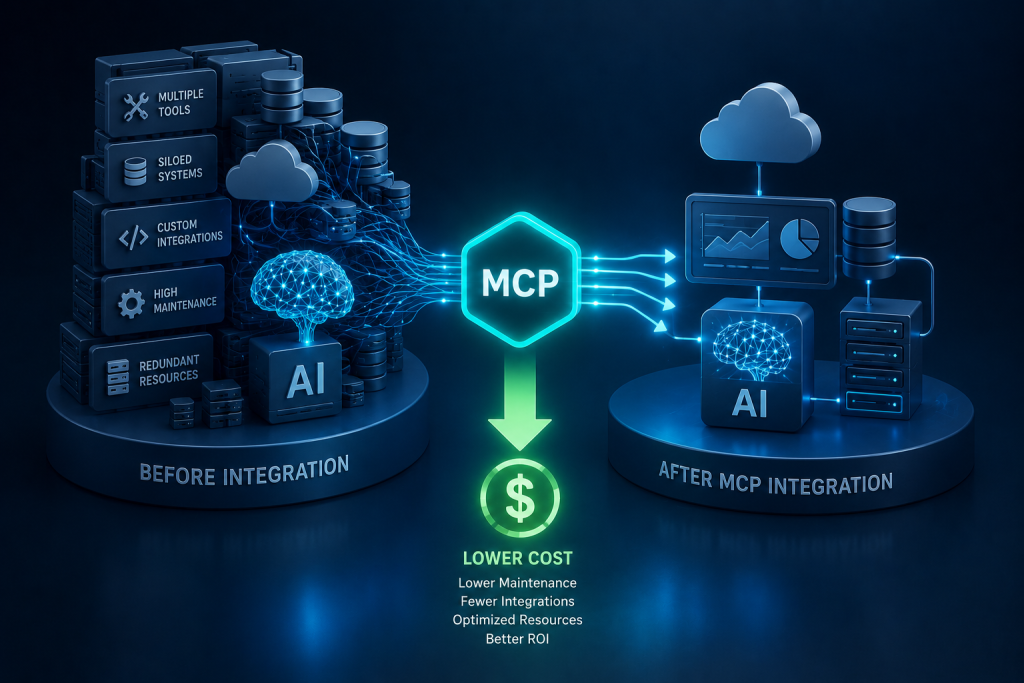
Without MCP, every AI system needs its own hand-built connection to every enterprise tool it touches. Add a new agent, and you build the integrations all over again. The wiring grows faster than the value.
| Example: A Mid-Sized Enterprise Today
Imagine a typical enterprise running several AI use cases in parallel; each one needs access to the same core business systems to be useful. The numbers below show what the integration layer actually looks like behind the scenes M = number of AI agents you run → 5 in production: Customer support copilot · Sales research assistant · Internal knowledge bot · Finance reporting agent · HR onboarding assistant N = number of business systems they need to access → 20 tools: Salesforce, SAP, Workday, Jira, Confluence, Snowflake, Zendesk, NetSuite, GitHub, ServiceNow, and others Result: M × N = 5 × 20 = 100 separate integrations to build, secure, and maintain. |
Each of those one hundred connections needs its own authentication, error handling, version management, and a ticket queue for the day Salesforce or SAP pushes a breaking API change. The build cost shows up in the original business case. The annual maintenance tax of 15 to 30 percent does not, and that is where most three-year TCO models quietly break.
This is the M times N problem: every new AI agent (M) multiplies against every business system (N), and the integration count explodes. It is the single biggest reason AI pilots stall before reaching production.
With MCP: Standardized, Reusable Connections
MCP turns that multiplicative problem into an additive one. Each tool gets wrapped in a standard MCP server once. Each AI agent learns to speak MCP once. After that, any agent talks to any tool through the same protocol.
| Same Enterprise, With MCP
M + N = 5 + 20 = 25 standardized endpoints, not 100 custom integrations. The math shifts from multiplication to addition the moment MCP is in place. |
This is the compounding effect, where the budget impact shows up:
- When Salesforce changes its API, one MCP server gets updated. All five agents keep working.
- When you add a sixth AI agent, it plugs into the twenty existing MCP servers on day one. No new integration project.
- When you switch from Claude to GPT or Gemini, the MCP layer survives the swap. Procurement keeps its leverage.
That’s why MCP integration is no longer an engineering decision. It is a procurement and architecture decision.
| Cost Factor | Without MCP | With MCP | What This Means for Budget |
| Integration complexity | M × N (100 in the example) | M + N (25 in the example) | Linear scaling, predictable forecasts |
| Time to deploy a new AI use case | Months | Weeks | Earlier revenue recognition |
| Maintenance burden | Paid per connector, every year | Centralized at the server layer | Engineering hours returned to the roadmap |
| Adding the next AI agent | Another twenty integration projects | Connects to existing MCP servers on day one | No incremental integration spend |
| Vendor switching cost | High and rising | Materially lower | Procurement leverage restored |
The leadership takeaway: Every quarter spent on custom integration work is a quarter you are paying the M times N tax. The longer the existing architecture stays in place, the higher the bill at the end of the year, and the harder the migration becomes once leadership finally signs off. Integration debt compounds quietly. By the time it shows up on a board slide, it has already cost two or three product cycles and a meaningful share of your engineering roadmap. The organizations that move first on MCP are not the ones with the biggest AI budgets. They are the ones who recognized integration architecture as a financial decision before it became a crisis.
How MCP Integration Reduces Enterprise AI Total Cost of Ownership
Five things change in your AI cost structure when MCP is in place. Each one ties to a budget line your CFO already tracks. Some show up in the first quarter after deployment. Others compound quietly over two or three years before the full savings become visible.
1. Direct Drop in Integration Costs
Standardized connectors replace custom development. The same data integration work that used to absorb the bulk of an AI project budget now runs at a fraction of the cost, because the connector is built once and reused across every AI system that needs it. The economic model shifts from “build per project” to “build once, deploy everywhere.”
How to Get This Benefit: Identify your three most expensive in-flight AI integrations and run the MCP cost comparison on each one. If the gap is large enough to fund another initiative, prioritize migration in the next planning cycle.
2. Faster Time-to-Value
Traditional AI implementations take six to twelve months. MCP-enabled deployments hit production in a fraction of that time because the integration work is already done. Faster deployment compresses payback periods and shrinks the window where stalled pilots burn cash.
How to Get This Benefit: Before approval of the next AI initiative, ask your program leads to compare two scenarios: custom integration versus MCP, measured on payback period rather than build cost. Once the numbers favor MCP, hire experienced MCP developers early in the cycle, because their familiarity with server patterns, authentication flows, and governance setup removes weeks of trial-and-error that internal teams would otherwise absorb on their first MCP build.
3. Lower Long-Term Maintenance Tax
Custom integrations carry a maintenance tax of 15 to 30 percent of the original build cost every year. MCP centralizes the burden. When a SaaS vendor changes their API, the MCP server maintainer handles it once and every downstream system benefits. That is real engineering capacity returned to the product roadmap, and it is the line item most CFOs underestimate when approving the original AI budget.
How to Get This Benefit: Audit how much of your engineering capacity is currently consumed by integration patching. If that number is above 20 percent, MCP migration is a productivity decision before it is a cost decision.
4. Reduced Vendor Lock-In and Switching Costs
Traditional AI platform deployments lock you into a specific vendor’s ecosystem, and the switching cost rises every quarter the architecture stays in place. MCP is model-agnostic. Replacing Claude with GPT or Gemini does not force an integration rebuild. This gives procurement real leverage in vendor negotiations and protects the architecture from the next model upgrade.
How to Get This Benefit: If your AI contracts are coming up for renewal, calculate your current switching cost honestly. If it is high enough to constrain negotiations, your vendor already knows it and is pricing accordingly.
5. Centralized Security and Compliance
Every custom integration is a new attack surface and a new audit obligation. MCP consolidates authentication, access control, and audit logging at the server layer. AI governance failures can carry penalties of up to 7 percent of revenue, so reducing the integration surface is a compliance decision your legal team will back.
How to Get This Benefit: Map your AI integration points against your current compliance framework. If there are gaps, MCP gives you a single layer to enforce policy instead of repeating the work for every connector.
Combined, these five levers cut long-term enterprise AI TCO by roughly half in published modeling. For most enterprises, that is meaningful capital redirected from plumbing to product work.
Key Considerations Before Integrating MCP
The savings above are real, but they are not automatic. Six decisions determine whether your organization captures the full TCO benefit or just shifts costs to a new layer.
1. Audit the Current Integration Surface Area First.
Map every system your AI tools already touch: data warehouses, billing, support, analytics, workflow engines. The integrations that repeat across multiple projects are where MCP pays back fastest. Without this audit, the rollout drifts, and the savings stay theoretical. Assign this to a named owner with a thirty-day deadline.
2. Choose Between Managed Gateways and Self-built Servers
Self-built MCP servers offer control but inherit the maintenance tax. Managed platforms typically deliver lower TCO for production workloads. Build only when the integration is core to product differentiation. Buy everything else. This is a procurement decision and should sit with whoever owns your AI platform budget, not your engineering managers alone.
3. Start with a Constrained Pilot, Not a Full Rollout
Pick a non-critical AI use case touching three to five enterprise systems. Prove MCP can replace existing integration logic at that scale before committing platform-wide. Treat the pilot as a financial validation, not just a technical one. Set a clear cost-saving target and measure against it.
4. Build Governance Into The Server Itself
Access rules, user roles, and policy checks belong inside the MCP server, alongside the controls already in place to protect your core APIs. Set them up once at that layer, and every AI tool inherits the same governance. A tool-by-tool approach is a budget killer and almost always ends in a rebuild within two years.
5. Be Honest About The Costs That MCP Can’t Reduce.
MCP cuts integration costs, but it can not cut every cost in the AI program. The model still charges per token every time an agent runs, AI talent still commands a premium, and cloud bills still scale with usage. Position MCP for what it actually does: it removes the integration tax between your AI agents and your business systems. Set that expectation clearly with your board, and the savings story holds up over time.
6. Pick MCP Servers With Versioning and Observability Built In
Without telemetry on latency, error rates, usage patterns, and per-team cost tracking, MCP just moves the chaos to a new layer. Observability is what turns the protocol from a cost-saver into a governance tool that finance and security teams can trust. Add this to your evaluation criteria before signing any platform contract.
The six points above are where most MCP rollouts either achieve their projected savings or lose them. Companies that run a mix of legacy systems and new AI workloads often get there faster with AI integration services from a partner that has already worked through the audit, pilot, and governance steps on similar projects. The right partner closes the gap between business case approval and live deployment, which is where most cost overruns start. For decision-makers, that is the difference between a TCO plan that holds up in year two and one that quietly drifts over budget.
Conclusion
Enterprise AI cost overruns are not a model problem. They are an architecture problem, and the integration layer is where most of the cost, risk, and maintenance burden live. MCP integration changes that math by replacing custom point-to-point connectors with a standardized, reusable layer.
The TCO improvement is documented and repeatable, but only for organizations that audit their current state, pilot deliberately, and govern the new layer with the same discipline applied to core infrastructure. For business leaders, the next move is straightforward. Run the audit this quarter, identify the two or three integrations where the math is most compelling, and bring the migration plan to your next planning cycle. Enterprises that treat MCP as infrastructure rather than experimentation will hit AI ROI faster and with more predictable budgets.