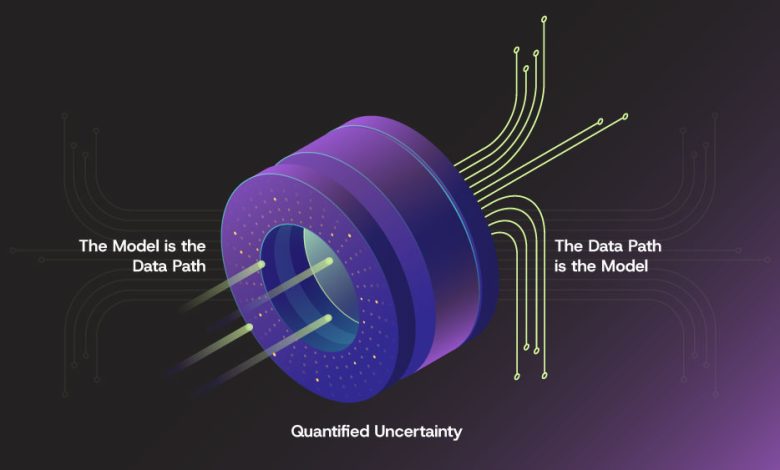
Every major AI system in production today works the same way. You take a dataset, compress it into a set of parameters, and deploy those parameters as a model. The data disappears. The model is all that remains.
This has been the default architecture for over a decade, and for good reason. It works. Large language models, recommendation engines, and predictive analytics platforms all follow this playbook. But as AI moves deeper into regulated industries and high-stakes commercial decisions, the consequences of that architectural choice are becoming harder to ignore.
When a model makes a decision, you cannot trace it back to specific evidence. When conditions change, the model does not know it is wrong. When you need to delete someone’s data, you cannot un-bake the egg.
What if the architecture itself is the problem?
The Cost of Compression
The standard machine learning pipeline treats data as input, models as the locus of intelligence, and training as the transformation that converts one into the other. Once training is complete, the model becomes the product. The data gets archived or discarded.
This separation creates three structural problems that no amount of scale can solve.
First, traceability is indirect at best. Decisions emerge from billions of parameters interacting across high-dimensional spaces. You can build post-hoc explanation tools, but you cannot point to the specific observations that produced a specific output. In regulated industries, including healthcare, finance, and advertising under privacy law, that is not an academic concern. It is a compliance liability.
Second, adaptation is episodic. The model’s knowledge is frozen at the moment training ends. When the world changes, such as when a new competitor enters the market, a regulation takes effect, or consumer behavior shifts, the model keeps operating on stale assumptions until someone decides to retrain it. In the meantime, confidence stays high while validity declines.
Third, generalization is approximate. The model extrapolates from compressed representations that may or may not hold under new conditions. It has no mechanism to assess whether a learned relationship is still valid. It simply assumes it is.
These are not bugs. They are consequences of the architecture.
Why Correlation Breaks Down
Parameter-based systems learn correlations. Given enough data, they approximate the statistical relationships between inputs and outputs, often with impressive accuracy. But correlation has a fundamental limitation. It does not encode uncertainty about itself.
A model trained on two years of purchase data can tell you that consumers who buy organic baby food also tend to buy premium diapers. What it cannot tell you is whether that relationship will hold next quarter, whether it reflects genuine preference or a temporary promotional overlap, or how confident you should be in the pattern if the retail environment changes.
When environments shift, and in CPG, advertising, and retail they shift constantly, correlation-based systems degrade without warning. Their confidence scores remain high even as their real-world accuracy collapses. Anyone who has watched a lookalike audience lose effectiveness after a platform privacy update has seen this firsthand.
This brittleness is not a matter of insufficient training data or model size. It reflects the absence of a mechanism to measure how reliable a relationship is, rather than simply how often it appeared.
Learning as Measurement
There is an alternative. Instead of defining learning as the compression of data into parameters, define it as the continuous measurement of relationships within data itself.
In this framework, the system does not fit a global function. It evaluates how interchangeable individual observations are with one another. The central quantity is uncertainty, specifically how surprising it would be to substitute one observation for another.
If the substitution preserves information, the observations are functionally similar. If it introduces significant surprisal, they are not.
This changes everything about how the system operates. Learning becomes the accumulation of measured relationships, not the optimization of weights. Inference becomes the process of identifying informative analogs within the data and weighting them by their measured reliability. Generalization emerges from consistent local structure rather than global approximation.
The result is that the distinction between data and model dissolves. The dataset itself, annotated with relationships and quantified uncertainty, becomes the model. There is no separate training phase, no fixed parameter set, and no compression of information into abstract weights.
What This Makes Possible
When the model is the data, several things change at once.
Every decision is traceable. Because no information is irreversibly compressed, every output can be traced to the specific observations that produced it. This is not a post-hoc explanation bolted onto an opaque system. It is native to the architecture.
Adaptation is continuous. New observations immediately affect relevance without requiring retraining. The system does not need to wait for an engineering team to schedule a retraining cycle. It incorporates new evidence as it arrives.
Failure is observable. When uncertainty increases, when the system encounters conditions it has not measured well, it can explicitly signal reduced confidence rather than silently producing unreliable outputs. In a parametric model, confidence and correctness can diverge dramatically. In a measurement-based system, they are structurally linked.
Bias is testable, not baked in. Traditional models embed inductive biases during training, including choices of architecture, loss functions, and optimization procedures that shape outcomes in ways that are often opaque and impossible to isolate after the fact. A measurement-based system minimizes such implicit structures. Relationships influence outcomes only to the extent that they reduce uncertainty. If a feature ceases to provide information, its influence diminishes naturally.
A Different View of Intelligence
This framework suggests something important about what machine intelligence actually is, or could be.
The dominant paradigm treats intelligence as increasingly sophisticated function approximation. Build a bigger model, train it on more data, and you get better predictions. This has produced remarkable results, but it also conflates two things: the ability to predict and the ability to know.
A measurement-based approach draws a sharper distinction. Prediction is not the objective. The objective is to evaluate how well-supported a conclusion is by the available evidence. Models do not create knowledge. They approximate it. Systems built on continuous measurement operate directly on the structure of knowledge as it exists in data.
This is not a theoretical argument. It is an architectural one, and it has practical implications for any domain where decisions need to be transparent, auditable, and responsive to change.
Where This Is Heading
The success of parameterized models has shaped the trajectory of AI for over a decade. That trajectory will not reverse. Large language models and deep learning will continue to dominate applications where scale and pattern recognition matter most.
But a growing class of problems demands something different. Transparency that is native, not retrofitted. Adaptation that is continuous, not episodic. Confidence that reflects actual reliability.
For those problems, the alternative is clear. The model is not a separate artifact. It is the data, structured, measured, and interrogated in real time.