AI is becoming a full-fledged assistant in marketing, which helps us speed up our workflow by taking on some of our tasks. Accordingly, 94 percent of marketers now plan to use AI in content creation, and 88 percent already use AI in their daily work.
With the development of AI and the emergence of its new capabilities, a trust crisis in content is becoming increasingly noticeable. People today find it increasingly difficult to trust the content they see on the internet and social media. To wit, AI can easily make all texts perfectly structured, logical and grammatically correct, but they lack humanity, and they all sound exactly the same. To that end, New York authorities recently passed a law, which may take effect as early as June 2026, that requires companies to disclose the use of AI characters in their marketing content.
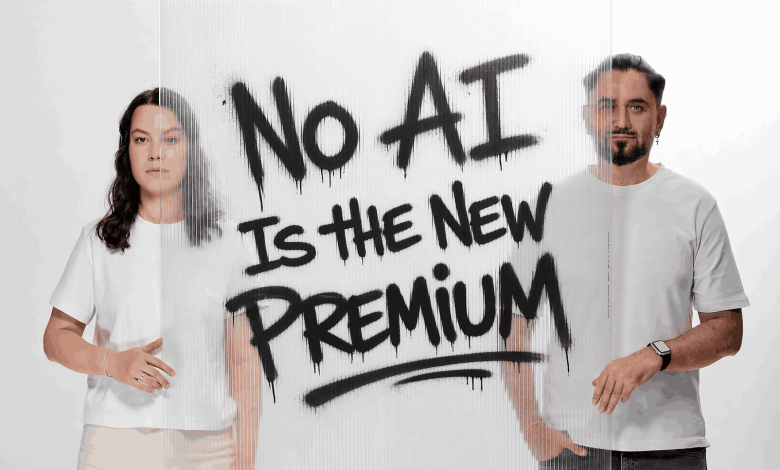
Against this backdrop, a new trend has emerged: humanity, which is unexpectedly becoming a competitive advantage for many brands.
We’re gradually moving to a new reality where everyone wants to see real people on the other side of the screen, including their own opinions, ideas and real stories, and not just some system’s perfectly generated content.
The Risks of Using AI
Along with its benefits, AI also brings risks, especially for those who regularly work on content creation.
When everyone starts using the same tools and similar prompts, the result becomes obvious: We get a feed full of identical content that looks nice and presentable on paper but offers no real value.
A survey of more than 1,000 shoppers conducted as part of the Retail Technology Show found that 53 percent of respondents don’t trust AI-generated social media content. Among Generation Z consumers, this figure rose to 58 percent.
The main problem is that AI can’t share emotions, let alone show the lived experience that makes you you, and everyone feels this perfectly well. If your text doesn’t include your own perspective, reasoning and conclusions, then most likely no one will remember you, including the algorithms.
How to Be Noticed in an AI World
Nowadays, it’s important not only to publish materials on various topics but also to become a trustworthy source; otherwise, you’ll get lost in the noise.
LLMs learn from authoritative sources such as Business Insider, Reuters, CNBC, and Axios, as well as niche publications and repeated messaging. So, it’s important now to share your original content, give comments to the media to establish expertise and repeat the same message often.
Research shows that approximately 94 percent of all links AI cites are media publications, and 82 percent of those come from free sources such as news articles, blogs and analytical materials. This means that the more quality content you publish, the greater the chance that you will appear on AI’s radar.
A logical question arises: How do you create such materials in practice? Below, I will share my tips that will help with keeping your brand human and boosting your visibility for LLMs.
Stop outsourcing your thinking to AI
If you begin work on a piece with the prompt “write me an article” typed into an LLM, consider all further work to be wasted.
AI can help structure an already finished text, correct errors, suggest gaps and possible additions for an article. But AI cannot and should not think for you.
If you don’t put your own expertise and voice into the text, it will sound anonymous. AI search systems will simply compile what was already on the internet, skipping your work and pulling in information that may not even be entirely accurate.
Replace Advice with Experience
You can find material on absolutely any topic on the internet today, but not all of it will be useful. Too much of it is abstract advice people will read and forget the same minute.
For example, in one of our recent articles on visibility in the age of LLMs, co-founder of Around PR Studio Viachaslau Smirnou shared a step-by-step breakdown of how we approach PR in practice.
Instead of generic advice like “publish more content so LLMs will notice you,” the piece showed concrete tactics such as building a founder’s personal brand, structuring articles around LLM-friendly questions, sharing original research, and creating a clear online footprint for the brand.
It also included real outcomes – how some of these articles later started appearing in Google results and even in AI-generated answers.
Try to include more specific examples from your own practice and client case studies in your materials. Add links, screenshots and before-and-after results. The more specifics you can provide, the more exciting it will be for people to read.
Data Makes Your Voice Credible
You also need to share your own research, supported where possible by quantitative data. LLM algorithms love numbers, especially unique ones.
A couple of months ago, together with our client Global Work AI, we conducted a study among remote job seekers. Today, if you search the company’s name on Google or ChatGPT, our research appears on one of the first pages.
Even a small survey or original statistics can become a source that LLMs will reference. Therefore, share interesting data you’ve collected as often as possible to turn your work into the kind of content that AI systems love.
Support Your Ideas with Trusted Sources
Don’t forget to support your thoughts with links to trusted sources: articles, research, statistics and other data.
For finding research and data, reports from major analytical companies such as McKinsey, Gartner, Statista and Clutch are useful, as are materials from major media outlets.
Also, approximately 50 percent of the links AI uses when generating responses are materials published within the last 11 months. Therefore, you need to look not only for useful data relevant to your article, but also check its accuracy and freshness.
Show Real People, Not AI Portraits
Images in your content are just as important as text. Perfect AI-generated images are already irritating many people. People want to see who’s really standing on the other side of the brand. Show yourself, your team and real moments from the company’s life.
As research shows, 95 percent of people have concerns about brands using AI-generated images. Among the main reasons are the risk of deception (71 percent), a sense of inauthenticity (65 percent) and ethical considerations (53 percent).
Here’s a clear example: on the left is a photo of Viachaslau Smirnou, CEO of Around PR Studio, generated by ChatGPT. On the right is one taken at a live photo shoot. Do you see the difference?
Why Is It So Important to Preserve a Human Voice in the Age of AI?
In a world where almost everything can now be generated, the only real competitive advantage left is you. AI can undoubtedly produce text faster, but your experience, ideas, observations, and personal perspective on the world cannot be generated, because they are shaped by the path you have lived.
This is the paradox of our time: AI is no longer just a tool that complements our lives – it is gradually filling them, surrounding us on all sides. Every year, new AI models become more capable, take on more complex tasks, and as a result, content genuinely created by humans is turning into a new kind of luxury and a meaningful competitive advantage.
That is precisely why many brands are now intentionally emphasizing human-created content, openly highlighting its origin in an attempt to capture both readers’ attention and the attention of LLM systems, hoping not to disappear in an increasingly automated information stream.
In reality, the strategy is simple: remain yourself, rely on your own experience and thinking, support your ideas with evidence rather than abstract advice, show real people behind your work, and think carefully before entering yet another prompt asking AI to do the thinking for you.
This article itself was written according to these principles. Below, you will find an AI analysis of the text showing what percentage of it was created by a human.