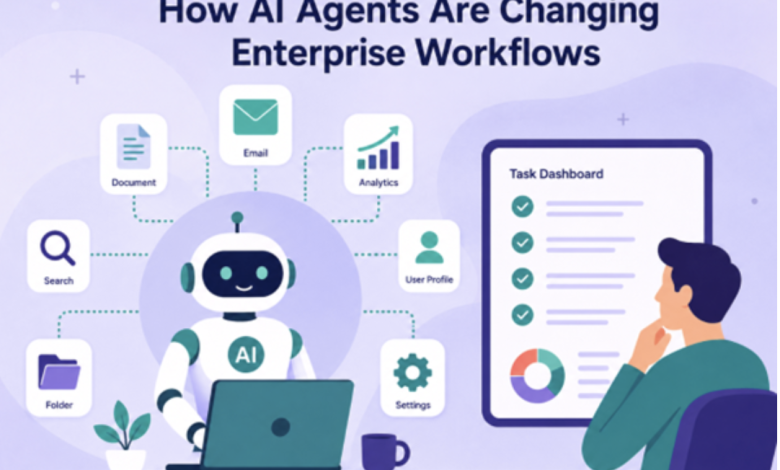
In 2026, AI agents are no longer just chatbots or copilots that wait for a prompt and return a helpful answer. They are becoming systems that can schedule tasks, connect to enterprise tools, perform actions, and operate under human supervision. This matters across many regulated digital environments, including fintech platforms, healthcare portals, and casino sites, where workflow accuracy, compliance, and human oversight are essential.
For CTOs, CIOs, operations leaders, product leaders, and digital transformation teams, this shift matters because it changes how work moves through the organization. The real question is not whether AI can write a message or summarize a document. It is how enterprise AI agents can participate in workflows, reduce manual handoffs, and support decisions while people stay in control.
Why 2026 Is the Turning Point for Enterprise AI Agents
The timing matters because Gartner predicted this shift before it became visible at scale. It forecast that by 2026, 40% of enterprise applications would include integrated task-specific AI agents, compared with less than 5% in 2025. That prediction is now playing out: agentic capability is moving from experimental pilots into everyday enterprise software, where agents support real workflows, connect to business systems, and handle defined tasks within controlled approval frameworks.
The change is the move from AI assistants to agentic workflows. Before, an AI tool helped an employee complete one task, such as drafting an email or finding a policy. Now, an agent can manage part of a process: collect data, check rules, create a report, update a system, and pass the task to the next application.
This is not the complete replacement of people. It is a shift in the operating model. Employees become supervisors, reviewers, exception handlers, and orchestrators. Agents handle repeatable steps, while people own judgment and accountability.
From Task Automation to Workflow Orchestration
Classic automation and RPA are useful, but they depend on strict rules. If the input changes, the format breaks, or the context is unclear, automation often fails. AI agents are different because they can interpret context, choose the next step, and work across several systems. This is why agentic AI workflows are attractive for complex processes. Here are some practical examples of how this shift looks inside everyday enterprise workflows:
- A sales agent updates the CRM, prepares a follow-up, and suggests the next best action.
- A finance agent verifies invoices, flags anomalies, and prepares an approval summary.
- An IT agent analyzes logs, suggests remediation steps, and creates a ticket.
The value is not only speed. It is continuity. Instead of asking employees to move information between applications, the agent keeps work moving and asks for help when confidence is low or risk is high.
The Enterprise Workflows Most Likely to Be Rebuilt First
Not every process should be agentified immediately. The first candidates are workflows with high volume, clear rules, repeatable decisions, and measurable outcomes. These are areas where agents can reduce delays without taking over sensitive judgment. Leaders should look for processes with many handoffs, status checks, document reviews, and routine reports.
Customer Support and Service Operations
Customer service will change quickly because many support workflows are repetitive, data heavy, and time sensitive. Agents will not only answer questions. They will check order status, update customer records, escalate complex cases, and prepare summaries for a human support manager.
This makes customer support automation more useful than a basic chatbot-only setup. A service agent can understand the request, find the account, review recent interactions, suggest a response, and create the next action. For sensitive complaints, the agent should hand the case to a human with a clear summary.
Finance, Procurement, and Back-Office Processes
Finance and procurement teams spend a lot of time reviewing documents, matching data, and chasing approvals. AI agents for back-office processes can reduce this load by checking invoices against purchase orders, flagging unusual spend, preparing approval notes, and supporting vendor risk checks.
The strongest value comes from exception control. An agent can handle routine matching and routing, while people focus on unusual cases, policy conflicts, fraud signals, and supplier issues. This reduces cycle time without weakening control.
IT, Security, and Infrastructure Operations
IT and security teams already work with alerts, logs, tickets, and policies. Agents can monitor systems, analyze incidents, check policies, route tickets, and recommend remediation steps. In this area, the difference between helpful and risky automation is governance.
Enterprises should not expect agents to resolve all incidents alone. For low-risk tasks, such as gathering logs or creating a ticket, automation can be direct. For high-risk actions, such as changing permissions, isolating systems, or modifying infrastructure, human approval should remain mandatory.
Knowledge Work and Internal Operations
Knowledge workers often lose time switching between documents, dashboards, emails, and internal systems. AI agents can reduce this friction by finding relevant data, preparing short briefs, comparing documents, and collecting research from approved sources. They can also turn recurring tasks, such as weekly summaries, meeting notes, status updates, and performance reports, into structured outputs that employees can review and refine. This is where AI automation in business operations becomes especially practical: the agent does not replace expert judgment, but it removes repetitive preparation work, so teams can focus on decisions, analysis, and execution.
Data Quality Becomes the Real Bottleneck
AI agents depend on accurate, current, and authorized data. If data is fragmented, outdated, duplicated, or poorly labeled, the agent will make mistakes or slow the process by asking for clarification. Data readiness becomes a board-level issue in 2026.
Production-ready agents need clean data pipelines, access control, data lineage, APIs, audit logs, and clear information ownership. They also need permission boundaries that match business roles. A finance agent should not see every HR file, and a support agent should not change billing rules without approval. Companies that fix data foundations will see safer automation and more reliable outcomes.
Human-Agent Collaboration Will Redefine Roles, Not Remove Them Overnight
The biggest workforce change in 2026 is not mass replacement. It is role redesign. Employees now spend less time on repetitive execution and more time on review, decision-making, exception handling, strategy, and quality control.
This change requires training. People need to know when to trust an agent, when to challenge it, how to review its reasoning, and how to escalate a case. Managers also need metrics for accuracy, intervention rate, customer impact, and business value. Companies that train employees to work with agents, rather than simply buying tools, gain a competitive advantage. The best teams treat agents as digital coworkers with limits.
Governance, Security, and Compliance Move to the Center
As agents gain access to enterprise systems, risk increases. The key risks include unauthorized actions, data leakage, hallucinated outputs, poor auditability, and unclear accountability. Strong governance must be built before scaling, not added after something goes wrong. This is especially important when an agent can read records, trigger workflows, or recommend actions that affect customers, money, access, or compliance. To reduce these risks, enterprises need a clear control model before agents are allowed to act inside live business systems. Practical controls include:
- Define what agents can and cannot do.
- Require approvals for sensitive actions.
- Log agent decisions.
- Monitor cost and performance.
- Test agents before production deployment.
This governance model should be simple enough for teams to use and strong enough for auditors to trust. Every agent needs a clear owner, a defined scope, and a fallback path. Leaders should also review agent behavior regularly because processes, policies, and data sources change. Scaling safely depends on visibility, testing, and accountability.
What Enterprise Leaders Should Do Before Scaling AI Agents
Enterprise leaders should start with one high-impact workflow, not a company-wide rollout. Choose a process with clear pain points, visible cost, and manageable risk. Then assess value and risk, prepare data and integrations, set guardrails, train employees, and measure ROI using cycle time, task cost, error rate, customer response time, and employee productivity. Each deployment should improve the operating model, not just add another AI tool.
The Future of Enterprise Workflows Is Agentic, but Not Fully Autonomous Yet
In 2026, the real shift is not just smarter AI, but agents that connect to business systems and carry out defined parts of real enterprise processes. They collect data, update tools, prepare summaries, and trigger next steps under defined rules.
The next stage is agentic, but human control, approval paths, and governance still define the operating model. The companies gaining the most value do not pursue autonomy for its own sake. They build reliable, human-controlled workflows with strong data, governance, and measurable business value. That is how AI agents move from demos to trusted enterprise infrastructure.