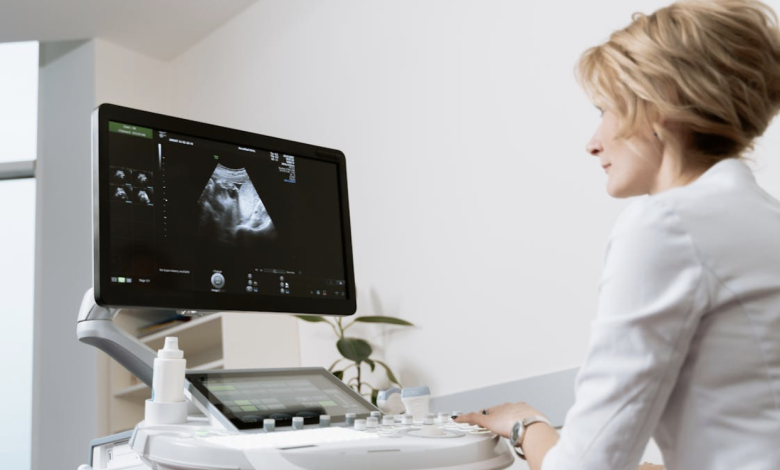
Real-time diagnostic accuracy can mean the difference between immediate treatment and dangerous delay. AI-powered ultrasound systems are changing what clinicians can see, measure, and decide within seconds of placing the probe on a patient.
From emergency departments to maternity units, intelligent imaging tools are helping professionals make faster and more confident calls.
Reducing Measurement Variability
Ultrasound has always relied heavily on operator skill. Small differences in probe angle or measurement placement can lead to variations in results, especially in cardiac and obstetric scans.
But how is artificial intelligence changing ultrasound? As we’ll see, AI ultrasound is improving diagnostic accuracy. And that’s one reason why clinical training now often involves using AI ultrasound tools.
According to recent research, AI-driven segmentation and automated quantification significantly reduce inter- and intra-observer variability in echocardiography. For clinicians, that means fewer conflicting measurements and more consistent diagnoses, even across busy teams.
Automated tools can calculate ejection fraction, chamber size, or fetal parameters in seconds. Instead of manually tracing structures frame by frame, clinicians receive instant, standardised outputs that support real-time decisions at the bedside.
A study on automated fetal biometry in PubMed demonstrated strong agreement between AI-generated measurements and expert assessments. Greater reproducibility translates directly into improved diagnostic confidence during time-sensitive appointments.
Guiding Image Acquisition
Capturing a diagnostic-quality image is half the battle. Inexperienced users often struggle with probe positioning, leading to incomplete or low-quality scans.
AI-guided acquisition helps novice users obtain diagnostic-quality echocardiograms. On-screen prompts and real-time feedback improve image capture and reduce the need for repeat attempts.
For patients, that means shorter scan times and fewer uncomfortable repositioning attempts. For healthcare systems, it expands access to high-quality imaging in settings where specialist sonographers are not always available.
Accelerating Interpretation
Speed matters in acute care. When clinicians can interpret results instantly, patient pathways move faster and treatment begins sooner.
An integrated AI tool is capable of estimating gestational age from ultrasound sweeps in real time on the device itself. Immediate processing supports clinical decision making without sending images off-site for analysis.
Faster interpretation reduces bottlenecks in emergency and outpatient departments. Clinicians can triage more effectively, prioritise urgent cases, and reduce waiting times without sacrificing diagnostic precision.
Enhancing Accuracy in Specific Clinical Applications
AI ultrasound systems are not just faster. They are also detecting subtle patterns that can be difficult to spot consistently.
AI-based computer-aided diagnosis can improve both efficiency and accuracy in breast ultrasound, for instance. Thus, it can help to reduce missed lesions and unnecessary uncertainty.
Improved accuracy in targeted applications often stems from three core AI capabilities:
- Automated lesion detection that highlights suspicious regions in real time
- Risk stratification tools that classify findings based on learned patterns
- Consistency checks that flag measurements outside expected ranges
Each of these functions supports clinicians at the exact moment a decision is being made. Instead of reviewing images retrospectively, practitioners receive structured insights during the live scan.
Across cardiology, obstetrics, oncology, and emergency medicine, AI-enhanced systems are transforming ultrasound from a purely operator-dependent modality into a data-supported diagnostic partner.
Expanding Access Without Compromising Precision
Many healthcare settings face workforce shortages and increasing demand. Traditional ultrasound training takes years, and expert interpretation is not always available in remote or under-resourced environments.
AI-guided systems reduce the skill gap by embedding expertise directly into the device. Real-time prompts, automated calculations, and built-in quality checks help ensure diagnostic-grade output even in point-of-care settings.
Greater accessibility does not mean lower standards. Artificial intelligence can maintain, and in many cases improve, diagnostic accuracy compared with manual workflows.
Patients benefit through faster diagnoses, fewer repeat scans, and more consistent results. Clinicians benefit from reduced cognitive load and structured decision support. Healthcare systems benefit from improved efficiency without cutting corners on care.
Improving Real-Time Diagnostic Accuracy With AI Ultrasound
Real-time diagnostic accuracy is no longer a distant goal; it is becoming the standard. AI ultrasound systems are reducing variability, guiding image capture, accelerating interpretation, and enhancing decision support across clinical environments.
Healthcare professionals who want to stay ahead of these developments should understand how AI ultrasound is reshaping everyday practice.
Has this article been helpful? If so, take a moment to explore some of our other insightful content!