
Key Takeaways
Setting up agentic payment checkouts in ChatGPT opens access to 700 million weekly users, but requires careful technical implementation and compliance with specific requirements.
- U.S.-only launch with platform advantages: Currently limited to U.S. merchants and users, with Shopify getting automatic access and Etsy sellers already integrated through existing dashboards.
- Single-item purchases only until 2026: The system supports one product per transaction, requiring merchants to optimize for high-converting individual SKUs rather than multi-item carts.
- Technical integration demands precision: Success requires exact API schema compliance, proper webhook signatures, and real-time product feed updates every 15 minutes with specific required fields.
- Payment tokens need exact matching: Stripe’s Shared Payment Token must precisely match merchant ID and cart total, while other processors can integrate via delegated payments API.
- Organic ranking with no paid placement: Product visibility depends purely on relevance, availability, price competitiveness, and quality signals—not advertising spend or preferential treatment.
The opportunity for conversion lifts up to 33% makes the technical complexity worthwhile, but merchants must prepare for rigorous certification requirements and ongoing webhook monitoring to maintain order synchronization. Agentic payment checkouts in ChatGPT just opened the door to 700 million weekly users. ChatGPT transformed into a checkout counter, with Walmart integrating its entire product catalog and making 270 million weekly customers discoverable through conversational AI.

The chance is massive. Studies show AI-assisted buying experiences can increase conversions by 25%, while early tests report conversion lifts of up to 33%. But setting up instant checkout isn’t straightforward. Some implementations have seen conversions drop three times compared to standard websites.
We’ll walk you through exactly how to set up agentic payment checkouts in ChatGPT in this piece. Merchant requirements, API integration, testing and troubleshooting-we’ll cover everything you need to get started without delay.
What You Need Before Setting Up Agentic Payment Checkouts
U.S. merchant and user requirements
Instant Checkout launched for U.S.-based merchants and users. The feature supports ChatGPT Plus, Pro, and Free users, but both buyer and seller must operate within the United States. Etsy sellers have access, with orders processing through their existing seller dashboard. Shopify merchants receive automatic eligibility without application or integration work, as Shopify handles the backend implementation and rolls out access in phases.
Merchants outside these platforms need to apply through and implement the Agentic Commerce Protocol. The system supports single-item purchases only at launch. Multi-item carts, expanded categories, and international availability are scheduled for 2026.
Product data readiness checklist
Your product feed serves as the source of truth for ChatGPT. Each product requires these fields: item_id, title, description, url, brand, price with currency code, availability status, seller_name, seller_url, and return_policy URL. Checkout-enabled products must include seller_privacy_policy and seller_tos URLs. The feed supports updates every 15 minutes and allows up-to-the-minute synchronization of pricing and inventory. Products need is_eligible_search and is_eligible_checkout flags set to true for ChatGPT integration.
Payment provider compatibility
Merchants processing with Stripe can enable agentic payments in as little as one line of code. Stripe issues a Shared Payment Token (SPT) scoped to a merchant and cart total. You can still participate if you use another payment processor by using Stripe’s Shared Payment Token API or adopting the Delegated Payments Spec with your existing provider. PayPal will support the delegated payments API for card payments starting in 2026.
API and webhook capabilities
Your integration requires pre-defined API endpoints under ‘/checkout_sessions’ to manage checkout sessions. The APIs need support for request-id and idempotency headers. You must send webhooks for ‘order_created’ and ‘order_updated’ events to keep ChatGPT synchronized with order status.
Compliance and merchant responsibilities
You remain the merchant of record and handle order acceptance or decline, payment processing, sales tax calculation, fulfillment, and returns. The Agentic Commerce Protocol preserves your customer relationship and existing systems.
How to Set Up ChatGPT Instant Checkout Step by Step
Step 1: Apply for merchant access
Visit and submit your application. You’ll provide product categories, catalog size, and your planned integration approach. OpenAI grants access to commerce documentation and protocol references after approval, along with a unique SFTP endpoint with authentication credentials for feed delivery.
Step 2: Prepare your product feed
Start with a sample feed containing about 100 representative products. Format your data as .jsonl.gz, .csv.gz, or Parquet with UTF-8 encoding. The required fields include feed_id, account_id, target_merchant, target_country (ISO 3166-1 alpha-2), product id, variant id, and variant title. Push the sample to your SFTP endpoint to validate. Common rejection reasons include missing required fields, malformed data types, invalid URIs, non-unique product IDs, and pricing mismatches between the feed and your website. Push your complete catalog after validation passes.
Step 3: Build checkout API endpoints
Implement five REST endpoints that conform to the Agentic Checkout OpenAPI specification. You need POST /checkout_sessions to create sessions, POST /checkout_sessions/{checkout_session_id} to update sessions, GET /checkout_sessions/{checkout_session_id} to retrieve current state, POST /checkout_sessions/{checkout_session_id}/complete to finalize orders, and POST /checkout_sessions/{checkout_session_id}/cancel to cancel sessions[134]. All endpoints must use HTTPS and return JSON. They must include headers for Authorization, Idempotency-Key, Request-Id, Signature, and Timestamp.
Step 4: Integrate payment tokens
Connect your payment processor through the Delegated Payment Spec. Stripe merchants should enable Shared Payment Token (SPT) support. The SPT gets scoped to your merchant ID and basket total. ChatGPT passes the token to your backend via API during checkout completion. Your system then processes the transaction through your existing provider.
Step 5: Set up post-purchase webhooks
Send order_created and order_updated events to OpenAI’s webhook endpoint. These events keep ChatGPT synchronized with live order status, including shipping updates and fulfillment changes.
Step 6: Test and certify your integration
OpenAI requires protocol conformance checks before live orders begin. Validate payloads and schemas, ensure webhook delivery, test error handling, and confirm API idempotency. Your products become eligible for Instant Checkout after certification.
Understanding the Agentic Commerce Protocol for Payments
How product discovery works in ChatGPT
ChatGPT accesses your product feed to surface items in shopping conversations. The feed replaces traditional product pages and tells the AI what’s for sale and whether stock exists. A shopper asks for recommendations, and ChatGPT parses the feed to match their intent. Products appear with a Buy button only if marked eligible for checkout and currently available.
Product rankings are organic and unsponsored. They’re based purely on relevance to the user. ChatGPT thinks about availability, price, quality, whether you’re the main seller, and checkout capability to rank multiple merchants selling similar products. Instant Checkout items receive no preferential placement in results.
The checkout flow and cart creation
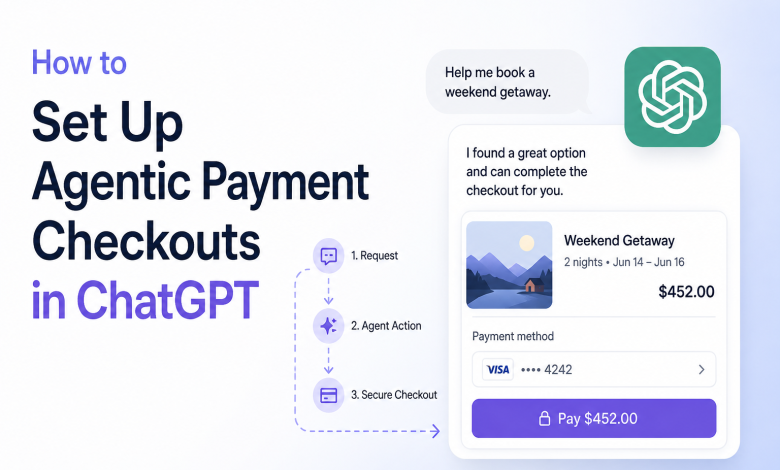
A buyer clicks Buy, and ChatGPT creates a checkout session via API call to your backend. Your system stores the order details and calculates shipping and taxes, then returns a structured response. ChatGPT guides the shopper through address, shipping, and payment selection. Each confirmation or change triggers another update request to the same session on your system. Payment gets approved, ChatGPT triggers the complete call, and your backend finalizes the order.
Delegated payment tokens explained
Stripe generates a Shared Payment Token (SPT) once the user chooses to pay. The SPT is a secure, single-use token scoped to your merchant ID and cart amount with limited expiration. It contains no raw card data and keeps PCI scope minimal. Your backend redeems the token via Stripe or another payment provider to process the charge.
Webhook events for order management
You send order_create and order_update events to OpenAI’s webhook endpoint to maintain order status synchronization. Requests must include an HMAC signature in the Merchant-Signature header. The data field must contain the full Order object.
Common Setup Challenges and How to Fix Them
Single-item purchase limitations
ChatGPT’s checkout flow supports single-item purchases only. Multi-item carts won’t arrive until 2026. This constraint forces you to optimize for high-converting individual SKUs. Each product requires a separate transaction. Customers who ask to buy multiple items from your catalog will face repeated checkout steps. Focus your original product feed on bestsellers and items with strong standalone appeal.
Visibility and ranking issues
ChatGPT search results carry no guarantees for appearance. Ranking is contextual and query-dependent. Two merchants with similar products may see vastly different placement based on relevance, price competitiveness, and availability. Update your product feed with enriched attributes on a regular basis. Accurate pricing, immediate inventory, and complete metadata improve your chances of surfacing in relevant conversations.
Technical integration errors
Missing fields, incorrect tax computation, and unverified webhook signatures will block transactions. ACP-compliant endpoints require exact schema matches. Test each endpoint against OpenAI’s conformance checks. Verify request headers, idempotency handling, and error responses before certification.
Payment token configuration problems
Stripe’s Shared Payment Token must match your merchant ID and cart total. Mismatched scopes cause payment failures. Verify your PSP integration returns valid tokens within expiration windows.
Webhook reliability and monitoring
Webhook delivery issues create order sync problems. Implement retry logic, verify HMAC signatures, and monitor delivery rates. Track order_created and order_updated events to maintain accurate order status in ChatGPT.
Conclusion
You now have the roadmap to set up agentic payment checkouts in ChatGPT. Start with your product feed and build compliant API endpoints. Combine payment tokens smoothly into your system. Focus on high-converting single items until multi-cart support arrives in 2026. The technical hurdles are real. But the reward is access to 700 million weekly users. Keep testing and monitoring webhooks while you optimize your feed to improve visibility.
FAQs
Q1. How does the ChatGPT checkout process function?
ChatGPT acts as a digital intermediary between shoppers and merchants, securely passing information back and forth during the purchase process. When a user clicks “Buy,” ChatGPT creates a checkout session with the merchant’s backend, guides the user through address and payment selection, and finalizes the transaction. Merchants pay a small fee on completed purchases, but the service remains free for users and doesn’t affect product pricing or search rankings.
Q2. What is an agentic checkout in the context of ChatGPT?
Agentic checkout refers to AI-powered payment processing where ChatGPT serves as an autonomous agent facilitating transactions between buyers and sellers. The system uses the Agentic Commerce Protocol to manage product discovery, cart creation, payment token handling, and order completion—all within a conversational interface. This approach allows merchants to reach ChatGPT’s 700 million weekly users through natural language shopping experiences.
Q3. Can users complete purchases directly within ChatGPT?
Yes, users can purchase products directly inside ChatGPT through the Instant Checkout feature. Currently available for U.S.-based merchants and users, the feature supports single-item purchases for ChatGPT Plus, Pro, and Free users. When a product appears with a “Buy” button during a shopping conversation, users can complete the entire transaction—including address entry, shipping selection, and payment—without leaving the chat interface.
Q4. Who is eligible to use ChatGPT’s shopping and checkout features?
The Instant Checkout feature is exclusively available for U.S.-based merchants and users. Shopify merchants receive automatic eligibility with phased rollout, while Etsy sellers can process orders through their existing dashboard. Other merchants must apply at and implement the Agentic Commerce Protocol. Both the buyer and seller must operate within the United States to complete transactions.
Q5. What are the main technical requirements for setting up ChatGPT checkout?
Merchants need a properly formatted product feed with required fields like item_id, price, availability, and policy URLs. They must build five REST API endpoints for checkout session management, integrate payment tokens through Stripe or another compatible processor, and implement webhooks for order status updates. All endpoints must use HTTPS, return JSON responses, and pass OpenAI’s protocol conformance checks before going live.