

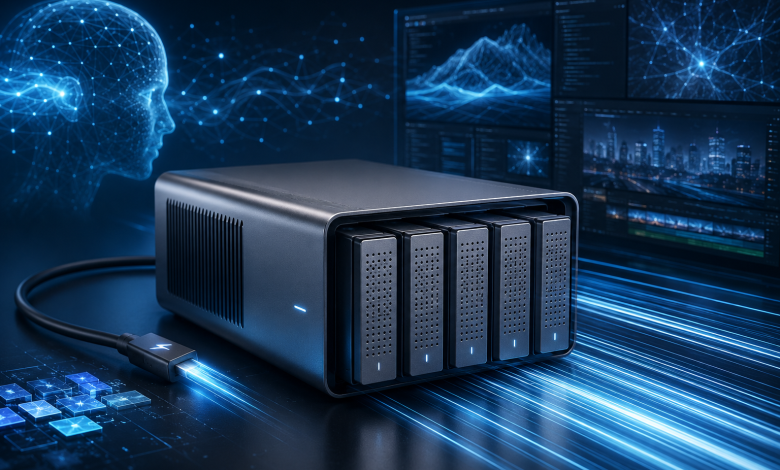
As local AI workloads become increasingly common, storage infrastructure is quietly emerging as one of the biggest bottlenecks for creators and developers. Large language models, multi-stream 8K editing, and real-time AI pipelines are placing demands on storage systems that traditional multi-bay architectures were never designed to handle.
That’s the everyday reality for most creators and developers using traditional multi-bay storage. The reason is simple: most systems share bandwidth across all connected drives. More active bays mean less speed per drive, and that’s just accepted as normal.
A new multi-bay Thunderbolt™ 5 storage system just challenged that assumption head-on, and the results are turning heads everywhere.
Why Shared-Bandwidth Architectures Are Becoming a Limitation
Conventional multi-bay storage systems typically distribute bandwidth across all connected drives. While this approach works adequately for lighter workloads, the limitations become increasingly visible when handling AI processing, high-resolution media assets, or large-scale local datasets.
For AI developers, this often translates into slower model loading, delayed preprocessing, and longer iteration cycles. For video teams working with RAW footage or multi-camera timelines, bandwidth contention can quickly introduce playback bottlenecks and workflow interruptions.
As AI and media pipelines continue shifting toward local environments, storage performance is becoming more than just a hardware specification. It is increasingly part of overall workflow efficiency.
Thunderbolt™ 5 Is Raising Expectations for External Infrastructure
The transition to Thunderbolt™ 5 introduces significantly higher throughput ceilings for external devices, creating opportunities for storage systems that move beyond traditional shared-bandwidth design.
One emerging approach is dedicated per-bay bandwidth architecture, where each NVMe SSD operates independently rather than competing for shared resources.
This shift could become increasingly relevant as local AI infrastructure grows in importance across creative, enterprise, and development environments.
A New Approach to Multi-Bay Storage Performance
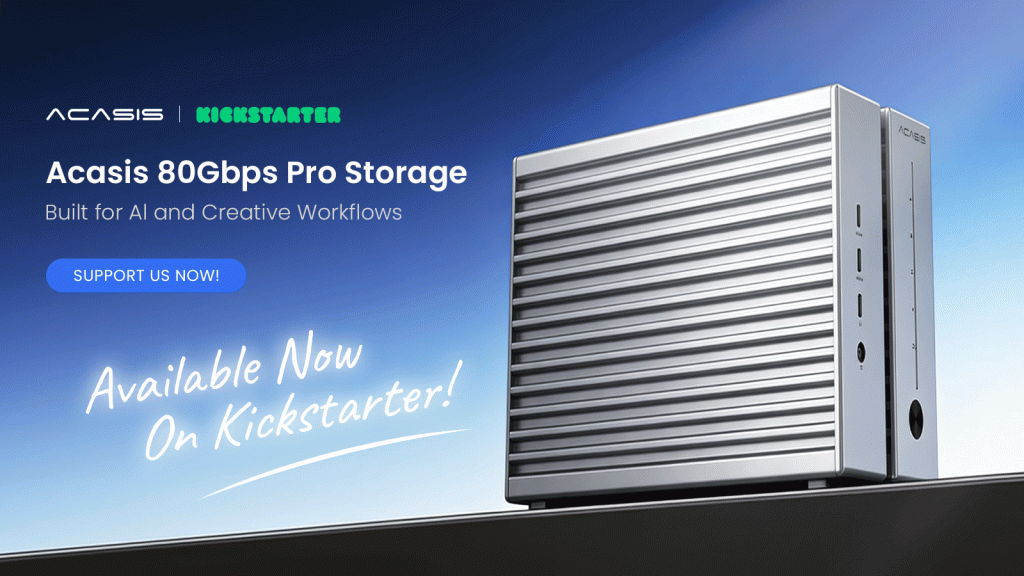
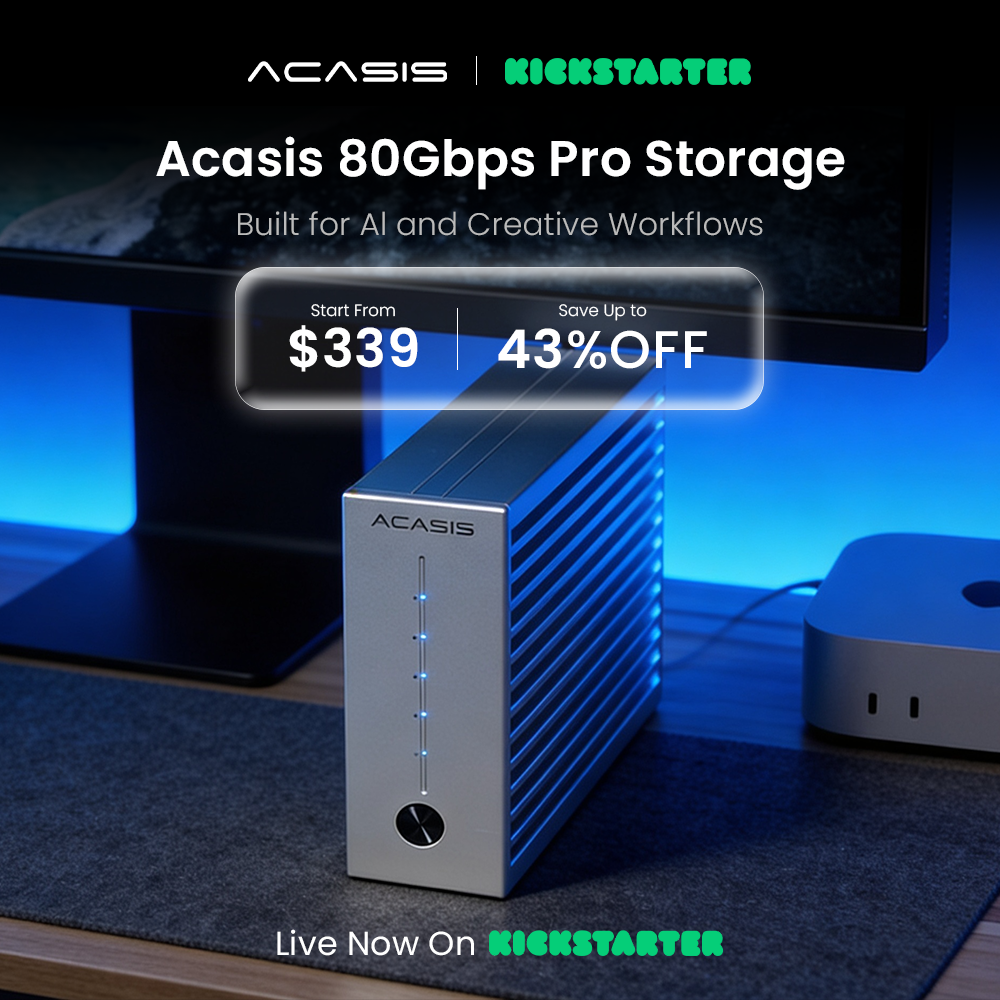
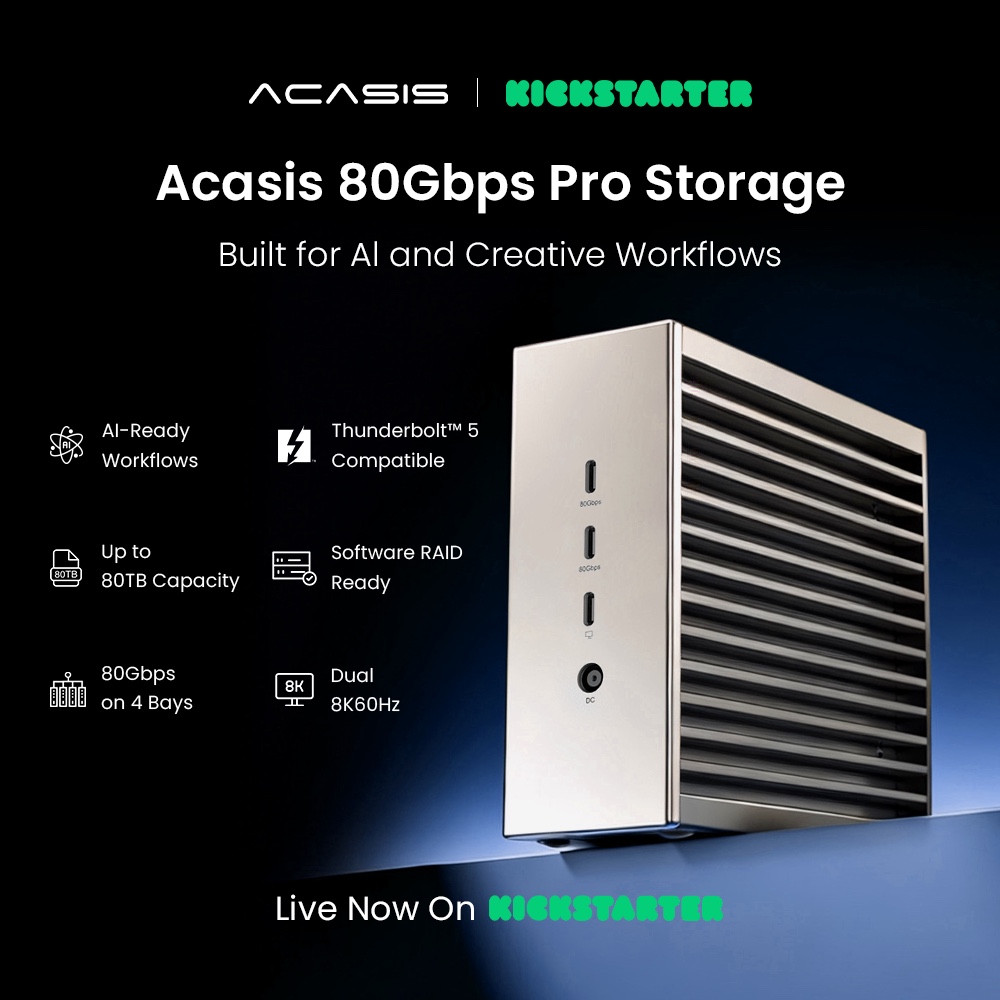
One example of this architectural direction is the latest 80Gbps Pro Storage introduced by ACASIS.
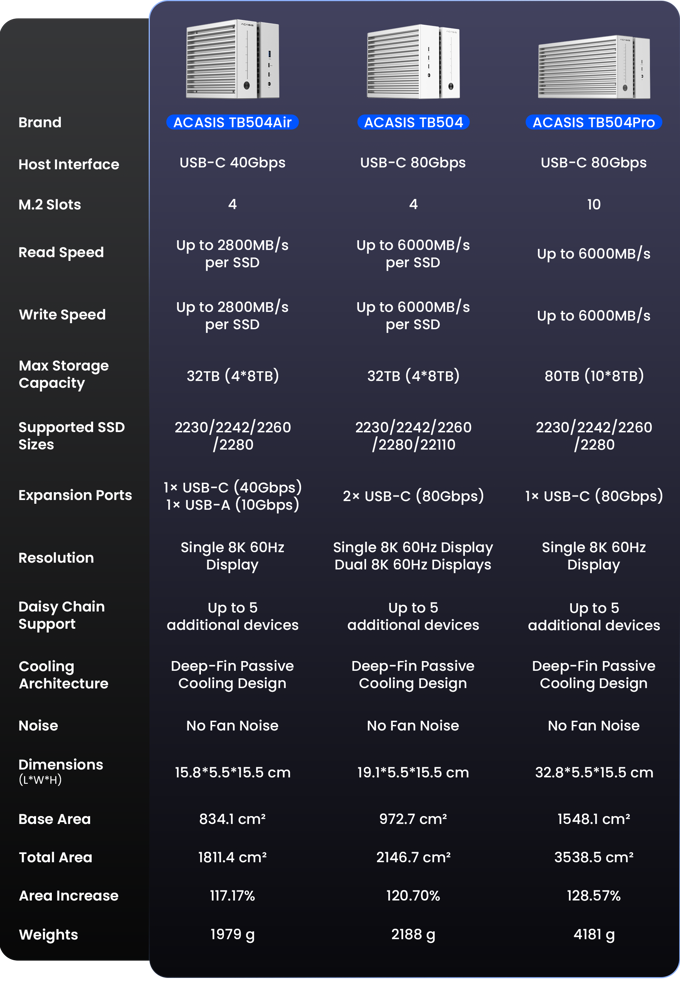
Rather than splitting total bandwidth across all drives, the system is designed to provide nearly 80Gbps of dedicated bandwidth per bay. In practical terms, each NVMe SSD can maintain transfer speeds exceeding 6,000+ MB/s, even when multiple bays are active simultaneously.
That distinction matters for workflows involving large AI models, vector search indexing, real-time media caching, or high-volume local data processing, where sustained throughput directly affects productivity.
The system supports M.2 NVMe SSDs in 2230, 2242, 2260, and 2280 form factors, covering virtually every M.2 drive available today. 3 models are on offer:
Software RAID functionality is also included, with support for RAID 0, RAID 1, RAID 10, and Large Volume configurations depending on whether users prioritize speed, redundancy, or flexible pooled storage.
Why Cooling and Acoustics Matter More in AI Workflows
As local AI workloads become more persistent, thermal stability is becoming a more important consideration for storage infrastructure.
Long-running inference tasks, overnight dataset preprocessing, and extended editing sessions can place sustained pressure on external hardware. In many studio or home-office environments, cooling noise also becomes a daily usability issue.
To address this, ACASIS adopts a fanless aluminum chassis with passive cooling fins integrated across the enclosure surface. The result is silent operation without introducing additional moving parts into the system.
For creators and developers working in always-on environments, silent and thermally stable infrastructure can significantly improve day-to-day workflow comfort.
The Growing Shift Toward Local AI Infrastructure
One of the broader trends emerging across the AI industry is the movement toward more localized infrastructure strategies.
While cloud platforms remain essential, many teams are increasingly building hybrid workflows that combine local compute, local storage, and edge-based processing for greater speed, privacy, and operational control.
This is particularly visible among:
- AI developers working with local LLMs and retrieval systems
- Video production teams handling multi-stream 8K workflows
- Photographers and media professionals managing large archival datasets
- Creative studios seeking lower-latency production pipelines
As these workflows evolve, storage systems are no longer viewed simply as passive accessories. They are becoming active components of AI and content production infrastructure.
A Storage System That Means Business
The broader significance of systems like these may not simply be higher transfer speeds, but a shift in how professionals think about local infrastructure altogether.
ACASIS will officially launch its FlowCore Series 80Gbps Pro Storage lineup on Kickstarter on May 15, 2026, at 9:00 AM ET.
The campaign will introduce both the TB504 four-bay model and the TB504Pro ten-bay configuration, targeting creators, AI developers, and professional users looking for higher-performance local storage infrastructure built around Thunderbolt™ 5.