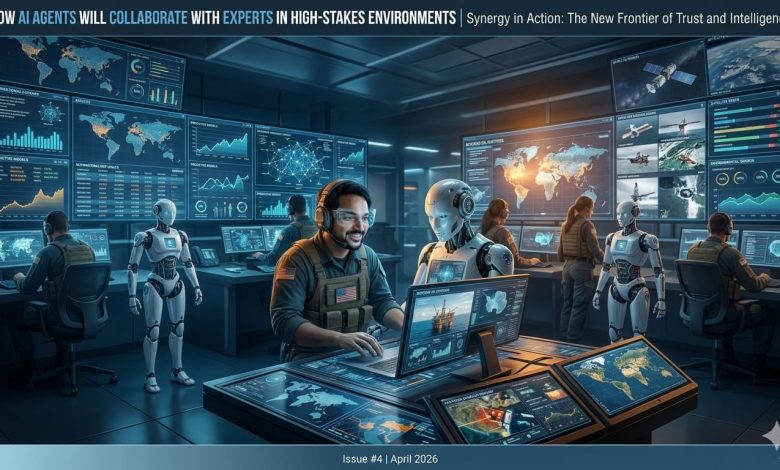
There’s been a quiet shift going on in organizations for a long time. AI, once used only as a tool to process data and generate results, has faced a functional update in its usage. In cut-throat business environments like financial operations, cybersecurity, clinical workflows, and mission-critical infrastructure, where speed and complexity are crucial for growth and success, AI is no longer waiting at the sidelines. It is taking the forefront of operations.
This has resulted in a new operating model. Not one where humans are using AI, neither is AI replacing humans. According to Forbes, it is a model forming hybrid teams where humans and AI contribute what the other cannot.
An evolution from “human-in-the-loop” system
Traditionally, the old model has assumed that results are handed over to humans to review and decide after AI generates the output. This worked when the functions were minute and the stakes were moderate. When the environment is controlled by high data velocity, time pressure, and distribution complexity from operational pressure, it breaks down.
This is a process where human oversight does not disappear but becomes a limitation.
With the new usage where humans are “in-the-system”,
- Humans and AI work within a shared decision loop
- Oversight is continuous but not limiting
- Decisions are co-produced
This fresh approach integrates AI directly into the work process instead of layering it on top of it. It does not reduce human authority. McKinsey’s Agents, Robots, and Us report says it redistributes human judgement across processes, shifting its focus to where it is needed the most while allowing AI agents to take charge of execution.
What makes hybrid teams actually work?
The success and effectiveness of human-AI teams are not dependent on how powerful the AI is. It rests fully on a system designed to be complementary, not one replacing the other.
AI agents bring:
- Real-time large-scale data processing
- Pattern detection across large variables and nuances
- Consistent task execution without getting tired
Human experts bring:
- Contextual reasoning for unique situations
- Ethical judgement
- Ability to take accountability for decisions
The system itself must provide an environment where;
- Both agents work from a shared context with aligned information
- Roles and responsibilities are dynamic and can shift based on complexity and urgency
- Trust is calibrated with a clear understanding of when AI can act and where human oversight is needed.
ICT & Health Healthcare case study
Hybrid systems have already found their place in modern healthcare systems where decisions impact patient outcomes. An ICT & Health research shows that instead of completely replacing clinicians, AI is working alongside these experts to improve diagnostic accuracy and coordination.
Nature briefing AI and robotics also made a great case for hybrid systems where AI is embedded into clinical workflows. It analyzes patient data in real time, prioritizes critical cases, and highlights unique insights that clinicians might miss when pressured for time.
This integration has also produced measurable results in research that compares diagnostic performance across human-only, AI-only, and hybrid teams. This research found that human-AI combinations (hybrid teams) consistently outperform systems where either of them works alone, especially in complex cases where there are multiple possible diagnoses.
This means that hybrid teams are not just making faster decisions, but more accurate and better-informed ones.
Conclusion
In industries where decision-making and effective workflows are crucial to growth, hybrid teams are quickly becoming the standard. The evidence from 2025 and into 2026 is consistent: the advantage does not lie with the organization with the most powerful AI. It goes to the organization that understands and designs the most effective collaboration between humans and agents.
Looking to the future, here are a few certainties.
- The human-to-agent ratio will become a core part of an organization’s operational metric, as important as budget allocation.
- Organizations that treat AI as a tool instead of a design principle will encounter traditional roadblocks that hinder growth in the digital age.
- The competitive advantage belongs to enterprises that treat hybrid teams as a competitive advantage, leveraging unified capability, instead of parallel tracks.
The question that engineers, CTOs, founders, and investors face is no longer if AI agents will be part of high-stakes decision-making. It is whether your organization’s architecture is built to adopt the changes and make that collaboration reliable, accountable, and scalable.
Harsh Verma is an AI and cybersecurity innovator & Principal AI Engineer focused on advancing autonomous agent systems and intelligent AI strategies. He helps navigate the shift toward AI-native security models and prepares organizations for emerging “AI vs. AI” threat landscapes. As a speaker, mentor, and advisor, he brings both technical depth and strategic guidance to leaders adopting next-generation AI capabilities. He drives responsible, scalable AI adoption. His work influences how enterprises innovate, secure, and operationalize the next generation of intelligent systems.
Harsh specializes in offering scalable AI solutions, mentoring aspiring entrepreneurs, delivering impactful conference talks, and advising startups on their AI strategies. Whether it’s navigating AI implementation, preparing for technical interviews, or fostering innovation with AI, Harsh is committed to delivering meaningful results in the tech industry.