Every business publication, every conference keynote, every LinkedIn post seems to be about the same thing right now: generative AI. And rightfully so – the technology is transformative. Small and medium business (SMB) owners across the country are experimenting with AI-powered writing tools, virtual assistants, and conversational interfaces. That’s a great start. But it’s only a start.
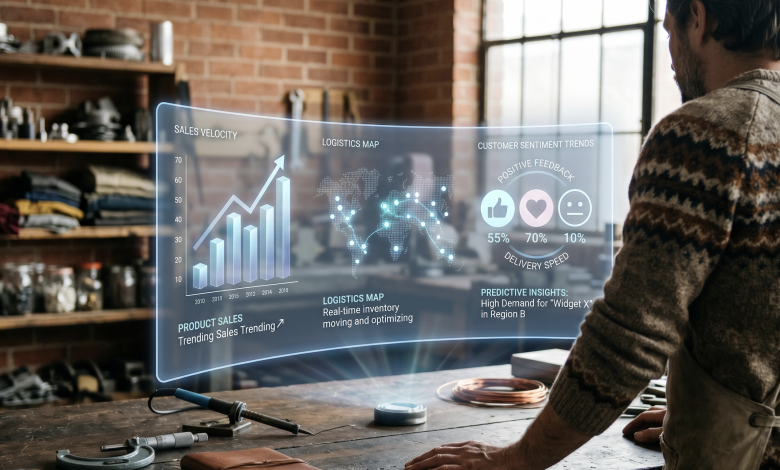
The real win from generative AI isn’t the tools themselves – it’s that this wave has made the power of machine learning more accessible than ever and shown business owners that models can deliver real value without needing a PhD. But if we stop at conversational use cases, we’re leaving the most impactful applications on the table. The businesses that pull ahead will be the ones using ML to predict demand, prevent churn, optimize pricing, and find inefficiencies they didn’t even know existed.
The Chatbot Trap
Most small businesses have taken their first steps with AI — using conversational tools to draft content or answer customer questions. That’s a solid start. But it’s only scratching the surface of what AI and ML can actually do for their business.
AI adoption among SMBs has surged – 58% now use generative AI, more than doubling from 23% in 2023, according to the U.S. Chamber of Commerce (2025)1. Intuit QuickBooks reports that 77% of SMBs use AI regularly as of January 20262. But dig deeper and the picture shifts: 64% of those AI users are only using generative AI chatbot applications2. With 33 million small businesses in the US employing 46% of the private workforce3, this narrow adoption has national-scale consequences.
The tools they’re overlooking aren’t experimental. They’ve been quietly maturing for years and are now plug-and-play — often built into platforms that SMBs already pay for.
Five Ways Small Businesses can use AI and ML to Transform
1. Demand Forecasting and Inventory Optimization
For product businesses, inventory is one of the biggest cost centers and hardest to get right. Over-ordering ties up cash; stockouts lose customers. Most SMBs manage this with gut instinct and spreadsheets.
McKinsey research shows ML-driven forecasting can reduce inventory costs by 20–50% and cut stockouts by up to 65%4. Inditex (Zara’s parent company) uses demand sensing models to produce closer to real-time demand – a strategy now accessible to small retailers through tools like Inventory Planner and Shopify’s built-in analytics5. Already, 21% of SMBs are using AI for inventory management and supply chain operations6. For a retailer doing $500,000 a year, a 20% reduction in inventory waste means $25,000 – $35,000 back in their pocket.
2. Financial Management and Cash Flow Prediction
Cash flow is the single biggest killer of small businesses — 82% of failures are due to cash flow problems, according to U.S. Bank7. Yet 46% of SMBs say poor financial or resource management is holding them back, and 51% still rely on spreadsheets for financial management2.
ML-powered tools can now predict cash shortfalls 30 to 90 days in advance by analyzing payment patterns, seasonal trends, and receivables. QuickBooks’ Cash Flow Planner forecasts cash position weeks ahead. Brex and Ramp auto-categorize expenses and flag anomalies in real time. Already, 21% of SMBs use AI for accounting and finances6. For many small businesses, this isn’t an optimization – it’s a survival tool.
3. Personalization and Recommendations
Enterprise companies spend millions on personalization engines. Small businesses personalize on the basis of personal relationships, but often lack the engines to automate a personal experience. McKinsey (2023) found that companies excelling at personalization generate 40% more revenue than average players8.
Klaviyo’s predictive analytics tells e-commerce businesses which customers are likely to buy next. Mailchimp uses ML to deliver emails when each subscriber is most likely to open. Marketing is already the #1 AI use case among SMBs, with 45% using it there2. The next step is personalized marketing, giving each individual their own experience – using chatbots who know and remember your customers, interactive ads, and customized buying journeys. A local boutique can now tap into the same “customers also bought” effect that drives 35% of Amazon’s revenue9. Personalization used to be an enterprise luxury. Now it’s an SMB opportunity.
4. Customer Churn Prediction
Most businesses find out a customer left when they stop showing up. By then, it’s too expensive – Bain & Company shows a 5% increase in retention produces a 25–95% increase in profits, and acquiring a new customer costs 5–7x more than retaining one10. It’s telling that 30% of SMBs say their top wish is reducing customer churn or increasing revenue from existing customers2.
ML flips this from reactive to proactive. Platforms like Baremetrics and Klaviyo now offer churn risk scores out of the box. Even a simple model trained on purchase frequency and engagement can identify 70–80% of at-risk customers weeks before they leave. The ROI math is straightforward.
5. Operational Efficiency — Finding the Leaks
This is the most powerful use case: instead of asking “which AI tool should I buy?”, ask “where am I losing money or time that I don’t even know about?” ML can be a diagnostic lens across an entire business. If the business is losing money to fraud, Stripe Radar uses ML to block fraudulent transactions – 19% of SMBs already use AI for fraud management6. If the team is spending too much time on lead management, ML-powered lead scoring can lift lead generation ROI by 77%11. Workflow tools like Zapier and Monday.com use ML to surface where teams lose hours to manual tasks. And the results speak for themselves: 78% of SMBs using AI say it’s boosting productivity, up from just 46% in mid-20242. The insight isn’t any single tool – it’s treating ML as a way to systematically find and fix the biggest leaks.
So Why Aren’t More SMBs Adopting?
If these tools are accessible and affordable, what’s holding small businesses back? It’s not cost. It’s not complexity. It’s a literacy gap.
Among SMBs not using AI, the #1 barrier is “don’t know enough about it” – cited by 39% in 2025, actually up from 31% in 2023, even as adoption has surged around them1. Intuit’s data tells a similar story: 28% cite lack of knowledge about AI capabilities, while only 22% say cost is the issue2. And 16% say they simply don’t know how to use or implement AI2.
The pattern is clear: SMB owners aren’t resistant to AI and ML – 80% believe AI will help their business, up 20 points from 20241. They just don’t know what’s possible, what to ask for, or how to evaluate whether a tool will actually deliver value. Enterprise companies have data science teams and consultants. A 15-person company has the owner searching the internet for “do I need AI?” This is a solvable problem – but it requires meeting SMBs where they are.
Getting Started: Assessing Your AI and ML Readiness
Before investing in any tool, work through four foundational questions.
Do you have your data in order? (If not, AI can help.)
ML models are only as good as their data – you don’t need perfect infrastructure to start, but you do need to get it in order. Start where your data already lives: your POS, CRM, or accounting software. Most platforms are already collecting what you need – and now have intelligence layers built into them. Use AI to understand and connect your data.
Do you know where you’re losing money or time?
Which of the five use cases above is your biggest pain point? Don’t start with the flashiest tool – start with the most expensive problem. A restaurant losing $40,000 a year to food waste needs demand forecasting long before personalization. Don’t know the biggest pain point? Ask AI to analyze.
Can you measure the impact?
Before you turn anything on, know what “better” looks like. Pick one metric. If you can’t measure it, you can’t prove ROI – and you’ll abandon the tool within three months.
Are you ready to change your workflows?
This is key. Technology changes require workflow changes – that change can be hard and messy, so be prepared for it and audit your processes where needed.
The Bottom Line
The AI and ML tools that can transform small businesses aren’t coming – they’re already here, built into platforms SMBs already use and pay for. The results are real: 85% of AI-using SMBs report increased sales and 84% report increased profits1.
The gap isn’t technology or cost. It’s knowing what’s possible, where to start, and how to tell if it’s working. The landscape is evolving fast – the tools available today will look different a year from now. But one thing won’t change: the small businesses that stay curious, stay open to learning, and are willing to adopt will be the ones that benefit most.
You don’t need to become a data scientist. You just need to start using what’s already at your fingertips.
Sources
[1] U.S. Chamber of Commerce / C_TEC, “Empowering Small Business,” Fourth Edition, 2025. Survey of 3,870 U.S. small businesses by Teneo Research, June 2025.
[2] Intuit QuickBooks, “Small Business Insights,” January 2026 wave. Quarterly survey of ~5,000 SMBs (0-99 employees) across US, Canada, UK, and Australia.
[3] U.S. Small Business Administration, Office of Advocacy, “Frequently Asked Questions About Small Business.”
[4] McKinsey & Company, “AI-driven operations forecasting in retail and consumer packaged goods.”
[5] Inditex annual reports and public supply chain disclosures on demand sensing strategy.
[6] Verizon, “State of Small Business Survey,” 2025.
[7] U.S. Bank, study on causes of small business failure.
[8] McKinsey & Company, “The value of getting personalization right — or wrong — is multiplying,” 2023.
[9] McKinsey & Company, “How retailers can keep up with consumers,” referencing Amazon recommendation engine revenue data.
[10] Bain & Company, Frederick Reichheld, “Prescription for cutting costs.”
[11] Forrester Research, “The Impact of Lead Scoring on Marketing and Sales Alignment.”
Note: McKinsey, Bain, and U.S. Bank statistics are established industry benchmarks. All other data points are from 2025-2026 sources.