Data drives every meaningful business decision. Yet most databases are far from complete or accurate. Records become outdated over time, fields remain empty, and valuable opportunities often slip through unnoticed.
This is exactly where data append services create a measurable impact.
A well-executed data appending strategy does more than filling missing fields. It strengthens data quality and sharpens targeting. It also contributes directly to better business outcomes. This guide explains what data appending is and how it works. It also outlines data append best practices that help extract real value from existing data.
What Is the Hidden Cost of Poor Data Quality?
Data quality issues are rarely obvious at first and focusing on data quality over quantity is what separates high-performing teams from the rest. Sales outreach fails to get responses. Customer engagement declines over time.
These symptoms often point to deeper structural issues within the database.
Data does not stay still. People change roles frequently. Companies evolve or restructure. Contact details become invalid or obsolete. As a result, databases slowly accumulate inaccuracies.
Common issues include:
- Missing contact information
- Outdated email addresses and phone numbers
- Incomplete customer profiles
- Duplicate or inconsistent records
These problems reduce marketing and sales efficiency. Inaccurate data leads to wasted spend and lower conversions. It also results in missed revenue opportunities that are often difficult to recover.
Moreover, research from IBM IBV highlights that data quality and governance remain major obstacles to AI adoption. Nearly half of business leaders, around 45%, report that concerns about data accuracy and bias are key barriers to scaling AI initiatives — a reality that underscores why data quality determines AI performance more than any other factor.
This situation cannot be fixed with a one-time cleanup. It requires a deliberate and ongoing strategy.
What Is Data Appending?
Data appending refers to the process of adding, updating, or correcting information in an existing database. This process relies on matching internal records with external data sources. It then enriches those records with relevant and verified attributes.
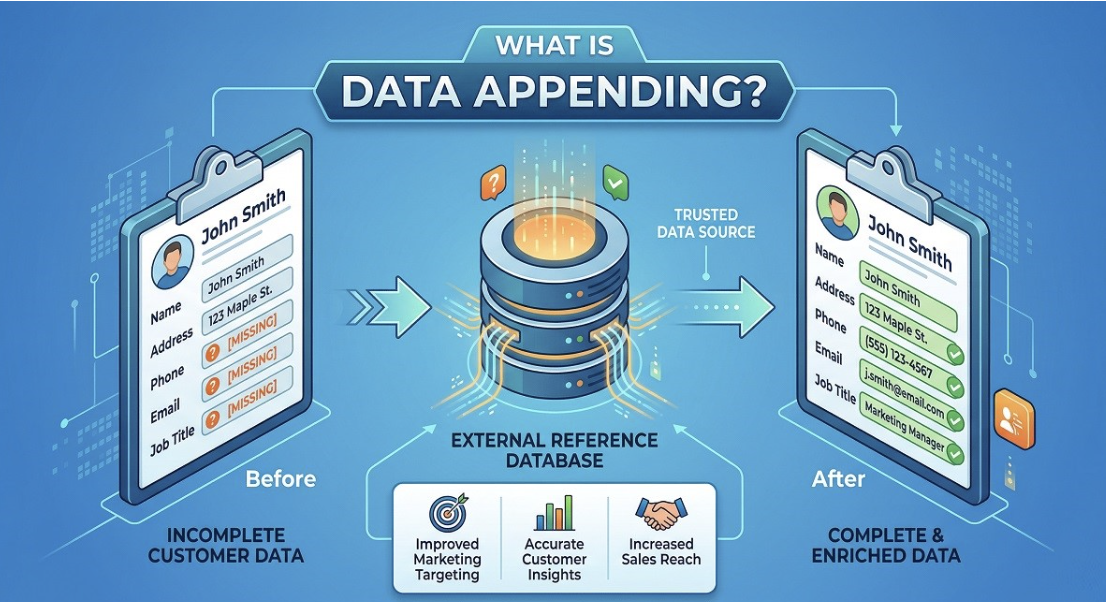
Consider a simple example. A record may only contain a name and an email address. That record can be enhanced by adding:
- Phone number
- Job title
- Company name
- Industry
- Geographic location
This transformation turns incomplete records into usable and insightful profiles. It creates a database that supports better targeting and more informed decision-making.
How Do Data Append Services Work?
A reliable data append company follows a structured and methodical process. This ensures both accuracy and consistency across datasets. Here’s what they do:
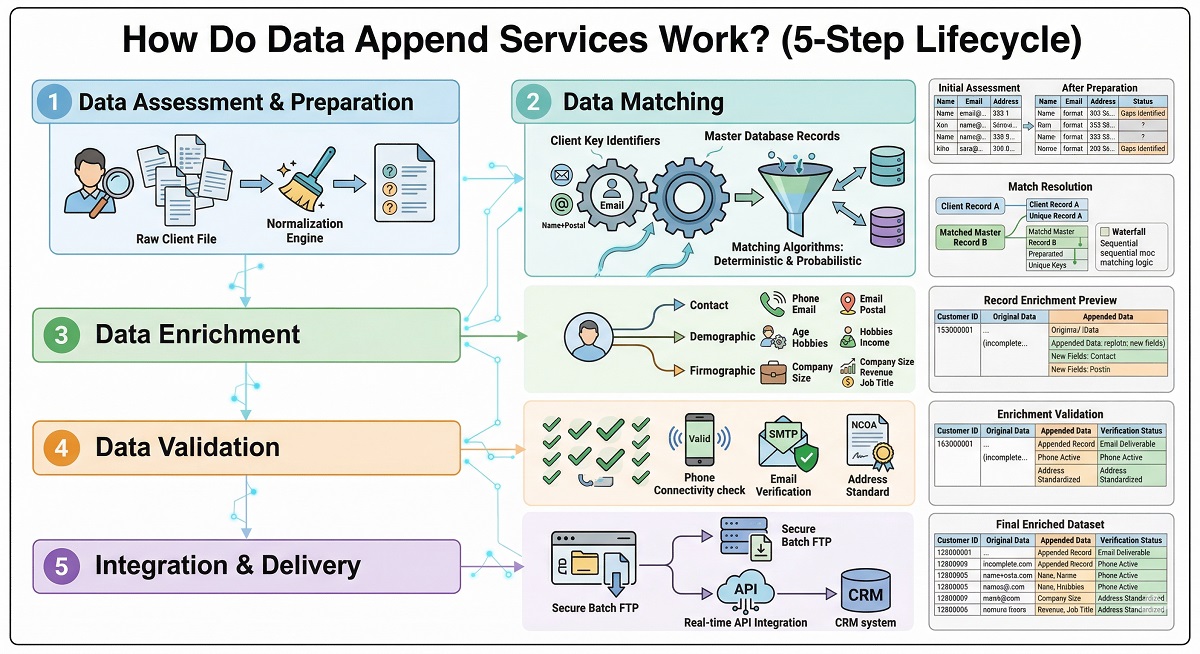
I. Data Assessment and Preparation
The process begins with a thorough review of the existing database. This step identifies missing fields and inconsistencies. It also highlights duplicate records that may distort analysis.
The data is then cleaned and standardized. This improves matching precision and reduces ambiguity.
II. Data Matching
Each record is matched against trusted external datasets. Matching algorithms rely on identifiers such as name, email, company, or phone number. These identifiers help locate corresponding data points with higher confidence.
III. Data Enrichment
Once matches are identified, missing or outdated fields are appended. This enrichment can include contact details and firmographic data. It may also include demographic information and behavioral signals.
IV. Data Validation
The appended data undergoes multiple layers of validation. Automated checks identify anomalies. Manual verification may also be used in certain cases.
V. Integration and Delivery
The final dataset is delivered in a structured format. It is then integrated into CRM systems, marketing platforms, or data warehouses.
This systematic approach ensures that data is not only enriched but also usable and trustworthy.
What Are the Types of Data Appending?
Different business needs call for different types of enrichment. Data appending services typically cover several specialized categories. These categories typically include:
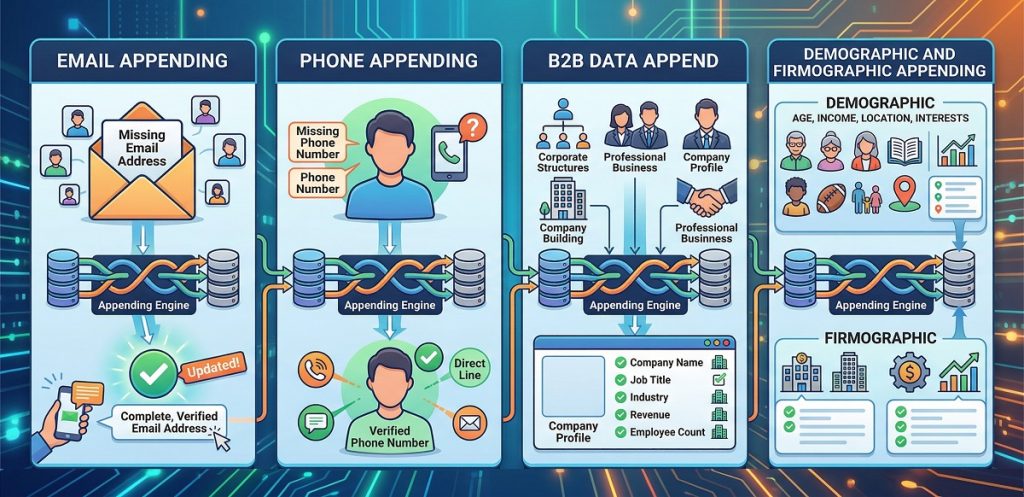
1. Email Appending
Email appending adds or updates email addresses within existing records. This improves campaign reach and reduces bounce rates. It also enhances deliverability over time.
2. Phone Appending
Phone appending provides direct dial numbers or mobile contacts. This supports more effective and timely sales outreach.
3. B2B Data Append
In B2B environments, data accuracy carries even greater weight. Decision-makers change roles frequently. Organizational hierarchies shift without much notice. B2B data append helps organizations transform their B2B database and stay up-to-date, essentially turning data into a living system that evolves alongside the business. It ensures that contact lists remain up to date. It also helps identify key stakeholders within target accounts.
This approach supports account-based strategies. It also enables personalized outreach at scale. Without accurate data, even well-designed strategies struggle to deliver meaningful results.
4. Demographic and Firmographic Appending
This approach enhances records with personal or company-level attributes. These insights support more nuanced segmentation. They also enable more personalized communication.
Why Does Data Appending Matter for Business Outcomes?
The impact of data appending services goes beyond basic data improvement. It influences performance across multiple business functions.
I. Improved Data Accuracy
Appending ensures that records remain complete and up to date. This improves the database’s overall reliability.
II. Better Audience Segmentation
Richer data allows for more precise segmentation. Businesses can group audiences based on meaningful attributes such as role, industry, or behavior.
III. Higher Campaign Effectiveness
Accurate data improves both deliverability and engagement. Campaigns reach the intended audience more consistently.
IV. Reduced Customer Acquisition Costs
Organizations can extract more value from existing data. This reduces the need for constant investment in new data sources.
V. Stronger Sales Efficiency
Sales teams benefit from complete and contextual profiles. This enables better prioritization and more informed conversations.
VI. Increased Return on Investment
Better data leads to better decisions. Better decisions often lead to stronger and more predictable outcomes.
What Are the Data Append Best Practices?
Consistent results require a disciplined approach. Following proven data append best practices makes a significant difference.
a. Begin with Data Cleansing
Cleaning the existing database improves match rates. Organizations looking to improve data quality systematically will find that cleansing is always the logical first step.
b. Define Clear Objectives
Organizations should identify specific goals early. These may include improving email deliverability or enhancing segmentation. Clear objectives guide the entire process.
c. Select the Right Data Append Company
Choosing a reliable data append company is critical. Providers should use verified data sources. They should also follow strong validation processes and compliance standards.
d. Ensure Data Privacy and Compliance
All data-appending activities must adhere to relevant regulations such as GDPR. This is where data remediation and compliance practices become equally important alongside enrichment.
e. Integrate with Existing Systems
Appended data should flow seamlessly into CRM and marketing platforms. This ensures immediate usability and avoids data silos.
f. Establish Ongoing Processes
Data appending should not be treated as a one-time activity. Regular updates help maintain accuracy and relevance over time.
g. Monitor and Measure Impact
Organizations should track key metrics. These include campaign performance, conversion rates, and data accuracy levels.
When to Outsource Data Append Services
Many organizations choose to outsource data append services to improve efficiency. This approach also helps ensure higher accuracy.
Outsourcing is useful for large or complex datasets. It is also beneficial when internal resources are limited. Organizations that require high accuracy or fast turnaround often benefit from external support.
Outsourcing provides access to extensive and curated data sources. It also brings specialized expertise and advanced tools.
This approach reduces the operational burden on internal teams. It also accelerates the enrichment process.
However, vendor selection remains crucial. A poor provider can introduce inaccuracies and create compliance risks.
What Are the Common Data Append Challenges and How to Address Them?
Even with a structured approach, challenges can arise. These challenges can be resolved by proper planning. The common challenges include:
I. Low Match Rates
Low match rates often stem from poor data quality. Improving data cleansing processes can significantly address this issue.
II. Data Inconsistencies
Different sources may use varying formats. Standardization helps create consistency across datasets.
III. Compliance Risks
Improper handling of personal data can lead to legal complications. Strict adherence to regulations is essential.
IV. Integration Issues
Appended data may not align with existing systems. Careful data mapping and integration planning can resolve this.
What Is the Future of Data Appending?
Data appending continues to evolve alongside technological advancements. The process is becoming more intelligent and anticipatory.
Emerging trends include:
- AI-driven data enrichment
- Real-time data validation
- Predictive data completion
- Deeper integration across platforms
Modern data appending services are shifting toward a more proactive model. They do not just update records. They help anticipate gaps and address them before they affect performance.
Conclusion
Data quality shapes how effectively an organization operates and grows. Incomplete or outdated data limits performance across every function.
Data append services offer a structured way to improve accuracy. They also enrich customer profiles and unlock the full potential of existing databases.
Organizations that invest in continuous data appending gain a clear advantage. They operate with sharper insights. They execute more effective campaigns. They achieve stronger and more sustainable business outcomes.