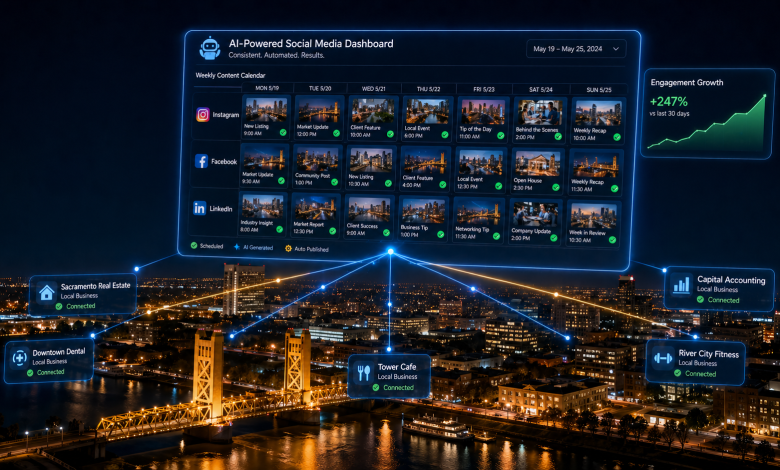
Most local businesses know they should be posting on social media consistently. Very few actually manage to do it.
The reason is not a lack of effort. It is a lack of infrastructure. Running a business while manually planning, writing, designing, and scheduling social media content every week is unsustainable for most teams. The result is a pattern every business owner recognizes: a burst of activity followed by weeks of silence, then a guilt-driven comeback post, then silence again.
AI has fundamentally altered this relationship. That which once required an entire social media team can now be arranged into a repetitive process, automated, and running in the background while the business itself is attending to its true work.
Why Inconsistency Is the Real Enemy of Social Media Growth
The lack of consistency in posting on social media is what usually causes small businesses to be unable to create a loyal audience online. All platform algorithms favor active accounts while punishing inactive accounts, irrespective of the quality of content that eventually gets posted once the account becomes active again.
It is tough for accounts with inconsistent posting patterns to receive any consideration from platform algorithms. An example is when a business becomes dormant for about two weeks before returning to posting. At this point, the algorithm will have demoted the account, thus limiting its reach.
The damage compounds over time:
- Engagement rates drop when followers stop expecting content
- Organic reach shrinks as the algorithm reassigns distribution to more active accounts
- Trust erodes when potential customers visit a profile and see months-old posts
- Competitors who post consistently capture the audience’s attention, while inconsistent brands are losing every day
The businesses winning on social media in 2026 are not necessarily producing better content. They are producing it reliably. And there is a measurable gap between the two groups that widens every month.
What AI Actually Does to Fix the Consistency Problem
AI solves the social media consistency problem by automating the four most time-consuming tasks in content production: ideation, writing, scheduling, and performance analysis. When these tasks are handled by an AI system, the human team only needs to review and approve rather than create from scratch every time.
Most business owners think of AI social media tools as content generators. That is only part of the picture.
A properly configured AI social media system handles:
- Content ideation: Generating topic ideas based on the business’s industry, location, and audience behavior patterns
- Draft creation: Writing caption drafts, blog snippets, and short-form video scripts calibrated to each platform’s tone
- Scheduling optimization: Identifying the specific days and times when the target audience is most active and scheduling content accordingly
- Performance feedback: Analyzing which posts drove the most engagement and using that data to improve future content automatically
According to HubSpot’s research on AI tools for social media marketing, businesses using AI-assisted content workflows report significantly higher posting frequency and lower time investment per piece of content compared to fully manual approaches.
The result is not just more content. It is a system that learns what works for a specific audience and gets measurably better at producing it over time.
How Local Sacramento Businesses Are Applying This System
Local businesses in Sacramento are using AI-assisted social media marketing systems to compete with larger brands that have dedicated marketing teams by automating content production while keeping the messaging locally relevant and authentic to their community.
There has been a noticeable change in the social media marketing Sacramento scene over the last couple of years. For instance, a Sacramento-based company dealing in home services that used to post two or three times a month without any strategy switched to artificial intelligence in the early part of 2025. After 90 days, the posting frequency went up to five times a week, doubling the engagement rate, with the number of phone inquiries from social media rising by 38 percent.
That outcome is not an outlier. The pattern repeats across industries:
- A local restaurant uses AI to generate weekly content calendars based on menu specials, seasonal ingredients, and upcoming events.
- A healthcare provider uses AI to schedule educational posts that maintain patient trust between appointments.
- A home services contractor uses AI to turn completed job photos into consistent before-and-after content without spending hours writing captions.
The common thread is not the size of the business or the sophistication of its marketing team. It is the presence of a system that removes the dependency on willpower and manual effort.
For local businesses evaluating this approach, working with an agency that already has these AI workflows built and tested is significantly faster than building the system from scratch internally. Sierra Exclusive Industries, which provides social media marketing Sacramento, documents this kind of outcome as a core part of how they onboard new clients, using AI-assisted systems rather than the traditional model of manually produced monthly content packages.
The Three Components of a Predictable AI Social Media System
Predictable AI social media growth involves the integration of three interdependent elements: the AI content generation tool that generates platform-ready copy, the scheduling mechanism that keeps track of regular postings, and the performance monitoring mechanism that keeps improving the content quality based on real audience metrics.
Creating a predictable AI social media growth system is not just about subscribing to an AI writing service; it involves having the following three elements:
The Content Engine
This is the AI layer that generates drafts based on the business’s brand voice, industry, location, and content goals. The best implementations feed the AI with specific inputs, including past high-performing posts, customer FAQs, and seasonal business events, to keep output relevant and locally grounded.
The Scheduling Infrastructure
This is the calendar and queue system that ensures content goes out at consistent intervals regardless of how busy the team gets. The AI identifies optimal posting windows based on audience activity data and fills the queue automatically, removing the manual decision of when to post.
The Performance Feedback Loop
This is where most businesses stop and where the strongest results actually come from. AI tools that analyze engagement data and feed insights back into the content engine get progressively better at producing content that resonates with the specific audience. Without this loop, the system produces more content. With it, the system produces better content over time, compounding the results of every post that came before it.
As aijourn.com has noted, AI tools for solo founders and small business teams are now sophisticated enough to handle workflows that previously required dedicated staff, making the consistency problem solvable for businesses at almost any budget level.
What to Look for When Choosing an AI Social Media Solution
The key criteria for evaluating an AI social media solution for a local business are platform integration depth, brand voice customization capability, scheduling automation reliability, and the quality of the performance analytics feedback loop.
Not every AI social media tool is built equally. Before committing to a platform or agency, local businesses should evaluate:
- Does the tool integrate natively with the platforms where your audience actually spends time
- Can it be trained on your specific brand voice rather than producing generic content
- Does it schedule automatically, or does it still require manual posting decisions
- Does it provide actionable performance data or just vanity metrics like impressions
- Is there a human review step that keeps content on-brand before it goes live
As aijourn.com has covered, the media and attention landscape is being actively redefined by specialized agencies that understand how AI tools and human strategy work together rather than treating them as competing approaches.
The businesses that get this wrong typically make one of two mistakes. They either buy an AI tool and expect it to run itself without strategic direction, or they hire an agency that uses AI for production but has no feedback loop built into the workflow. Neither produces the compounding results that a properly structured system delivers.
Frequently Asked Questions
How does AI make social media posting more consistent for local businesses?
AI makes social media posting consistent by automating the four most time-consuming tasks in the content workflow: ideation, writing, scheduling, and performance analysis. Instead of relying on a team member to manually produce and post content every day, an AI system generates drafts, fills a scheduling queue, and publishes at optimized times automatically. This removes the dependency on manual effort that causes most local businesses to post inconsistently.
Can AI maintain a local and authentic tone for Sacramento-area businesses?
Yes. Advanced social media AI technology allows for the training of algorithms using the existing content, the language of the clientele, and the cultural elements of Sacramento, so that AI-produced material will seem more targeted toward Sacramento than generic. The most successful approaches involve a combination of using the AI drafts and a final check by human operators to catch any material that seems off-message. Companies located in Sacramento have observed higher engagement using AI trained specifically on local content.
How long does it take to see results from an AI social media system?
For most small businesses, improvements are usually observed in terms of consistency in posts within two weeks when they have their social media AI system fully operational. It may take four to eight weeks before engagement rate increases start being noticed due to the process of redistribution of reach by the platforms themselves. The effects on revenue usually become noticeable after three to six months.
Do local businesses still need a social media agency if they are using AI tools?
AI tools handle content production and scheduling efficiently, but they do not replace the strategic layer that an experienced social media agency provides. Strategy, audience analysis, platform-specific campaign planning, and creative direction still require human expertise. The most effective model for local businesses is a combination of AI-assisted production and human-led strategy, which is the approach taken by social media marketing specialists in Sacramento who understand both the technology and the local market.
What is the biggest mistake local businesses make when implementing AI social media tools?
The most common mistake made regarding AI lies in the fact that companies utilize AI to create content rather than creating an organized process around the technology itself. Companies that utilize AI in order to increase their post-production rates without incorporating some form of feedback process, voice training, and scheduling tools will ultimately have higher volumes of content, but their content will not be as consistent or high-quality as a result. It comes down to the difference between making a better process versus generating more content.
Conclusion
Inconsistent social media posting is not a discipline problem. It is a systems problem. And systems problems have systems solutions.
AI has made it possible for local businesses to maintain the kind of consistent, improving social media presence that previously required a dedicated marketing team. The compounding effect of consistent posting on platform algorithms, audience trust, and brand visibility is not theoretical. Sacramento businesses that have made this shift in the past year have measurable outcomes to show for it.
The gap between businesses with AI-assisted social media systems and those still relying on manual effort is going to widen significantly through 2026 and into 2027. The businesses building these systems now are not just solving a posting problem. They are building a durable competitive advantage that gets harder to close the longer it runs.