Walk into almost any manufacturing plant and you’ll notice it right away. The systems running production aren’t new. They’ve been patched over the years, layered on top of one another, and adjusted to fit changing needs. From the outside, it might look messy but it works. And in manufacturing, working reliably isn’t optional, it’s everything.
That reality has reshaped how manufacturers think about AI. They aren’t chasing flashy “lights-out factories” anymore. They’re looking for practical ways to cut costs, keep operations efficient, and make improvements that show up in the day-to-day. AI is judged now by whether it helps lines run better, not by how ambitious it sounds.
Why the Strategy Shift Happened
A few years ago, AI investments were experiments in many plants. Teams tried implementing big ideas with big roadmaps such as digital twins, autonomous robots and predictive systems. Some technically worked, but the costs associated were astronomic, and many stumbled when it came to real operations.
Production leaders have a different focus than innovation teams. Uptime, safety, and consistent output come first. Any AI that risks stopping a line, delaying shipments, or introducing defects isn’t going to survive.
Margins are tighter than they used to be. Material costs bounce around, energy prices spike, labor is harder to secure. Manufacturers still want AI, but the tolerance for risk has shrunk.
Operational Efficiency as the Primary Use Case
The AI projects that stick today aren’t sweeping overhauls, they’re targeted improvements. They target points of friction, not the whole plant. Managers ask direct questions: where are we losing time? Where are we wasting materials? Where is downtime preventable? Present AI as a solution to those issues, and adoption moves quickly.
Reducing Unplanned Downtime Without Touching Core Controls
Unplanned downtime is one of the most expensive problems in manufacturing. Even a single failure can disrupt schedules, inventories, and deliveries.
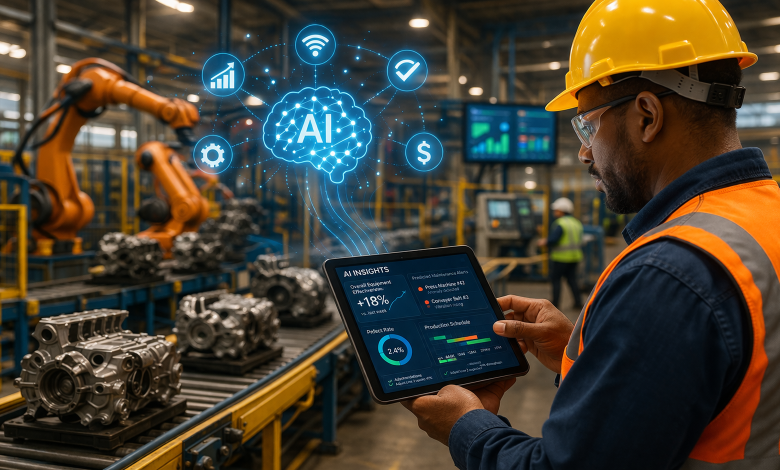
Predictive maintenance is usually the first step. AI monitors sensors, vibrations, and temperature shifts to spot potential problems early. Machines aren’t shut down automatically. The alerts go to maintenance teams, who decide what to do. Humans stay in control, and production keeps running.
Improving Production Scheduling in Real Time
Scheduling inefficiencies aren’t flashy, but they quietly eat margins. Idle machines, delayed inputs, suboptimal sequences all add up. AI now helps by analyzing historical data alongside live operations.
It doesn’t replace supervisors. It offers options, flags potential improvements, and gives a bigger picture than manual methods ever could. Gains may seem small at first, but over weeks and months in high-volume plants, they add up fast.
Tackling Scrap and Quality Losses
Scrap and rework are often considered inevitable, but many issues follow patterns that AI can detect early. Computer vision and anomaly detection can flag deviations before they escalate. Tiny misalignments or surface flaws invisible to the naked eye now get noticed.
The AI doesn’t take over inspectors’ jobs but rather highlights what to look at. Operators validate the findings. This collaboration improves yield while keeping accountability in human hands.
Why Integration Matters More Than Model Sophistication
Most plants still run on legacy ERP and MES systems that can’t just be replaced. Modern AI fits into that existing infrastructure instead of rewriting it. Middleware, APIs, and connectors let the intelligence layer work alongside the old systems.
This approach lowers resistance. Managers don’t feel forced to risk an entire system replacement. AI becomes a tool to inform decisions, not a disruption to production.
The Human Factor in AI
Manufacturing is built on experience. Operators know their equipment in ways no algorithm can fully replicate. AI that ignores this fails. AI that uses it earns trust.
Human-in-the-loop systems are now the standard. AI generates suggestions, points out anomalies, and flags risks. Humans review and adjust, feeding corrections back into the system. Gradually, AI learns the realities of the plant floor, and operators see it as a helpful partner rather than a black box.
Measuring What Actually Matters
Manufacturers have become disciplined about ROI and the metrics that matter including downtime, scrap rates, maintenance costs, labor efficiency, and energy use. Projects that can’t impact one or more of these usually stall. Operational efficiency gives clarity, and improvements show up on reports and in cost statements, making justification easier.
Why Disruption Is No Longer the Goal
There was a time when digital transformation meant sweeping change. Most manufacturers now know controlled evolution is safer. AI is layered on step by step. One plant, one test, refinement, expansion. It’s cautious, incremental, and effective. Headlines don’t matter. Risk reduction and reliable gains do.
A More Mature Phase of Industrial AI
Industrial AI is entering a grounded era. The goal isn’t to prove the technology works, it’s to prove it consistently delivers. AI succeeds when it respects plant realities, integrates smoothly, produces measurable savings, and keeps humans in control. Manufacturers aren’t resisting AI. They expect it to fit their operations.
Companies that grasp this shift see real results, not from chasing disruption, but from pursuing discipline. In an industry where margins are earned through precision, discipline wins.
About the Author:
Nishkam Batta is the Founder and CEO of GrayCyan, an applied AI company focused on manufacturing operations and enterprise workflow automation. He also serves as the Editor-in-Chief of HonestAI magazine, a publication dedicated to responsible and accountable enterprise AI.