
Amazon’s Rufus drove Black Friday purchase sessions at five times the growth rate of unassisted shopping. Bain data shows consumers trust retailer AI three times more than third-party agents. The trust asymmetry shaping agentic commerce may be the most underreported story in the space.
Most of the analytical attention in AI commerce has focused on the third-party AI layer: how ChatGPT’s shopping features are changing discovery, how Google’s AI Mode is displacing traditional search, how OpenAI’s Instant Checkout and Stripe’s ACP integration are building out the agentic transaction stack. These are consequential developments. But they have partially obscured a signal that may carry more commercial weight than any protocol announcement from 2025: retailer-owned AI dramatically outperforms third-party agents on the metrics that actually matter, and the underlying reason, consumer trust, is structural rather than ephemeral.
Understanding why this asymmetry exists, and what it implies for the broader ecosystem, requires working through both the performance data and the trust dynamics driving it.
The Black Friday Signal
Amazon’s Rufus provided the strongest controlled signal to date. During Black Friday 2025, sessions involving Rufus that resulted in purchases grew at 100% versus the trailing 30-day average — compared with only 20% growth for sessions without Rufus. The 5× differential in purchase-session growth is the highest conversion signal from any AI shopping assistant yet measured with first-party data at scale.
The result is controlled in ways that most published AI commerce data is not. It compares Rufus-assisted sessions against unassisted sessions on the same platform, in the same time window, for the same merchandise. It eliminates the platform-level confounds that make cross-channel attribution so unreliable in studies comparing ChatGPT referrals against organic search. The 5× figure represents the clearest direct measurement of what AI assistance inside a retail context actually does to purchase behavior.
Walmart’s trajectory corroborates the directional finding. The retailer launched a GenAI shopping assistant and later Sparky, focusing on trust-building features: review synthesis, occasion-based recommendations, assistance across the full shopping journey. The emphasis on features that inform and validate rather than simply automate reflects an intuition about consumer readiness that the Bain data makes explicit.
The Trust Asymmetry
Bain’s research finds that consumers trust AI agents operated by retailers approximately three times more than third-party agents. This asymmetry has strategic implications that the industry has been slow to process.
Trust in AI-generated recommendations is not simply a function of AI quality. It is shaped by the institutional context in which the AI operates. A recommendation from an AI embedded in a retailer the consumer already buys from carries implicit accountability — the retailer has skin in the outcome, product liability exposure, and an ongoing relationship to protect. A recommendation from a third-party AI assistant carries none of those anchors. The AI is a black box from an entity the consumer does not have a direct commercial relationship with, making recommendations on behalf of no accountable party.
This distinction matters more, not less, as the recommendations carry higher stakes: and it interacts with broader consumer trust data in revealing ways. HubSpot and SurveyMonkey’s global study of over 15,000 consumers finds that only 30% trust AI search results “a lot” or “completely.” The Eight Oh Two study finds that 85% of AI users always or often double-check AI answers against other sources. Consumers are adopting AI for discovery and research, but verifying before they buy.
The “trust-but-verify” pattern suggests that shoppers are using third-party AI to narrow their consideration sets, generating a shortlist, and then returning to familiar retail environments to complete the purchase. This means third-party AI influence is substantially larger than last-click attribution captures, but the trust ceiling on autonomous third-party purchasing is lower than the adoption headlines imply.
What This Means for Third-Party AI Commerce
The trust asymmetry creates a specific constraint for the protocols and platforms competing to become the default agentic commerce layer. OpenAI’s Instant Checkout and Google’s UCP checkout flow are built on the premise that consumers will authorize AI agents to complete transactions on their behalf inside third-party AI environments. The consumer readiness data suggests this will work — but for a narrower segment and a more limited category of purchases than the protocol announcements implied.
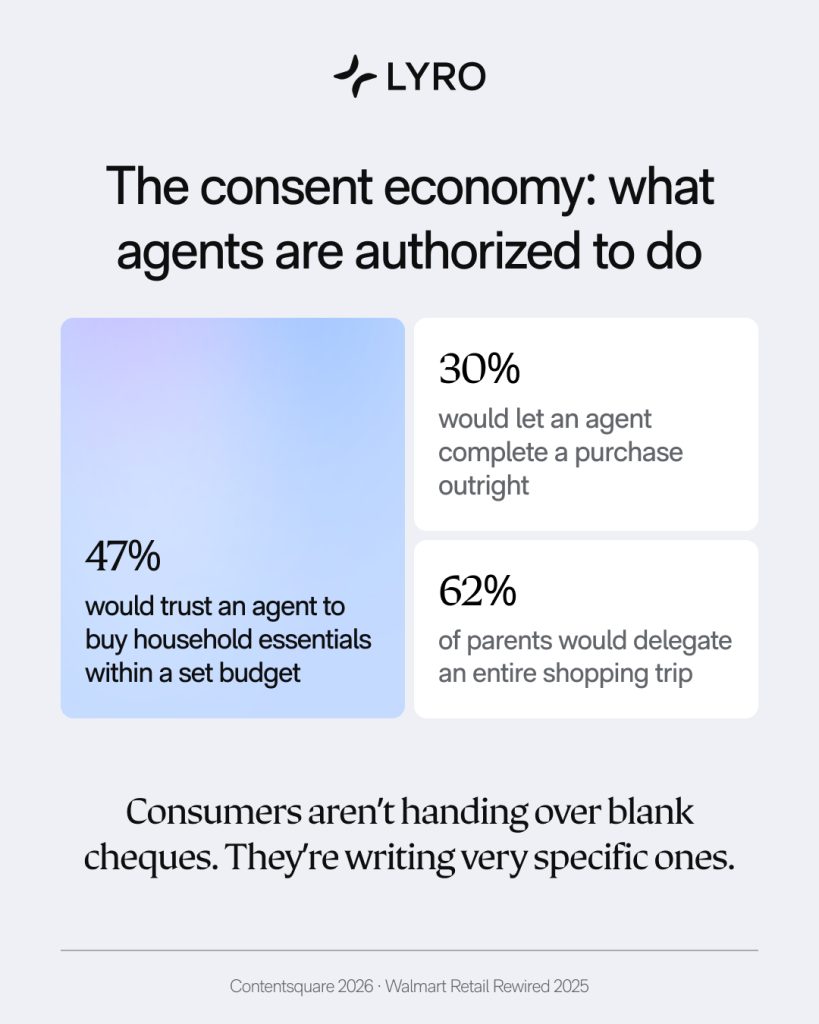
Omnisend’s longitudinal tracking found that reluctance to let AI handle transactions dropped from 66% in February 2025 to 32% by July 2025 — a near-halving in five months. Walmart’s Retail Rewired survey finds that 47% of consumers would trust a digital assistant to buy household essentials within a set budget, with delegation budgets averaging $362 for technology and $263 for home goods. These are real signals of consumer readiness for autonomous purchasing. But they are concentrated in low-consideration, high-frequency categories where the consequence of an error is low — household essentials, standard replenishment, defined-budget commodity purchases.
The categories where third-party AI trust is highest are precisely the categories where the unit economics of autonomous purchasing are most attractive to agents and wallets: low-value, repeatable, confident recommendations. For higher-consideration purchases, the trust dynamics favor retailer-owned AI or human involvement.
This produces a bifurcation in the agentic commerce market. Third-party AI purchasing flows will scale first in commodity replenishment and low-stakes category exploration. Retailer-owned AI will drive conversion in higher-consideration contexts where brand relationship, product specificity, and post-purchase accountability all matter.
The Data Quality Dimension
Part of what makes retailer-owned AI structurally advantaged is information access. Amazon’s Rufus has real-time visibility into actual inventory levels, current pricing, variant availability, review data, and purchase history: all maintained with the accuracy requirements of an active marketplace. It also operates within Amazon’s product graph, which enforces data standards at scale.
Third-party AI assistants do not have equivalent access. OpenAI’s own benchmarks show ChatGPT Shopping Research delivering 64% overall accuracy, meaning more than a third of recommendations contain errors including broken links, discontinued models, or incorrect product attributes. McKinsey’s analysis finds that a brand’s own website accounts for only 5–10% of the sources AI search references when generating answers. In CPG and financial services, over 65% of sources are publishers, user-generated content, and affiliate sites.
The implication: even a third-party AI operating in good faith is working with degraded, inconsistent, and often outdated product information compared to what a retailer’s own AI has available. The accuracy gap is not primarily a model quality issue — it is an information access issue. And it is unlikely to close substantially until merchant catalog integration at depth becomes standard, which is what ACP, UCP, and the structured feed requirements they impose are designed to enable. Until then, retailer-owned AI has an inherent accuracy advantage in product-specific recommendations.
The Ecosystem Positioning Question
For brands evaluating where to invest, the trust asymmetry data supports a specific allocation logic that Forrester analyst Emily Pfeiffer has articulated: the future is not purely conversational commerce routed through third-party LLM platforms, but genAI-augmented guided selling built into owned retail and brand experiences.
The practical implication is that brands with direct-to-consumer channels and strong brand equity have a structural advantage in deploying their own AI agents — and should be treating that advantage as a competitive priority rather than a future capability. Retailers that own the customer relationship own the trust context that makes AI recommendations land differently. An AI assistant embedded in a store a customer has bought from before carries accountability that no third-party assistant can replicate.
Platforms like Tidio’s Lyro implement this logic at the SMB level: bringing the same architecture that Amazon and Walmart are running at enterprise scale to smaller e-commerce operators, with the same emphasis on resolution quality and escalation design over pure automation metrics. The underlying pattern is consistent: the AI performs best when it operates within the institutional context that already carries consumer trust, with human escalation paths that preserve that trust when the AI reaches its limits.
For the third-party protocol ecosystem, the trust asymmetry is not a death sentence — it is a use-case scope. ACP and UCP will capture value in commodity purchasing flows and low-stakes discovery. The higher-stakes commerce, where conversion really matters, will continue to run through owned environments. The question for every platform building agentic commerce infrastructure is which side of that line they are optimizing for, and whether their architecture actually fits the trust conditions of the segment they are targeting.
This article draws on data presented “AI in E-Commerce in 2026: The New Shopping Funnel,” a research report by Tidio, the AI help desk powered by Lyro AI.