Abstract
Human resource service teams are experiencing a rapid increase in employee requests across payroll, benefits, access, and workplace policies. Traditional manual triage approaches introduce delays and inconsistencies, impacting employee satisfaction and operational efficiency. This article presents a vendor-neutral framework for AI-driven employee case triage and knowledge recommendation that simulates intelligent classification, provides contextual knowledge suggestions, and enables automated routing. The framework improves response times, reduces case volumes, and prepares organizations for scalable AI adoption.
1. Introduction
Employee expectations for HR services have evolved significantly, with a demand for faster responses and accurate resolutions. HR teams must manage diverse inquiries across multiple channels, often relying on manual triage processes. This creates inefficiencies and increases operational burden. Automation provides a structured approach to streamline case handling and improve consistency.
AI-driven frameworks enhance this process by simulating intelligent decision-making. Even without full machine learning capabilities, organizations can replicate AI-like behavior using structured logic and workflow automation. This allows HR teams to improve service delivery while preparing for future AI integration.
2. Challenges in HR Case Management
HR service environments face recurring challenges including high case volumes, repetitive inquiries, inconsistent categorization, and delayed routing. Employees often submit similar requests that could be resolved through knowledge articles. However, without intelligent recommendation systems, these cases continue to burden HR teams.
Additionally, manual classification leads to variability in decision-making. Different agents may categorize the same issue differently, resulting in inconsistent handling and longer resolution times.
3. Framework Overview
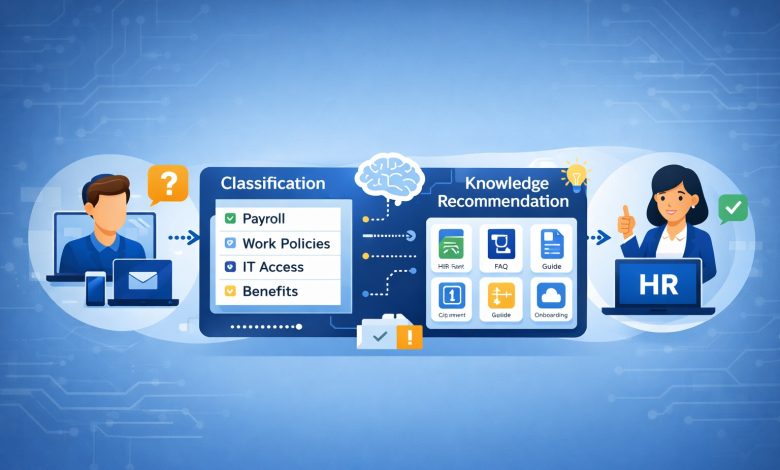
The proposed framework consists of four core layers: Employee Request Intake, Simulated AI Classification, Knowledge Recommendation, and Automated Routing with Lifecycle Management. These components work together to deliver a consistent and scalable HR service experience.
4. Employee Request Intake
Employee requests are captured from portals, emails, or chat systems and converted into structured records. Key attributes include request description, employee role, department, urgency indicators, and contextual metadata. Standardization ensures that classification logic operates consistently across all inputs.
5. Simulated AI Classification
The classification engine uses deterministic rules to mimic AI behavior. It evaluates request content using keyword detection, pattern matching, and contextual rules. This enables consistent categorization of HR issues such as payroll queries, access requests, or policy clarifications.
This simulation approach provides explainable decision-making and eliminates the need for model training, making it suitable for environments without advanced AI infrastructure.
6. Knowledge Recommendation Engine
To reduce case volumes, the framework introduces a knowledge recommendation layer. Based on classification results, relevant knowledge articles are suggested to employees. These may include policy documents, FAQs, and procedural guides.
Research shows that effective knowledge management systems can reduce support workload by up to 30% by enabling self-service resolution (Deloitte Insights, 2023). By enabling self-service resolution, organizations reduce workload on HR teams while improving response times and employee satisfaction.
7. Automated Routing and Lifecycle Management
Cases that require human intervention are automatically routed to appropriate HR teams. Routing logic considers category, expertise, workload, and priority. Lifecycle automation manages status updates, notifications, SLA tracking, and escalations.
According to industry research, automated routing can improve case resolution times by 20–40% by ensuring requests reach the right team faster (McKinsey & Company, 2022). This ensures consistent handling and transparency throughout the case lifecycle.
8. Benefits of AI-Driven HR Case Triage
- Faster and more consistent case triage
• Reduced case volume through knowledge recommendations
• Improved employee experience and response times
• Scalable HR service operations
• Enhanced transparency and auditability
9. Responsible Automation
Responsible automation requires transparency, fairness, and oversight. Organizations should review classification logic regularly, ensure unbiased routing, and provide human intervention for complex or sensitive cases. Ethical AI practices are essential for maintaining trust in HR decision-making (Harvard Business Review, 2021).
10. Conclusion
AI-driven employee case triage and knowledge recommendation represent a significant advancement in HR service delivery. By simulating AI capabilities through structured workflows, organizations can improve efficiency, reduce workload, and enhance employee satisfaction. This framework provides a practical pathway toward intelligent HR operations.
References
Deloitte Insights (2023): https://www2.deloitte.com
McKinsey & Company (2022): https://www.mckinsey.com
Harvard Business Review (2021): https://hbr.org