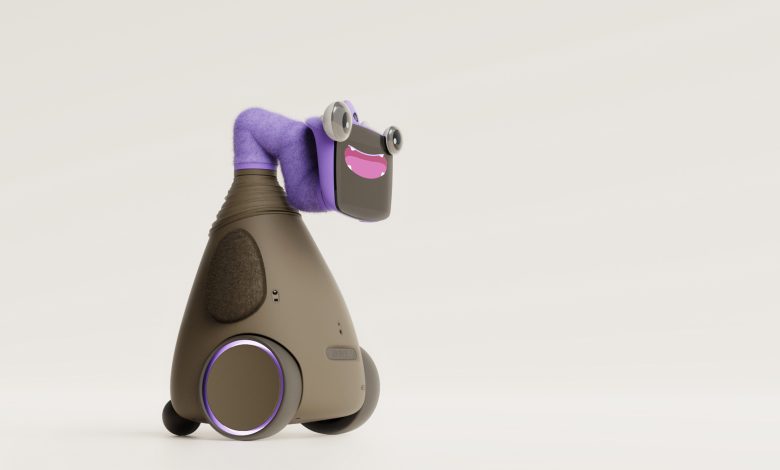
The headlines from CES 2026 might make you think that artificial intelligence was the star of the show, but for me some of the most meaningful conversation wasn’t about the latest general‑purpose model. It was about a family robot named OlloBot, that we were fortunate enough to design. Forbes called it a cyber‑pet designed to live with a family rather than serve them. That distinction, with instead of for, marks an interesting point in consumer AI robotic conversation, and one that designers would do well to consider.
Beyond the uncanny valley
I have seen, as I think we all have, domestic robots that have oscillated between two extremes of form. On one side there were utilitarian appliances that quietly went about executing tasks but looked and felt soulless. On the other were humanoids or petoids were seemingly in a race toward realism. OlloBot points to a third path. Its flexible neck, expressive eyes and flippers sit atop a smooth, egg‑like body designed to be touched. It deliberately avoided human likeness, opting instead for character and softness. As a result, people on the CES floor instinctively treated it like a pet.
This is not a trivial aesthetic choice; it’s a recognition that emotion is a core user need and essential for how people adapt to new technology. The challenge for designers working with AI is to make the developments that come with the pace of change relatable. The aim is not to impersonate a person or pet or to simulate consciousness. It is to build technologies that feel safe, readable and emotionally present in the home.
Tactility and transparency as UX
OlloBot signals its intentions through non‑verbal cues. It communicates through body language, facial expressions and a custom sound system closer to R2‑D2 than a talking assistant. Under its shell, cameras, microphones and sensors learn household rhythms and recognise family members. It is built a glowing heart, a removable memory module that stores data locally rather than in the cloud. When you move to a new robot, you can literally carry those memories forward.
Why fetishise such details? Because, tactility and transparency are fast becoming core UX features. If we take another example outside of the world of AI to illustrate this. Over the past few years we have explored how surveillance infrastructure can become sculptural, even joyful, and promote human connection. We created a Sculptural Surveillance project in Denmark that transforms a utilitarian monitoring tower into something abstract and artistic. Rather than alienating people, or making them feel watched, the units create engagement, connecting people with the necessary tools of their surroundings.These towers spark curiosity and pride. The same principle applies to the AI robotics sector: if a robot sits in your living room, it should feel either like part of the décor, it should feel like something you relate to emotionally, a presence with warmth, rather than a machine that doesn’t belong.
“Enough‑smart” AI
The OlloBot team also made a counter‑intuitive decision: they limited what the robot can do. It doesn’t try and open the doors for you, or fetch objects like, or even vacuum your house or manage your calendar. Rather, it has been created to notice human moments, such as a birthday or something cute and unseen from the human eye, and takes this as a cue to record via photo or video. It is designed to remember, adapt and respond in ways that feel personal. In other words, it is enough‑smart. The intelligence is specific and contextual, not generic. Rather than chasing ever‑greater generalisation, consumer robots are more likely to succeed when they excel at a narrow set of emotionally resonant tasks.
Design teams should embrace this constraint. An overloaded robot that tries to do everything risks overwhelming us. A companion that does just enough invites us in.
A cultural shift from optimisation to warmth
We are living through a broader cultural moment in technology where people crave warmth over optimisation. The rise of cyber‑pets, ambient screens and tactile interfaces signals a desire for technology that belongs in our lives, not just technology that performs for us. e.
The same thinking should guide consumer robots. We must ask ourselves: what makes a machine belong in a home? OlloBot suggests that belonging is achieved not through perfect mimicry or endless features, but through empathy, play and craft. Its presence at CES was a quiet manifesto: let’s build robots that don’t just impress us, but that we might grow up alongside.
Designing for belonging
How do we design such companions? I return to three principles that guide design:
- Play in the process. Treat every idea like play and prototype quickly. Whether 3D‑printing caps or hand‑carving foam mock‑ups, iterate through tactile models to see what feels right. This hands‑on loop prevents a designer from falling in love with renderings and pushes to refine concepts in the real world. Applying this to home robots encourages forms that invite touch and warmth.[Text Wrapping Break]
- Design with empathy. In the design process, involve those people who feel alienated by AI to help design with empathy. When discussing AGI robots, you must turn complex robots and intimidating algorithms into something people can actually connect with. Whether it’s a camera tower or a cyber‑pet, the goal is to create devices that individuals can feel proud of rather than devices they tolerate.[Text Wrapping Break]
- Elevate the everyday. Tiny interventions can make a moment feel welcoming, personal and connected. A glowing heart, a soft coating or a diary of shared moments can turn technology into companionship.[Text Wrapping Break]
Robotics as relational design
Technology tends to encode the values of its creators. By shifting that creator value from utilitarian efficiency or a desire for the most realistic look to empathy and human connection, we can work towards shaping a new generation of domestic robots that prioritise belonging and connection over performance. That can then move robots from machines to companions.