The architecture of government acquisition has not fundamentally changed since the Federal Acquisition Regulation (FAR) was compiled in 1984. Contracting officers still open PDFs by hand, reconcile clauses across hundreds of pages, shepherd documents through email chains, and re-key data into spreadsheets. This is not a workflow. It’s cognitive logistics, costing agencies years they cannot afford.
Major defense programs now average eight to 11 years from requirements approval to first-unit delivery. The contracting phase alone can consume three years of that cycle. During the same window, adversaries are pushing autonomous systems from the lab to the field in 18-month sprints. The will to change exists inside government. What has been missing is the architectural substrate that lets agencies move without breaking the compliance framework they must protect. That substrate now exists.
Autonomous Acquisition: Stop Picturing the Black Box
When most people hear the phrase autonomous acquisition, they picture a black box making billion-dollar award decisions while humans are locked out of the room. Conflating autonomy with unsupervised decision-making is one of the most persistent misconceptions slowing progress in the field.
A more useful frame borrows from the Society of Automotive Engineers (SAE) definition of self-driving vehicle levels. Level Zero is a pure manual system, such as drafting in SharePoint and email. Level Five is a system that anticipates demand, generates requirements, and executes compliant awards around the clock. Most agencies today sit between Level Zero and Level One. Some are experimenting with Level Two copilots capable of generating a first-cut acquisition package in under two hours, rather than 100 days. Every level on the autonomous acquisition ladder should be gate-checked so that when system confidence drops below a defined threshold, a human takeover request is fully issued. Full-cycle autonomy, where it exists, should operate only within tightly scoped, high-confidence acquisition domains. Autonomous does not mean unsupervised. Autonomy, properly designed, elevates oversight rather than replacing it.
Brilliant People, Broken Interface
Today’s acquisition officers routinely build then evaluate multi-volume RFP packages, track dozens of amendments across attachments, maintain clause compliance across FAR, DFARS, and agency supplements, and manually connect signals scattered across thousands of pages. The heroism involved in this work is real. But the need for that level of heroism is an indictment of the system itself.
Anything drowning in document logistics is ripe for autonomy: clause selection, compliance gap analysis, market research summaries, evaluation worksheet population, proposal scoring. Each manual touchpoint introduces delay, and over months and years those delays compound.
What remains irreducible is discretion. An AI system can generate a policy-aligned acquisition package overnight. What it cannot independently compute is whether that package carries downstream political consequences, disrupts a regional economy, or requires the kind of nuanced judgment that comes from understanding the human stakes involved. The goal is not to remove people from acquisition but to move them from performing cognitive logistics to supervising, directing, and approving a far more capable system.
Why Data Engineering Is the Real Foundation
Much of the public conversation about AI in government focuses on the capabilities of large language models. That conversation matters, but it is incomplete. The more important question is what the model is reasoning over and whether the underlying data is disciplined enough to support the decisions being made.
General-purpose models tend to struggle in the places that matter most to contracting professionals, such as interpreting sensitive data classifications, navigating complex regulatory clauses, and reasoning across the vast archive of documents that define how acquisition organizations actually operate. Much of that institutional knowledge also resides in systems these models were never designed to access.
Large language models are powerful lenses, but a lens pointed at chaos still sees chaos. Pointing one at unstructured data without disciplined data engineering produces a confident improviser who’s fluent, convincing, and wrong in ways that would not survive serious oversight. Domain-aware data engineering is not optional; it is the whole game.
Trust and Speed Are the Same Thing
There is a temptation to treat trust and speed as competing forces in government procurement, as though slowing down is the inevitable price of accountability. This framing misses the opportunity.
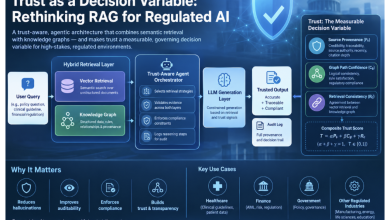
When AI systems emit verifiable provenance claims for every action taken, oversight becomes easier rather than harder. If the GAO asks why one vendor was selected over another, the answer should be one click away and instantly traceable. Provenance is not a compliance check box; it is the condition under which a contracting officer can trust a machine recommendation enough to move forward with confidence.
Speed without trust is a non-starter in federal acquisition. A system that cannot be explained, traced, or survive an oversight inquiry has not improved the process. It has simply added a new point of failure. Trust must come first. Everything else follows from it.
What Responsible Adoption Requires
For agencies looking to move from experimentation to genuine capability in this area, the path forward requires rethinking the architecture of work.
That means shifting the unit of work from static documents to continuously reconciled data. It means building AI systems that cite sources, emit evidence trails, and expose their reasoning to human review, not systems that generate prose without provenance. It also means moving incrementally: beginning with the highest-volume, lowest-discretion tasks, proving the model at scale, and expanding autonomy only as trust is earned and verified.
The compliance frameworks that govern federal acquisition exist for good reason. The opportunity is not to work around them but to build systems capable of operating within them at machine speed and accountable enough that humans responsible for outcomes can stand behind every decision the system supports.
The architecture of government procurement has not changed in forty years. The technology to change has finally arrived. The agencies that lead this transition thoughtfully, with provenance, discretion, and genuine human oversight built in from the start, will define what responsible acquisition looks like for the next generation.