



NASHVILLE, TN
Archaeological and genetic evidence is gradually coming together to bolster the Urantia Book account of pre-historic human migration. According to the book, a people arose in Mesopotamia around 25,000 years ago called the Andites, who were a unique blend of three different ancestry pools, and as these people spread around the world, they brought with them knowledge passed down to them for thousands of years.
Genetically they are carriers of the MCPH1 haplogroup D genetic line which appeared sometime around 37,000 years ago and which spread around the world until today it is present in roughly 70% of modern human beings. According to The Urantia Book, the Andites were aggressive civilization builders who brought technological innovations with them as they migrated.
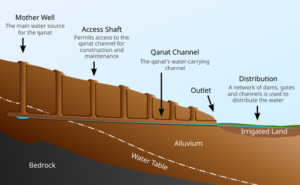
Derek Samaras has identified one of these technological innovations used to irrigate crops in arid environments, known as the qanat in Mesopotamia, the area of its origin, but by many other different names in different regions.
| Tradition | Region | Local Date | UB Corridor |
| Qanat | Iran / Central Asia | 3,000+ BCE | Heartland Origin |
| Karez | Afghanistan / Xinjiang | c. 2,000 BCE+ | Eastward Surge |
| Khettara | Morocco / Sahara | c. 2,000–1,000 BCE | Saharan Push |
| Viajes de Agua | Spain / Iberia | Pre-Roman | Western Wave |
| Puquio | Peru / Chile | c. 500 BCE–500 CE | Andite 132 Fleet |
| Mambo | Japan | Pre-1,000 CE | Eastward Surge terminal |
This technological innovation is thought by modern science to have developed independently in all these areas. The Urantia Book contends the technology followed the people, and the timeline for its appearance in each region follows its account of these migrations.

The Urantia book also claims the temples honoring God originating in this time period were circular, and of course, circular temples are what we see from Göbekli and Karahan Tepe, 9500 BCE; to the Tower of Jericho at 8,000 BCE; Nabta Playa (Egypt) at 7,000 BCE; Carnac (France) at 4,500 BCE; Newgrange (Ireland) at 3,200 BCE; Stonehenge beginning at 3,000 BCE; to Callacpuma in the Andean highlands of northern Peru, which The Urantia Book states was reached by 132 Andite sailors in antiquity.
“The global megalithic tradition has a distribution problem that conventional archaeology has never satisfactorily solved,” states Mr. Samaras. “When you sort the major sites not by culture but by construction date and geography, they do not scatter randomly. They describe a directional expansion radiating outward from a single origin zone in the Anatolian and Mesopotamian heartland, with later dates as distance from the origin point increases.”
He continues: “One of the most powerful confirmations in the entire record is not where the Andites appeared. It is where they did not.
“The Urantia Book is precise: ‘Only a few teachers and traders ever penetrated farther south in Africa than the headwaters of the Nile’ (78:5.5). That is a falsifiable claim. The arid conditions that drove qanat engineering in Iran, Morocco, and the Andes also exist in sub-Saharan Africa, the Kalahari, the Namib, the Horn, and the highlands of Madagascar. If the hydraulic tradition spread by independent invention wherever arid conditions motivated it, we would expect to find it in all of those places. We do not. The qanat tradition, the megalithic precision tradition, and the large-eyed phenotypic iconography all stop below the Nile headwaters. Madagascar has none of it.
“When the boundary a historical source predicts matches the boundary the physical record shows—not approximately, with exceptions, but precisely—that is confirmation. The Madagascar Limit is the clearest single piece of negative evidence for the accuracy of The Urantia Book’s Andite migration account. It makes a specific, geographically falsifiable prediction. The record confirms it.”
Published in 1955, The Urantia Book covers our pre-history, cosmology, and the life and teachings of Jesus with innumerable precise details such as those discussed above. New scientific discoveries tend to confirm rather than negate the accuracy of the book and as time goes on, the Urantia Corps for Spiritual Progress believes this trend will only continue to confirm the accuracy of The Urantia Book.