A single restaurant might have 60 employees and 400 weekly shifts. Layer in compliance rules, cost targets, skills, availability and employee preferences, and suddenly there are more than 50 million possible ways to build a schedule.
That decision still lands on a manager who is already overworked and behind before the week even begins.
For decades, the industry’s response has been predictable: more software, more dashboards, more reports. But the job hasn’t gotten easier. It’s gotten more complex. And most AI tools haven’t solved that problem — they’ve simply documented it.
That’s the uncomfortable truth. Most restaurant AI doesn’t fail because it’s too ambitious. It fails because its answers show up too late.
Managers don’t need better explanations of what went wrong. They need help making better decisions while the shift is still happening.
This is where a new category of AI — often referred to as agentic AI — begins to matter. This tech goes beyond analyzing data to actually doing something with it. Instead of surfacing patterns after the fact, it translates operational signals into clear, immediate recommendations. In an environment where decisions happen in seconds, that distinction is everything.
From Static Planning to Real-Time Solutions
Scheduling is the clearest example of agentic AI’s potential. On paper, this task is a planning exercise. In reality, it’s a constantly shifting optimization problem with too many variables for any human to fully process. Managers build schedules using experience and instinct, then spend the rest of the week reacting to everything that breaks: call-outs, demand spikes, compliance risks, and gaps in coverage.
AI changes that dynamic by evaluating far more variables, far more quickly, and continuously. It doesn’t just produce a schedule; it adapts it. When something goes wrong mid-shift, it suggests a fix that keeps the operation moving.
That same dynamic applies to hospitality compliance, which is often treated as a separate challenge but rarely exists in isolation. During a busy shift, a manager is balancing labor laws against service, staffing and guest experience.
In those moments, the difference between reactive and proactive systems becomes clear. When AI can detect a risk early and recommend an adjustment that preserves both compliance and coverage, it removes a trade-off that managers are otherwise forced to make under pressure.
The downstream impact of these decisions shows up most clearly in employee experience. Turnover in restaurants is often framed as a hiring problem, but in practice, it’s an operational one. New employees don’t leave because they were hired incorrectly. They leave because the experience doesn’t match expectations.
They don’t feel trained. Their schedules feel inconsistent. The job feels harder than it should.
These signals exist long before someone quits. They show up in behavior, like missed shifts, early clock-outs and frequent swaps, but they’re rarely connected in a way that drives action. AI has the potential to change that by identifying patterns early and giving managers the context to respond before a problem becomes a resignation.
At the same time, better scheduling and more consistent training reduce the underlying friction that drives disengagement in the first place. When operations are more predictable, employees are more likely to stay. And when managers spend less time on administrative work, they have more time to coach, which remains one of the most important drivers of employee retention in restaurants.
AI Falls Short When It’s Added Rather than Integrated
Despite all of this potential, most AI initiatives fail before they ever reach successful implementation. The first issue is fragmentation. In many organizations, scheduling, labor, payroll and sales data still live in separate systems. When those signals aren’t connected, any recommendation — no matter how advanced — will feel disconnected from reality. And once trust is lost, adoption follows quickly behind.
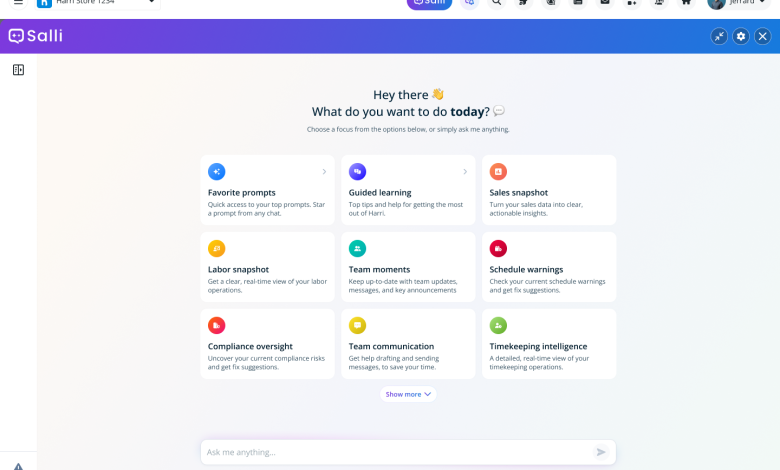
The second issue is workflow. Even accurate insights become useless if they live in a separate dashboard that managers have to remember to check. In a high-pressure environment, anything that adds friction gets ignored. The most effective systems integrate directly into the tools and moments where decisions are already being made.
This is where many AI solutions fall short. They diagnose problems but stop there. An alert that highlights a potential issue may be technically correct, but it doesn’t reduce the manager’s workload if they still have to figure out the solution themselves.
What managers actually need are clear, specific recommendations delivered in plain language, along with enough context to understand why those recommendations were made. These are experienced operators. They don’t want to be told what to do by a black box, but they will trust a system that makes its reasoning transparent and supports their judgment.
The difference is subtle but important. One approach adds another layer of work. The other removes it.
Restaurant AI often looks compelling in a boardroom, where clean dashboards and predictive models promise efficiency. But restaurants don’t run on dashboards. They run on hundreds of small decisions made in real time, under pressure, by people who don’t have the luxury of stepping back to analyze.
That’s the standard AI needs to meet.
The question for operators is: Does the technology actually help a manager run a better shift? If it doesn’t, then it’s not solving the problem. It’s just another tool managers have to work around.
And that’s not what the industry needs.