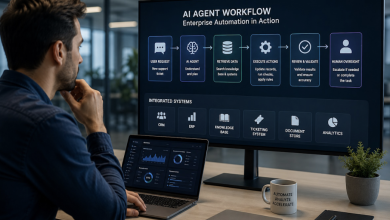
Enterprises have spent the past two years experimenting with generative AI (GenAI), yet far fewer have achieved fundamental operational transformation. More than 70% of organizations remain stuck in proof-of-concept limbo, indicating that the challenge lies not in the technology itself but in the lack of a structured approach to scale — and in how organizations define the scope and ambition of the AI initiatives they pursue. Many early GenAI programs focus on narrow productivity or knowledge-retrieval use cases, which can deliver incremental value but rarely justify transformative investment on their own. To scale ROI, organizations need a unified framework that integrates strategy, engineering, data readiness, process adjustments, governance and talent into a single operating model. Without this foundation, even the most promising AI efforts fail to move beyond pilots.
AI must be understood not as a tool, but as a shift in how the enterprise operates. It is reshaping how humans collaborate with technology and requires a deliberate balance of technical expertise, critical thinking, and domain knowledge. Organizations are learning that isolated pilots and experimentation are not enough; lasting value emerges when operating models, software delivery practices, and governance frameworks evolve in parallel. Becoming AI-Native demands disciplined blueprints that guide decision-making, product engineering, and human-agent collaboration across the enterprise.
From Experimentation to Enterprise-Scale AI
Many organizations begin their AI journey with disconnected pilots, an LLM for support, a chatbot for content creation, or a data-modernization effort in isolation. This scattered approach is a misstep that rarely produces a durable impact. Enterprise AI leaders have observed that customers struggled to connect these fragmented efforts until a single, coherent blueprint clarified how all components fit together and provided a modular roadmap for adoption.
This reflects a broader market reality: while many organizations have begun experimenting with AI, only a minority have successfully scaled those efforts to produce sustained business impact. Governance, workflow integration and operating-model readiness remain persistent barriers. In practice, many enterprises continue to realize their most reliable returns from established forms of AI — such as predictive analytics, optimization and classical machine learning, while GenAI value remains uneven and highly dependent on context. GenAI tends to deliver the greatest benefits when embedded into mature workflows already shaped by data, models and disciplined engineering practices, rather than when deployed as a standalone capability.
Why a Unified, Enterprise-Wide AI Framework Matters
Enterprise-wide transformation ensures alignment across business, engineering, data and operational processes. It establishes consistent sequencing, architecture and governance, so each model, tool and use case contributes to enterprise-wide outcomes rather than isolated wins. Critically, this alignment enables AI systems to operate in an interconnected manner, where the output of one model becomes the input to another, creating compounding -not additive- value.
Consider an AI-enabled supply chain: demand-forecasting models inform inventory planning; inventory signals feed production scheduling; production outputs influence logistics and distribution decisions. When these systems share data, feedback loops, workflows and automation, AI becomes a continuously learning network rather than a collection of point solutions. This is where enterprises begin to realize exponential returns from AI adoption. Without a unifying framework, organizations risk building systems that are costly, redundant and difficult to integrate or govern.
Unified frameworks also accelerate execution. They provide shared terminology, maturity stages and governance expectations, reducing operational friction and preventing duplication of effort. As organizations adopt more autonomous and agentic systems, this shared structure becomes essential for maintaining safety, reliability and value creation.
Blueprint I: A Strategic, Top-Down AI Framework
A top-down blueprint guides leaders in defining their AI vision, establishing governance, assessing readiness and prioritizing high-value use cases. This strategic model supports full-scale AI adoption by helping enterprises envision new growth opportunities, operating models and revenue possibilities.
Such frameworks enable leaders to identify which processes are suitable for automation, augmentation, or agentic orchestration — and which are not. They also surface dependencies across data, platforms, talent and risk management that must be addressed early to avoid downstream bottlenecks. This strategic clarity is essential as organizations explore agentic AI, where autonomy, oversight and responsibility must be deliberately designed rather than retrofitted.
Blueprint II: Preparing a Workforce for AI-Native Collaboration
AI adoption depends as much on people as on technology. This blueprint focuses on equipping teams to operate alongside intelligent systems and autonomous agents, emphasizing responsible AI practices, decision-making in AI augmented environments, and the development of new engineering and analytical skill sets.
While a top-down approach remains the most effective path to AI-native transformation — aligning strategy, governance, talent and engineering practices around a unified operating model — it is also the most challenging for enterprises with low maturity. Many begin with bottom-up experimentation, including isolated pilots, team-level use of AI tools or productivity-focused use cases that demonstrate value quickly.
These early efforts can build momentum and internal credibility, but they rarely scale on their own. Most eventually encounter the same barriers: siloed projects, inconsistent governance and disconnected workflows that prevent AI from delivering enterprise-wide impact.
Recent data shows that 78% of organizations are already using AI in some form, underscoring that AI is no longer experimental but increasingly embedded in everyday work. As adoption accelerates, the role of the workforce evolves. Professionals are no longer simply users of tools; they act as orchestrators of intelligent systems — designing, supervising and refining workflows where human judgment and machine intelligence work together.
Workforce readiness therefore requires more than tool proficiency. It demands new decision-making models, responsible AI practices and organizational structures that support continuous learning. When organizations combine early experimentation with structured transformation, they build the capability and alignment necessary to scale AI safely and strategically.
Blueprint III: Embedding AI in the Software Lifecycle
An AI-native software development lifecycle integrates AI across every phase of product development — from ideation through deployment — augmenting teams with intelligent workflows, automated quality controls and standardized patterns for AI-driven engineering.
As organizations shift from using AI tools to building AI-first products, lifecycle discipline becomes the differentiator between scalable innovation and unmanaged operational risk. Embedding governance, testing and continuous performance tracking into delivery pipelines ensures that AI systems remain reliable, safe and accountable. This structured approach helps organizations modernize toward AI-native product delivery while achieving measurable gains in productivity and quality.
The Path Forward:
Early adopters show that the biggest risks in AI transformation are structural rather than technical. Cloud consumption can escalate rapidly, with enterprise usage for both large and small language models reaching levels that demand strict architectural and financial governance. Security, responsible AI oversight and data fragmentation introduce further complexity. Notably, 52% of enterprises cite data quality as their greatest barrier to scaling AI, highlighting that model sophistication alone cannot compensate for weak data foundations.
Yet successful organizations follow a recognizable pattern. They begin with a blueprint aligned to their current readiness—whether strategic planning, engineering modernization or workforce enablement — and expand from there. Those that progress fastest embed governance early, modernize data and lifecycle foundations and design systems where models, workflows and teams operate as an integrated whole rather than in isolation.
AI-native enterprises will ultimately be defined not by individual use cases, but by their ability to orchestrate humans, systems and intelligent agents through governed, scalable and automated workflows and newly designed frameworks. Blueprint-driven transformation enables organizations to move beyond experimentation toward sustained performance — capturing AI’s full value while maintaining control, trust and resilience as adoption accelerates.