Material handling environments are no stranger to AI. In warehouses and logistics facilities, where forklifts weave through narrow aisles and workers move constantly between shelving and loading areas, AI-driven vision systems are widely used to detect pedestrians and obstacles in real time. Because these environments are structured and have predictable layouts, they’re an ideal starting point for computer vision technologies designed to reduce collisions and improve situational awareness. Naturally, operators working in warehouses now view this kind of AI-assisted technology as a practical extension of existing safety practices – it just clicks.
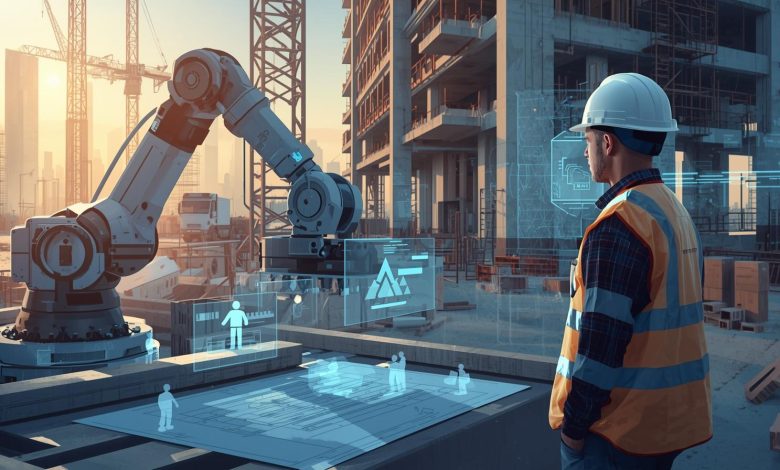
Construction sites, however, pose a very different challenge. Unlike warehouses, which have predictable patterns of movement, both in terms of people and materials, the only certainty on construction sites is uncertainty. If a warehouse was a track race, with every participant running along a predefined lane, construction sites are more like a football game, with dozens of participants running in different directions on an open-play pitch. Only this pitch shifts – structures rise, materials are loaded and unloaded, terrain changes under heavy machinery, and dust can be kicked up into the environment, affecting visibility. In the US, roughly 1 in 5 workplace fatalities occur on construction sites, and more than a quarter of those are caused by collisions or “struck-by” incidents involving heavy machinery. Attention is now rightly turning toward whether the same real-time detection systems that have improved safety inside warehouses could also help address the far more complex hazards found in construction.
Why construction remains one of the most dangerous workplaces
Despite decades of progress in training, regulation, and protective equipment, construction continues to rank among the most hazardous industries in the world. According to the US Bureau of Labor Statistics, the sector recorded more than 1,000 worker fatalities in 2023, the highest total of any industry, with transportation incidents, equipment strikes, and falls among the leading causes. These risks are closely tied to the nature of construction itself, where workers routinely operate around large, powerful machinery while navigating incomplete structures, unstable ground, and temporary work zones. Unlike controlled industrial facilities like warehouses, construction sites rarely remain the same from one hour to the next. Machines such as excavators, loaders, graders, and articulated haul trucks can weigh tonnes and often operate in close proximity to ground crews going about their daily tasks. Even the most experienced operators face visibility challenges, with blindspots often extending for several meters around large vehicles and workers approaching from unexpected angles. Combine this with dust, noise, adverse weather, and the constant movement of people and materials, and it’s a recipe for potentially life-ending hazards.
The limits of training and human awareness
Most construction safety programs are built around training, procedures, and personal responsibility. These elements are vital parts of the safety picture, but they don’t complete it. Training relies heavily on the assumption that people will always be able to spot danger early enough to respond, and no individual – no matter how experienced or well-trained they may be – can be expected to spot every potential risk and act in time to mediate it. It’s unrealistic, and unfair, to place that kind of burden on individual members of staff.
Human perception has natural limits, particularly in environments filled with noise, dust, movement, and visual obstructions. Operators of heavy machinery rely on mirrors, cameras, and spotters to maintain visibility, but large machines still create blind spots that can conceal pedestrians or obstacles from view. At the same time, workers on the ground are frequently focused on their immediate task, whether guiding materials, securing structures, or preparing equipment. In environments like this where heavy machines and people share the same space, even a brief lapse in awareness can quickly turn into a near miss or a serious incident. The bottom line: no human is capable of eliminating risk on their own.
How AI vision systems are changing the equation
Advances in AI and machine vision are now beginning to introduce a new layer of awareness into industrial environments like construction sites. Using cameras combined with onboard processing, these systems can analyze what is happening around a machine in real time, identifying pedestrians, obstacles, and other hazards that might otherwise go unnoticed. Unlike traditional camera systems that simply display a video feed, AI-powered systems actually interpret the scene, allowing them to recognise risk and alert operators before a dangerous situation develops. In effect, they act as an additional set of eyes that continuously monitor the environment, alleviating much of the burden we place on human shoulders.
Of course, accuracy is critical for these systems to succeed in real-world environments. But trust is important too. Anyone who has spent time around heavy equipment knows that alarms and warnings are only effective when operators trust them. If alerts trigger too frequently without a genuine hazard, workers quickly become desensitized to the noise. The situation is often compared to the classic “boy who cried wolf” story: once people hear too many false alarms, they begin to ignore them. That has shaped the way many industrial AI safety systems are designed. Instead of flagging every possible object in view, effective systems focus on identifying meaningful risks such as pedestrians entering a machine’s path or workers approaching dangerous zones. By minimizing unnecessary alerts, these technologies help ensure that when a warning does occur, operators recognize it as something that genuinely requires attention. And in high-risk environments like construction sites, that balance between awareness and alert fatigue can make the difference between a useful safety system and one that operators simply learn to tune out.
Construction is the new proving ground for industrial AI
As awareness of AI-driven safety technology spreads, construction is emerging as one of the most important testing grounds for its real-world impact. Contractors and project managers are beginning to recognize that the same computer vision systems improving safety in warehouses could also address some of the most persistent risks on job sites. Construction equipment often represents a significant investment, with excavators, loaders, and haul trucks costing hundreds of thousands of dollars and operating in environments where a single incident can halt work, damage machinery, or seriously injure workers. So reducing these risks is not only a safety priority, but an operational one.
Early deployments are already showing how real-time detection can help prevent common construction incidents such as collisions with ground crews, equipment rollovers, and falls near site edges or unstable terrain. Because construction sites are constantly changing, hazards often appear without warning, making them difficult to control through procedures alone. An AI system that continuously monitors the environment can help bridge that gap by identifying risks the moment they emerge, working with operators to ensure safety at all times – even in overstimulated environments where their own senses are impaired.
Redefining safety on modern construction sites
Construction has always required a careful balance between productivity and safety. As projects become larger and machinery more powerful, the margin for error continues to shrink, especially on busy job sites where people and equipment must work side by side. Training, procedures, and experience will always remain central to safe operations, but the complexity of modern construction environments increasingly demands additional layers of awareness. Technologies that can monitor surroundings continuously and identify hazards in real time are now beginning to fill that gap, but trust in the technology matters – adoption will depend as much on understanding the technology as on the technology itself. Contractors are only just beginning to explore how AI-assisted safety systems fit alongside established safety practices, but once site managers see how these tools can help prevent a near miss or highlight a risk before it escalates, without adding to the burden operators already carry, the technology will come into its own. Eventually, AI-driven awareness systems will become another standard component of responsible site management, empowering crews to navigate the hazards of heavy equipment and dynamic sites more safely.