Five years ago, hiring someone in another country meant lawyers, months of paperwork, and a budget most companies did not have. Today, a startup with ten employees can hire in thirty countries without setting up a single legal entity. Global hiring has become genuinely accessible.
But accessible does not mean easy. The complexity did not disappear. It just moved. Choosing the right employment structure, staying compliant across multiple jurisdictions, managing people across time zones and cultures. That is still hard work. AI is starting to change how HR professionals handle that complexity, and it is worth paying attention to what is actually working.
How global hiring got here
Remote work did something nobody fully anticipated. It made geography feel irrelevant at exactly the moment when companies were desperate for talent. If your developer could work from home in Manchester, why not from Lisbon? If your marketing hire could be anywhere in the US, why not Canada?
That shift happened fast. The infrastructure around it is still catching up. Employment law varies dramatically by country. Tax obligations, mandatory benefits, termination rules, contractor classification rules. They are different everywhere, and they change regularly. For HR teams managing global headcount, keeping on top of all of that manually is not realistic.
This is the gap AI is starting to fill.
Where AI is genuinely making a difference
The most practical gains right now are happening in four areas.
Sourcing and screening at scale. AI tools can search across global talent pools in a way no human recruiter can match on speed. They surface candidates from markets you would not have thought to look at, flag relevant experience, and do the initial filtering before a human ever gets involved. For companies hiring in multiple countries simultaneously, this is a significant time saving.
Salary benchmarking by country. Compensation norms vary enormously. What is a competitive salary for a software engineer in Poland is very different from what you need to offer in the Netherlands. AI-powered tools now aggregate salary data by role, seniority, and location in real time. This means HR teams can go into hiring conversations with accurate local benchmarks rather than guessing or relying on outdated surveys.
Job posting localisation. Most global job posts are just domestic posts with the word “remote” added. AI tools can adapt job descriptions for different markets, adjusting for local terminology, legal requirements around what you can and cannot advertise, and cultural expectations. A job post that converts well in the UK often needs real changes to work in the US or Germany.
Background and right to work verification. AI is accelerating identity checks and verification processes that used to take days. For HR teams hiring across borders, where document types and verification requirements vary by country, this is one of the more underrated wins.
The compliance problem and where AI helps
Compliance is where global hiring gets genuinely painful. Employment law in the UK and US alone is complicated enough. Add twenty more countries and it becomes a full-time job just to stay current.
AI tools are now monitoring regulatory changes across jurisdictions in real time and flagging risks before they become problems. If Germany updates its rules around contractor classification, or a US state changes its paid leave requirements, the right tools will catch that and surface it to your team before it affects your employees.
For companies using Employer of Record (EOR) providers to hire internationally, AI is also improving how HR teams evaluate and compare those providers. Comparing contract terms, coverage, pricing, and compliance track records across multiple EOR options used to mean hours of manual research. AI-assisted tools are compressing that considerably.
That said, compliance is also where over-reliance on AI carries real risk. AI is good at flagging known issues in established frameworks. It is not good at interpreting ambiguous situations or navigating a regulatory grey area that has not been tested yet.
For anything high stakes, a human with actual legal expertise still needs to make the call. Use AI to get informed faster. Do not use it to replace proper legal review.
What AI still cannot do
This is the part most AI articles skip because it does not fit the narrative. But it matters.
AI is not good at cultural nuance. Knowing that a candidate from Japan might undersell themselves in an interview, or that direct feedback lands differently in the Netherlands than it does in the US, requires human judgment and experience. No model is reliably getting that right yet.
AI is not good at building relationships with candidates. In competitive hiring markets, the reason a strong candidate chooses your company over another often comes down to how they felt during the process. That is a human job.
And AI is not good at judgment calls in ambiguous situations. When the rules are unclear, when you are in genuinely new territory with a hiring situation, you need a person who can think it through. AI will give you a confident-sounding answer regardless of whether it actually knows.
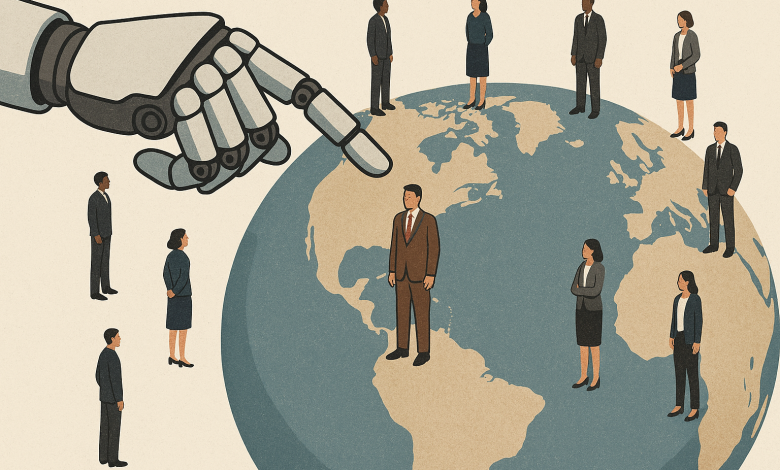
The best global hiring teams I see are using AI to move faster and get better information. They are not using it to replace the judgment that experienced HR professionals bring.
What HR teams should do right now
If you are starting to build AI into your global hiring process, here is where to begin.
Start with salary benchmarking. It is low risk, immediately useful, and most HR teams are still doing this manually. Tools like Figures, Radford, or Mercer have AI-assisted options worth exploring.
Then look at your compliance monitoring. If you have employees in more than five countries and you are tracking regulatory changes in a spreadsheet or by reading newsletters, you are already behind. There are tools built specifically for this.
Ask your EOR providers what AI capabilities they are building. The better providers are investing in this. The ones who are not will become harder to work with as your needs get more complex.
And please, localise your job posts. Run your current postings through an AI tool and see what it flags. You will probably be surprised.
The companies getting this right
The companies winning at global hiring are not necessarily the ones using the most AI. They are the ones who are clear about what AI is actually useful for in their specific context.
AI is a research and speed tool. It helps you get better information faster and removes a lot of the manual work that used to slow global hiring down. It does not replace the need for good HR judgment, cultural awareness, or proper legal advice.
The opportunity for UK and US HR professionals right now is to get practical about this before the gap between those who do and those who do not becomes too wide to close.
Global hiring is not getting simpler. But the tools available to manage it are genuinely getting better. That is worth paying attention to.