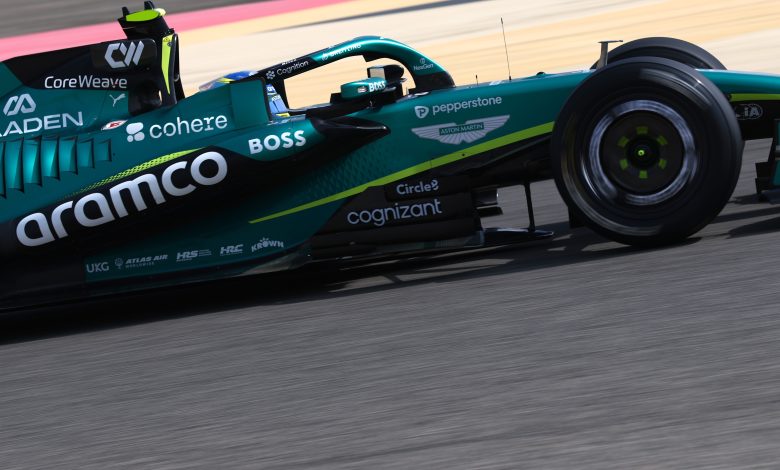
By its very nature, Formula One is an extreme and fast-paced sport, sometimes described as the ‘fastest R&D lab on Earth’, as teams compete to push the boundaries of engineering. It is also a sport of fine margins, often decided by fractional improvements to reduce lap times, enhance vehicle handling, and optimise pit stops. And key to all of these fractional improvements is some new process, material, design, or technology that allows a team to move precisely and at pace. Formula One, then, is a near-perfect environment for AI, and at the same time, AI is becoming imperative to performance in the sport – and well beyond.
Redefining the design phase
One of the key ways in which AI is disrupting the sport is through its potential to rewrite many of our assumptions about the design phase. With over 13,000 components making up a Formula One car, and a new part designed on average every 15 minutes, being able to explore endless parameters and scenarios efficiently means cutting through the noise to what will truly deliver performance improvements.
On the one hand, this might be through allowing us to discover new technologies in the first place. Rather than days or weeks setting up complex simulations, AI can help us significantly accelerate the pace of innovation as a whole and increase the overall return on investment of our research and development initiatives.
Then, there’s the opportunity to actually accelerate the time it takes for us to make design decisions, which has the potential to entirely overhaul the way we approach race conditions. With the help of an AI agent, we could eventually work towards a new approach to design based on real-time iteration derived from conditions on the racetrack.
Take a variable like wind, which affects car behaviour in a variety of ways, depending on its direction and intensity. Responding to shifts in this type of variable is challenging within the design cycle, as conditions can change from day to day. As tools evolve, however, it could become possible to monitor these changes more dynamically— for instance, opportunities to enable AI agents to analyse the difference between one set of conditions and another as the car runs on track, and to identify the most practical mechanical set-up for the conditions.
Looking ahead, this could help to significantly compress the time required to explore and refine aerodynamic concepts. In a future workflow, observations such as wind could be fed into AI models that rapidly analyse performance differences and suggest possible optimisations – such as subtle adjustments to the vehicle’s front wing. Rather than replacing existing engineering validation processes, these observations could one day instead accelerate them: for example, it could be that proposed shapes are passed into CFD for detailed analysis, before being manufactured for wind-tunnel testing and – if validated – these would be progressed towards production, ahead of future races. AI, therefore, could eventually help to identify and prioritise promising design direction, compressing this design phase.
Rethinking decision-making
There’s also the parsing through of complex information that might take numerous teams and disciplines considerable time to work through, and – within the context of strict cost caps and regulations – efficiencies here offer a considerable advantage. Given the tight time-frames teams are often working to, there’s huge value to be captured by an AI model that can derive the consequences of these decision-making constraints. Crucially, it’s not about AI replacing human decision-making: the AI can present the team with the trade-offs they may need to make and implement the most practical decisions with minimal delay.
And the potential for AI to support faster decision-making processes, boost productivity and streamline business processes stretches across the organisation, well beyond the car’s development. By automating routine analysis and summarising complex datasets, we will use AI tools to enable improved knowledge sharing across different departments and help to identify efficiencies in areas such as manufacturing workflows, supply chain planning and race weekend operations – all of which could help us to collaborate more effectively and respond faster.
Computing infrastructure: a decisive edge
A further impact of the AI revolution on Formula One is an increased importance placed on the computing infrastructure of the sport. In practice, teams are needing to shift towards enterprise-tier cloud computing agreements to handle the amount of data and calculations needed to support modern race decision-making. A major intensification in this area is why we’re seeing more teams move to purpose-built cloud platforms designed for accelerated computing workflows – a good example being our own partnership with CoreWeave, the first ‘AI hyperscaler’.
Uptime, calculation speed, and overall agility in processes and design are now some of the key areas where those critical marginal gains can be made, with teams aiming to adapt as much as is possible in real-time to changes in racing conditions. In many regards, the infrastructure side of the AI compute opportunity is becoming a race of its own. In practice, teams are responding to these conditions in the run up to race weekends and adapting designs to reflect this – but to dominate this generation of Formula One, we are continuously looking to cut this timeframe down. Potentially, in a generation’s time, teams may even be making adaptations hours before the race.
This means that Formula One is seeing a new race taking place at the level of the data centre and software environment: a race between teams to deploy the best infrastructure, training data, AI models, and integration of those models into their workflows. And with AI fast becoming a business imperative across virtually every industry worldwide, it’s an arena in which the stakes could prove to be just as high as the race taking place out on the track.