Hypothesis – AI’s impact will mirror earlier Transformative Technologies
We’ve now lived through three great technological transformations – the introduction of the personal computer, the advent of the Internet, and the emergence of the smartphone and social media. Three great waves of digital revolution that have collectively transformed business, our economy, and society. Now we are entering a 4th wave – artificial intelligence.
As we reflect back on the past three waves, we’re starting to hear some familiar arguments, pro and against. Hype and warnings. And some familiar implementation challenges (governance, infrastructure, change management, etc.). Which made us think, maybe the nature of how we adapt to AI and Skills-based talent will resemble how we’ve adapted to former transformative technologies like the PC, the Internet, and the smartphone/social media. So, we started to reflect on those patterns and tried to apply them to the potential impacts they might have on L&D and Talent functions.
Outline of AI and Skills-based Talent’s Impacts
First-order effects: Efficiency and Quality at Scale
Pattern 1: New Efficiencies, and the Choices it brings
The first and most obvious impact of AI (and all transformative digital technologies) is the efficiency it drives over previous methods. Just like the PC enabled massive productivity gains over analog methods, AI promises radical new efficiency in using technology – better, faster, cheaper. But this efficiency brings with it choices in how we leverage it.
- Doing The Same with Less. If demand is stable, you can achieve the same output with less input, driving cost savings. Automation can drive downsizing.
- Historical Example: replacing bank tellers with ATM machines. Replacing office mail with email.
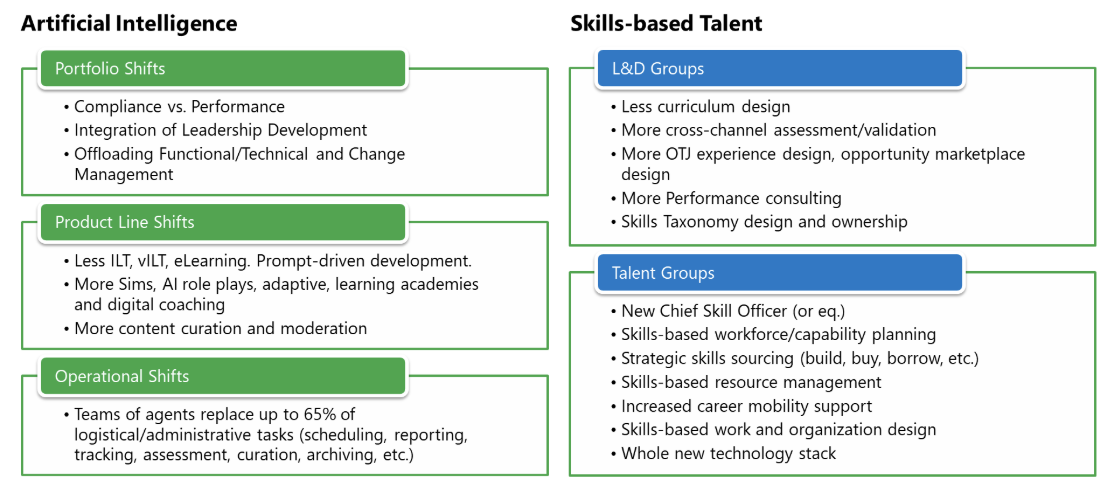
- L&D Example: Downsizing learning teams as AI automates and simplifies traditional work. Content can be secured without SMEs, courses can be built with prompts, and agents can automate administrative tasks.
- Doing More with the Same: If we historically have had trouble keeping up with demand, we could use the new efficiency to expand capacity. Times we have been forced to say “No” because we lacked bandwidth. All those tasks we never get to because there was no time – could now be within our grasp.
- Historical Example: Using websites to expand the reach of marketing efforts, using automation to increase productivity
- L&D Example: Maintaining large content libraries, adding content domains other groups currently handle, doing the analyses and measurements that were too time-intensive, etc.
- Increasing Speed & Agility: Increased efficiency means shorter cycle times. That which took 3-6 months might take us 3-6 weeks. This could help response to new needs faster. It could help us keep up with the pace of change. It can help us shift from one solution/product to another more quickly.
- Historical Example: Faster setup/changeovers enable more product customization and a wider array of products.
- L&D example: Ability to create more customized versions of courses for different audiences. Ability to respond to rapid changes in learning needs more quickly (e.g., technology changes).
This pattern represents most of the articles and LinkedIn posts we read. It makes sense, as it’s the most direct and visible entry point, but it is also the least differentiating over time.
Pattern 2: Removing Economic Constraints moves elite solutions downstream
At any given time, some solutions are optimized for mass production, while others are too advanced/expensive for widespread production – available only to select few strategic or elite audiences. Once, the automobile was a plaything of the rich, but the Model T brought mass produced cars to the masses. Same with cell phones. We consistently ration more advanced solutions based on economies of scale. Transformative technology often changes these economies of scale, bringing what was elite to the mainstream.
- Democratizing the Field: New technology enables laypersons to do what once required Professionals. Solutions become self-serve, or baked into other tech.
- Historical Example: Desktop publishing opens the field of graphic arts. TurboTax enables millions to do their own taxes. Social media enables everyday citizens to become news channels.
- L&D Example: SMEs create their own vILT, WBT, and Tier 1 eLearning using prompts instead of IDs.
- Upskilling the Mainstream: What was once only available to the elite is now available to all.
- Historical Example: Cars and cell phones became mainstream when previously they were only for the rich/elites. Everyone gets a television, a refrigerator, and air conditioning
- L&D Example: Classroom, vILT, WBT, and Tier 1 eLearning are replaced by simulations, adaptive learning, learning academies, and opportunity marketplaces at scale. Teams upskill to create more advanced solutions.
- Reimagine Ways of Working – The new technology is leveraged to do things only barely imagined before. Just as what was mainstream becomes self-serve, and what was elite becomes mainstream, innovation creates the new elite solution being experimented with at the top of the product value chain.
- Historical Example: Instead of pointing cameras at the stage to democratize access to theater, use the new medium (Motion Pictures) to change the art of storytelling and create the field of cinematography.
- L&D Example: AR/VR or multi-user simulations get a step closer to mainstream. Real-time digital coaches review and critique everyday decisions, AI career advisors suggest the next-best assignment, learning profiles are replaced by personalized LLMs, and AI enables personal decision simulators to predict success. Learning operations are replaced by managers who orchestrate a team of AI agents to complete the work.
Second Order Effects: Horizontal Ecosystem Realignment and Vertical Industry Emergence
Pattern # 3: The System Realigns (horizontally)
As new technology becomes pervasive, a system of related processes, tasks, products, etc. realign around the new mainstream. The impact of new technologies pushes them wider into horizontally related areas. These are not simply “extensions of L&D”; they represent a structural shift in how work, skills, and capabilities are designed and operated across the enterprise.
- A World of User-Generated Content drives a need for standards and quality control.
- Historical Examples: As movies become pervasive, ratings systems and a desire for home videos emerge. User-generated Internet content generates a demand for content standards.
- L&D Examples: Democratization of SME-generated content may create a demand for content curation, moderation, regulation, and/or consultation
- A World where What Was Elite becomes Mainstream drives ecosystem alignment
- Historical Examples: As cars become mainstream, gas stations, car dealerships, automobile supply and maintenance stores pop up. Cell towers, stores, and accessories emerge around cell phone expansion.
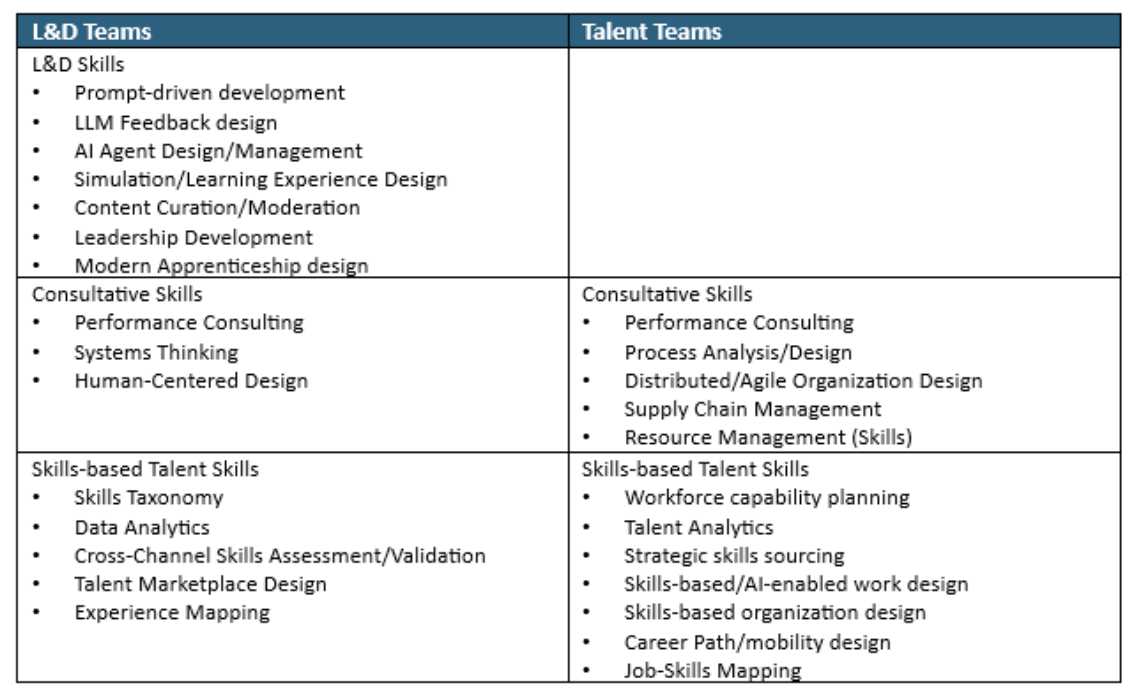
- L&D Example: As mainstream training moves to simulation, adaptive, academies, and opportunity marketplaces, the need for instructional designers shifts to a need for simulation design, performance consulting, process analysis, and system modeling. Stretch and shadow assignments managed in a talent marketplace require new capabilities to manage gig assignments. Simulations used to both teach and assess require new assessment and validation skills.
- A Reimagined World of New Solutions redraws historic responsibilities.
- Historical Examples: The telephone replaces postal mail and telegraph for regular correspondence. The ubiquity of automobile transportation spawns a trucking industry that largely replaced rail freight. The television replaces the radio as the primary family entertainment in homes.
- L&D Example: Talent development broadens from delivering courses/programs to a capability development as L&D, staffing, performance management, and career development converge. As AI-enabled skills-based learning system can instantly create learning pathways in real-time, the need for curriculum design lessens. Compliance-oriented and performance-oriented curricula may bifurcate. Functional teams may fully take over their own technical (product, process, engineering) training.
Pattern #4: New Industry/Societal Impacts Emerge (vertically) that often change the rules
Indirect, high-order patterns emerge from mass lower-order realignment. New Industries are formed, historical industries converge, new markets are created, and societal impacts emerge.
- New Industries and markets are formed.
- Historical Examples: A motion picture industry is born. A market for home videos sparks the growth of video rental stores. Used car markets are born from the ubiquity of automobiles. The IT industry is formed from the ubiquity of personal computers. The gig economy arises from smartphone apps. Social media creates digital marketing and social influencers.
- L&D Example: Vendors specializing in moderating/managing SME generated content may emerge. Library vendors and offshore CoEs may shift from eLearning to simulations/adaptive libraries. L&D teams may start to take ownership of AI-enabled skills taxonomies.
- Industry convergence:
- Historical Examples: Portable music players, PDAs, cell phones, GPS navigators, cameras, text and email merge into one device; Cable companies offer internet and phone service. Media giants consisting of motion pictures, tv, and internet platforms merge.
- L&D Example: Skills-based systems like skill taxonomies, talent marketplaces, performance management, ATS, and talent intelligence systems are likely to merge with LMS and HCM systems. Traditional job responsibilities shift as “Chief Skills Officers” merge L&D responsibilities with performance management, leadership development, staffing, and career development.
- Broader Societal Impacts Emerge:
- Historical Examples: Ubiquitous automobiles drive the growth of suburbia. The Internet and cell phones make virtual work viable – downtown corporate offices move outside the city. Cell phones change parenting behaviors. The Internet changes political campaigning. Cyber currency challenges financial systems. An increasing gig economy creates demand for portable insurance and tax re-categorization for “freelancers”
- L&D Example: A new profession, “Chief Skills Officers”, may emerge, spawning new university degree programs, industry trade groups or professional journals.
Third Order Effects: Convergence and New Transformation
Pattern 5: Convergence of Technologies Drives the Next Transformation
Inevitably, and even while earlier transformations are evolving, new technologies combine yet again to make the next wave of transformative technology possible:
- Historical Examples: Personal computers and telecommunications networks make the Internet possible. Cell phones + GPS + Cameras + iPods + PDAs: make the smartphone possible. Smart Phone + Apps + Payment systems make the Gig economy possible.
- For L&D: Orchestrated AI agents that design work, assess skills, route learning, validate performance, and optimize outcomes continuously may create new capability economics manifest through human-AI systems. Systems that independently project business demand, translate it into human capability needs; assess talent market intelligence of skills supply trends, and compare with internal skills intelligence to identify organizational capability gaps may converge into unitary systems.
AI and AI-enabled Skills-based Talent Management will Pressure L&D/Talent Teams to Evolve
Taking these historic patterns together, we infer the following conclusions:
- Patterns 1 and 2 explain why AI adoption in learning is inevitable. The only question is how different organizations will respond to the choices before them (downsizing or expanding, upskilling or offloading, grow into skills or stay focused on content)
- Patterns 3 and 4 explain why functional boundaries will likely collapse. As product mixes and ways of working change, the ripple effect of adjacent systems will likely change historic organizational responsibilities and functional boundaries. Functional business units may adopt basic training development. Learning responsibilities may bifurcate between compliance and performance-driven solutions.
- Pattern 5 explains why a new operating model is required, not just a better L&D model. As products, processes, and organizational models change, new supply chains, professions, and talent ecosystems emerge – all sharing skills data as an enabler of new talent approaches and strategies.
How L&D and Talent Functions will feel pressure to evolve
New Skills Required of L&D and Talent Professionals
Artificial intelligence is not simply another tool for learning teams to adopt. It is a transformative force that will reshape how capability is designed, governed, and scaled across the enterprise. History suggests that transformative technologies do more than improve efficiency; they redraw functional boundaries, collapse adjacent systems, and create entirely new operating models. The question for L&D and Talent leaders is not whether AI will drive change, but whether they will proactively architect the human-AI systems that define the next era of capability economics. Those who view AI as an opportunity to reimagine work, skills, and performance at a systems level will help shape the next transformation — rather than be shaped by it.
Bio:
 Craig Friedman has 30 years of experience as a human capital and talent advisor, executive, and entrepreneur. He specializes in skills-based talent strategies, learning operating models, change management, and performance consulting. Talent & Skills Transformation Leader at St. Charles Consulting Group, Craig partners with CHROs and CLOs to align global talent strategies, supporting Fortune 500 companies and four of the five largest professional services firms.
Previously, Craig spent 15 years at Deloitte, leading talent development for the U.S. Tax practice and earning several national and international learning awards. He also co-led Deloitte’s clinician change adoption practice and helped establish corporate universities for regional health systems.
Craig’s background includes launching two eLearning start-ups and earning two U.S. patents for innovations in online education. He holds an M.A. in Learning Sciences from Northwestern University and dual undergraduate degrees from Tufts University in Human Factors Engineering and English. Craig is the author of the new book Enterprise Skills Unlocked: A Blueprint for Building a Skills-Based Organization, published in June 2025. He was recently appointed to the 2026 Managing and Leading Performance Advisory Board established by the HR Research Institute.