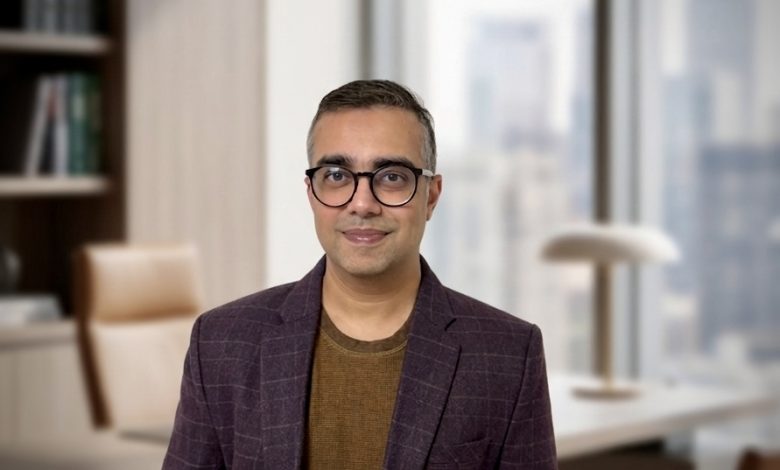
Abhinav Sharma does not present AI as a novelty. The platform under his responsibility includes AI-enabled improvements designed to strengthen investor decision-making and to enhance the quality of trade execution. He treats that as a strict requirement, not a marketing line.
“Intelligence in the product has to earn its keep,” Sharma says. “If it does not help investors act with more clarity or get better outcomes, it should not be there.”
Sharma holds a Senior Executive Director role in software engineering at one of the world’s largest investment banks. The do-it-yourself investing systems he oversees were reported to have roughly $137B in client assets as of January 2026. More than two million active users rely on the platform, and yearly trading activity sits in the multi-billion-dollar range. He leads a global organization of over 150 technologists based across the United States and India. He also directs an annual technology investment program of more than $20M focused on strengthening and modernizing the brokerage foundation.
At that scale, Sharma says AI has to be treated like part of the core system. It cannot be a side experiment. It must behave consistently and must be governed. His work is carried out in a regulated environment that requires alignment with SEC and FINRA expectations as well as ADA accessibility requirements.
“In this category, you build for traceability,” Sharma says. “You need to be able to explain what happened and why.”
He ties his AI perspective to measurable platform outcomes. Reported execution benchmarks include 97.35 percent price improvement versus NBBO and 78 percent midpoint or better execution. Additional figures include about $41 in average savings per 1,000 shares and about 0.05-second execution speed for S and P 500 market orders under 2,000 shares. Sharma points to these numbers as evidence that engineering decisions can be evaluated against investor impact.
“Performance is not a story,” he says. “It is something you can measure and improve.”
He also emphasizes that decision support depends on information quality. Sharma is described as the architect of a live market-data streaming capability that supports scalable pricing, order execution, and portfolio monitoring across stocks, options, and fixed-income products. He treats that capability as foundational because delayed information changes investor behavior and can lead to poor timing.
“If the view is behind, the decision can be behind,” Sharma says. “Real-time visibility matters.”
Sharma’s focus on clarity and accountability was shaped across several high-expectation environments. He earned a Master’s in Computer Engineering at Columbia University and helped launch a mobile application company during the period when smartphones were reshaping consumer habits. That early product environment taught him how quickly users reject confusion.
“Users do not care how hard the work was,” Sharma says. “They care whether it makes sense.”
He moved next into financial technology during the expansion of mobile payments and digital banking at Barclays. He worked on person-to-person payments and mobile banking capabilities, then expanded into broader digital banking, credit card platforms, and lending ecosystems. He later served as Vice President and Head of Digital Engineering at Barclays US, leading large digital platforms and co-branded credit partnerships, including the Uber program. Barclays recognized his contributions in 2012 with a Global COO Star honor tied to the development and scaling of Pingit.
“Payments taught me that consistency is the trust signal,” Sharma says. “If results vary, confidence collapses.”
A later chapter at Comcast deepened his approach to reliability at extreme consumer scale. As Senior Director, he led engineering for the Xfinity Mobile and xFi digital platforms serving more than 40 million customers. Initiatives were showcased at CES in 2020 and again in 2022. Sharma describes that period as a daily lesson in building systems that hold up under real-world usage.
“At that size, you do not get to be surprised,” Sharma says. “You build for what actually happens.”
In investing, “what actually happens” includes market stress. Sharma has led technology organizations through periods of extreme volatility and dislocation events, when trading volume surges and platform stability becomes paramount. He views those periods as the clearest tests of readiness.
“Stress is the audit,” he says. “It shows whether the platform was built to hold.”
Modernization work supports that readiness. Sharma spearheaded initiatives that moved legacy brokerage technology away from tightly bound designs and toward microservice-based and cloud native approaches. The stated goals include improved resiliency, stronger scalability, and better fault isolation. He also expanded and restructured global engineering groups across the United States and India to exceed 150 technologists within a compressed timeframe, adding leadership layers, hiring specialized low-latency engineers, strengthening DevOps maturity, and building a culture with near-zero tolerance for failure.
“Architecture and operations have to move together,” Sharma says. “Reliability cannot be left to luck.”
The platform supports advanced capabilities, including options and fixed income access through mobile bond trading, alongside live market data and the AI-enabled improvements intended to enhance decision-making and execution outcomes. Sharma stresses that sophistication only helps when users can understand what they are doing.
“A powerful tool that confuses people is not progress,” he says. “It increases mistakes.”
He also highlights governance as a core design requirement, not paperwork. His work aligns with SEC and FINRA expectations along with ADA accessibility requirements, balancing innovation with auditability and operational risk controls.
“If you cannot explain an outcome, you cannot defend the system,” Sharma says. “That matters when money is involved.”
Outside his day-to-day role, Sharma contributes through professional communities and evaluation work. He participates in the Forbes Technology Council and holds IEEE Senior Member status. He is also a Raptors Dev Fellow, a hackathon judge, a CES 2026 Innovation Awards judge, and a judge for the Globee Artificial Intelligence award in 2025.
“Evaluation work keeps you grounded,” Sharma says. “You see what holds up when it faces scrutiny.”
Looking ahead, Abhinav sees his work continuing to focus on simplifying and expanding access to financial markets for everyday investors. He believes the next phase of capital markets evolution, with AI-enabled capabilities, will center on making markets faster, more intelligent, and continuously accessible.
“The future expands access,” Sharma says. “The foundation has to stay trustworthy as that access grows.”
For more information about Abhinav Sharma, visit his LinkedIn profile.